The short answer is that, far from being the "soft underbelly of Europe," Italy rapidly turned into a bloody quagmire for the Allies. Invading Italy was a British idea, especially pushed by Winston Churchill. The Americans were never a fan of the operation from the start, insisting even before it began that the Allies plan for a major invasion of France in 1944.
Italy is a long, narrow peninsula bisected vertically by the substantial Apennines mountain range. This is ideal ground for a defender. With such a narrow frontage, and with terrain largely unsuited for mobile warfare, breakthroughs and exploitation are difficult. There are only so many troops that an attacker can commit at one time. Limited defending forces can set up blocking position after blocking position, all of which must be taken frontally at great cost to the attackers, and then retreat from one to the next when the pressure becomes unbearable. And indeed, this is exactly what the Germans did.
After the fall of Sicily, the Allies secretly negotiated the surrender of the Italian military. The expectation was that immediately after the Allies invaded southern Italy, the Italian military would surrender, and the Allied armies - 5th American and 8th British - would be able to advance rapidly before the Germans managed to assemble a coherent defense. This did not happen. The Germans were quite ready for both the invasion and the Italian defection. By prearrangement, they swarmed the Italian army and disarmed their troops. Simultaneously, they rushed substantial mobile forces south to contain the beachhead. German 10th Army launched a furious counterattack against the Allied landing beaches that nearly succeeded in throwing Mark Clark's 5th Army back into the sea. The offensive was stopped by overwhelming Allied air support and naval and field artillery fires, but the situation remained far from ideal.
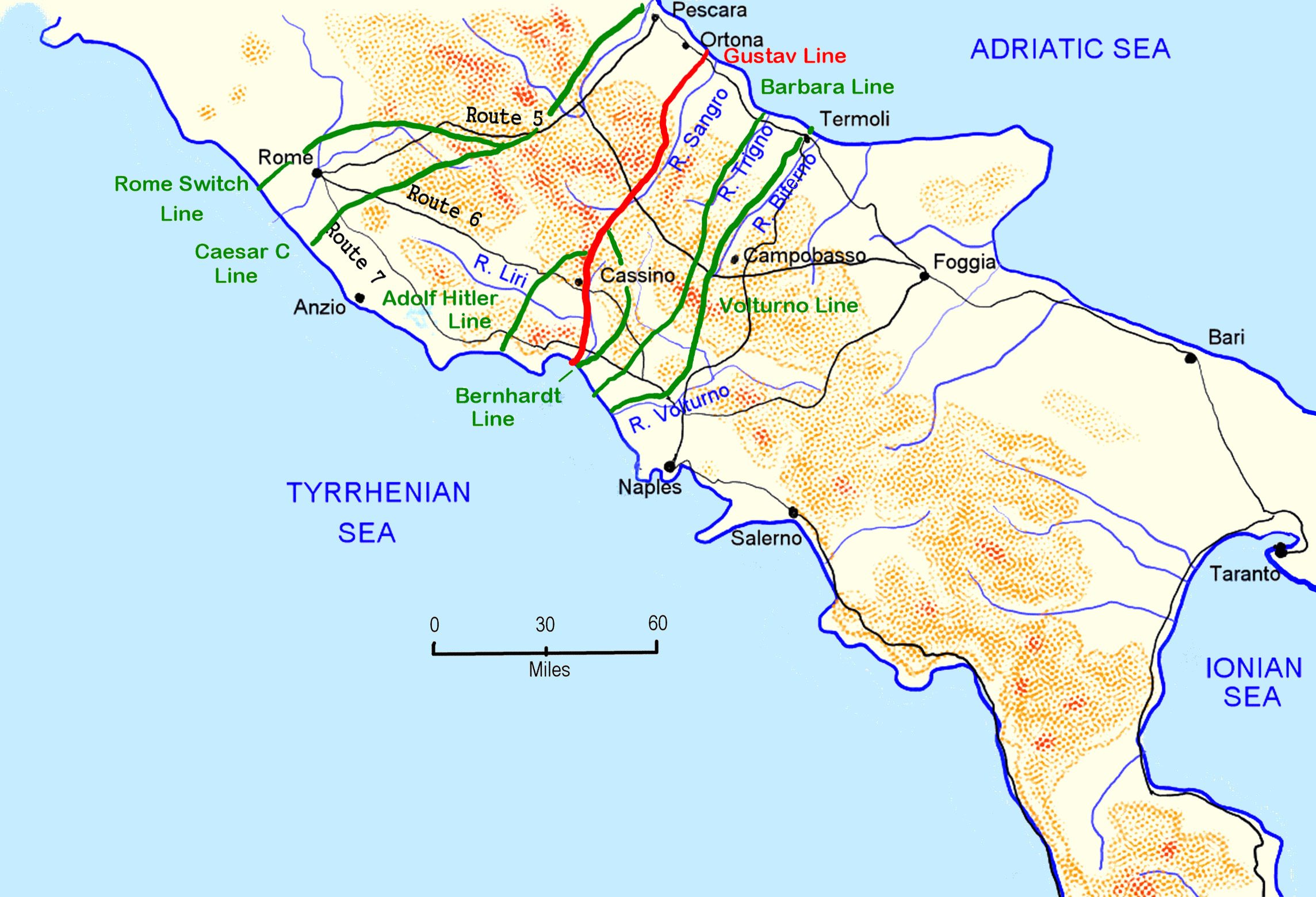
The Allies then went on the offensive. Under increasing pressure, the Germans fell back as far as the Volturno and Biterno Rivers, abandoning Naples and Foggia. At this point, the invasion of Italy entered its static phase. While the Allies regrouped in preparation for further offensives, the German commander, Albert Kesselring, ordered the creation of a series of defensive lines which ran the width of the Italian peninsula. The southernmost lines, Volturno and Barbara, were less substantial and meant only to delay the Allies until the primary defensive belt, the so-called Winter Line, could be completed. The idea was to keep the Allies out of Rome - and away from Germany - for as long as possible.
This image should be helpful in understanding the situation.
The Allies penetrated the two outpost lines before crashing into the Winter Line in mid-November. There they largely halted for the next six months, stymied by fierce German resistance from skillfully constructed defensive works. It would take a series of offensives in the first half of 1944, as well as the near-disastrous invasion of Anzio, to route the Germans out of their positions. Rome only fell on 5 June, 1944 - one day before the Allied invasion of Normandy.
With the loss of Rome, the Germans retreated north - but not to the Alps. They established another series of defensive lines - Trasimene, Arno, Gothic, Po - across northern Italy. Thus the process of breakthrough, consolidation, and attack began all over again for the Allied armies. The diversion of substantial forces to Operation Dragoon, the August 1944 invasion of southern France, weakened the Allies and retarded future progress. Northern Italy was not secured until the end of the war, and the Allies did not reach the foothills of the Alps until early May 1945.