First, a factual statement: crossbows are not better at penetrating armor. This is fact, and can be proven by many videos depicting their performance. In particular, the first video linked below depicts a 160 lb longbow failing to significantly damage a (as close as humanly possible) reproduction of a 14th century unhardened breastplate. In the next video, while admittedly less scientific, depicts a 850 lb draw weight crossbow penetrating an archery target substantially less than the 160 lb longbow. While proof is always necessary, this can be proven with math - the longbow is drawn over a length 26 inches - and thus applies its force over that entire length, whereas a crossbow has a draw length of closer to 6 inches and has less time to accelerate the projectile.
I bring this up, because in an old askhistorians thread a person, the top contributor, says "15th century crossbows had draw weights of 1000 pounds and could easily penetrate most plate armors. " This is patently false. An extra 150 lbs is not going to defeat this example of armor - and around the 15th century armor began rapidly improving and would be even harder to penetrate. The bottom line is this: Both bows and crossbows fail to defeat standard plate armor of the time, barring rare shots such as eye-slits or splintered/ricochet arrows piercing gaps in armor. In the poster's defense, the rest of his post is accurate (except the steel string part. I think he meant the limbs, but I'm uncertain.) Finally, as an add on to the question asked in that thread, if bows affected armor development - the armor being reproduced there has a V-shaped protrusion on the upper breastplate - the video host reasoned that it was to stop ricochet arrow heads and splinters from going underneath the helmet and into the face, and I agree. This seems to indicate that this armor was very much designed to stop archery fire.
It's this misinformation that I am curious about. Where did it start, and why is there such a prevailing idea that crossbows are better at penetrating than longbows? Is it because the listed poundage is so much higher that laypeople think it must penetrate armor? This concept is prevalent in all modern cultural showings of the weapon, like video games.
Sources
Old Thread: https://www.reddit.com/r/AskHistorians/comments/17l37v/rdnd_wants_to_know_what_effect_did_the/
Videos: https://www.youtube.com/watch?v=DBxdTkddHaE https://www.youtube.com/watch?v=1w8yHeF4KRk
Breastplate that he reproduced: https://steel-mastery.com/churburg-type-breastplate-14th-century.html
It's this misinformation that I am curious about. Where did it start, and why is there such a prevailing idea that crossbows are better at penetrating than longbows?
A prevailing idea that powerful crossbows are better at penetrating armour is quite natural, since powerful crossbows can deliver bolts with far more energy than arrows from a high-draw-weight longbow. For example, this replica crossbow, 1200lb draw weight:
achieved energies of about 200J, in excess of what is usual for high draw weight longbows (closer to 150J, or even lower). A larger crossbow, of similar draw weight, with heavier bolts, achieved close to 500J (488J, to be precise):
How effective might these be? From Alan Williams, The Knight and the Blast Furnace, Brill, 2003, we can take some data:
To defeat mail armour (including padding under the armour), and still have enough energy left to be damaging to the occupant of the armour: about 170J (120J to get through the mail and padding, 50J left over for the wearer).
To defeat plate: 1mm requires 55J, 2mm requires 175J, 3mm requires 300J, and 4mm requires 475J (for steel plate, reduce to half of these values for wrought iron, and increase by 50% for hardened steel). These energies are just to get through the plate, and we can add another 100J for the padding and wearer.
Thus, the crossbows tested above should be effective against mail (unless the wearer is using a textile-mail-textile sandwich, in which case the 200J bolts should be stopped). Against wrought iron armour, the 488J bolts should be effective against armour of perhaps 5mm thickness, i.e., against any iron armour commonly worn before guns. Against steel armour, 3.5mm thickness, which is thicker than most. Against hardened steel armour, about 2.8mm (which is thicker than average).
When we further consider that arm and leg armour was usually much thinner, often below 1mm thick, the anti-armour potential of powerful crossbows is obvious.
The lesser crossbow tested above (200J) would still be effective against mail, and 2mm wrought iron plate. It would be dangerous to steel plate of about 1.5mm thick (but breastplates that thin were often worn over mail, and it would fail against that combination). Against hardened steel plate, 1.2mm would be its limit. So, any breastplate meant to be worn alone, of quality or with any pretension of quality, should be able to stop it. Thus, a 1200lb crossbow that fails against armour.
This, we can't accurately say that all powerful crossbows could pierce any plate armour, or any plate armour short of the best. It depended on the particular crossbow. Note that the big crossbow (488J) has a power stroke of about 15" - this is why it can deliver much more energy than its smaller cousin (and that's with a rather modest efficiency of about 40%).
Where does the wrong idea that crossbows (including those like the one achieving 200J above) will go through all armour come from? That's an interesting question, and I don't know the answer. But I note that one also finds a similar idea about the English longbow, that it could pierce breastplates at will (which is not at all supported by comparison of the number of arrows shot in some of the great English "longbow victories" with the number of enemy dead).
While I'm not familiar with scholarship on the subject prior to the end of the 19th century (and only then with English scholarship), it seems to me that there are four factors at work here: two high medieval sources talking about the power of the crossbow, a late 15th century manuscript illuminator, and the 19th century idea that bows in the early/high middle ages were weak "shortbows".
First off, we have the two sources from the high middle ages. The most commonly cited of these is Anna Komnene's Alexiad, an account of the life of Alexios Komnenos written down around 1148. Anna was the daughter of Alexios and, while she might not have been an active part of any military campaign, she had the unfinished notes of her husband (Nikephoros Bryennios the Younger) and interviewed old soldiers when writing about her father's deeds. The result is a highly quoteable description of the crossbow in action:
This cross-bow is a bow of the barbarians quite unknown to the Greeks; and it is not stretched by the right hand pulling the string whilst the left pulls the bow in a contrary direction, but he who stretches this warlike and very far-shooting weapon must lie, one might say, almost on his back and apply both feet strongly against the semi-circle of the bow and with his two hands pull the string with all his might in the contrary direction. In the middle of the string is a socket, a cylindrical kind of cup fitted to the string itself, and about as long as an arrow of considerable size which reaches from the string to the very middle of the bow; and through this arrows of many sorts are shot out. The arrows used with this bow are very short in length, but very thick, fitted in front with a very heavy iron tip. And in discharging them the string shoots them out with enormous violence and force, and whatever these darts chance to hit, they do not fall back, but they pierce through a shield, then cut through a heavy iron corselet and wing their way through and out at the other side. So violent and ineluctable is the discharge of arrows of this kind. Such an arrow has been known to pierce a bronze statue, and if it hits the wall of a very large town, the point of the arrow either protrudes on the inner side or it buries itself in the middle of the wall and is lost. Such then is this monster of a crossbow, and verily a devilish invention. And the wretched man who is struck by it, dies without feeling anything, not even feeling the blow, however strong it be.
Nicholas Mesarites, a churchman whose ship had been attacked by pirates in 1208, describes the crossbow more simply, but with no less emphasis on the power of the bolt, claiming that the bolt was an "undeflectable spike of death". While Mesarites is far more obscure, it's hard to imagine a book that discusses the crossbow without touching on Anna Komnene's description, especially of quarrels penetrating bronze statues or penetrating through walls.
The problem here is that Anna has been taken at face value, without looking at the passage in the proper context. Book 10, Chapter VIII of the Alexiad, focuses heavily on Count Marianus Mavrocatacalon - the son of the commander of the Byzantine fleet - forcing the surrender of Richard of the Principate of Salerno. The description of the crossbow might be because it was unfamiliar to the Byzantines - and it is fairly consistently described in 12th, 13th and 14th century Byzantine sources as a "Latin" (i.e. "Western European") weapon, as well as frequently described in detail, as though it was unknown - but Anna's mention of the power of the crossbow was much less an accurate description of its power than a rhetorical device to emphasise the danger that her friend, Marianus, was in.
The basic sequence of the events is that Marianus was shot while trying to convince Richard to surrender, but although the bolt penetrated his helmet it didn't touch so much as a hair on his head due to the intercession of God. Marianus then shot Richard, shooting through his shield, scale armour and then wounding him in the side. A priest then shot three arrows at Marianus, and a battle raged. Later, when a truce was being arranged, the priest threw a sling stone at Marianus with such force that it shattered his shield, broke his helmet and knocked him senseless, though with heroic vigor equivalent to Hector Marianus then got back up again and shot the priest with his bow three times. The priest did not give up and, after throwing all his stones, resorted to barley cakes and managed to hit Marianus in the head once again.
It's clear from the context that the power of the crossbow has been exaggerated by Anna, much as the power of Marianus' bow and the priest's slingstone have been taken to heroic levels. Similarly, a large focus of the passage is on the bellicosity of the priests, in contrast to the total abstinence from violence expected of Orthodox priests, and in this context the diabolical nature of the crossbow can be argued to also have been exaggerated in order to highlight the differences between Western and Eastern weapons and methods of war.
An earlier, and less quoted, reference to the power of the crossbow comes from the Carmen de Hastingae Proelio, most likely written by Guy, the bishop of Amiens, around 1067. It's the earliest account of the Battle of Hastings and, like most clergy of his period and class, Guy was not unfamiliar with fighting on a personal level and he was part of a aristocratic culture that revolved around martial prowess. His description of the power of the crossbows is more restrained than Anna, but is far more explicit in implying that crossbows were more powerful than bows. He states that:
Against quarrels, shields are not secure.
And:
First the infantry units, furnished with quivers, attack, and from afar transfix bodies with their darts. Crossbowmen, with a shower of blows like a storm of hail, strike and destroy shields.
Both descriptions hold the implication that crossbows were powerful enough to destroy shields with the impact of their bolts and that this was something that arrows were incapable of. However, the possibility exists that Guy was attempting to create an artificial division between the archers, who formed the bulk of William's missile arm, and the crossbowmen, who were definitely a minority ("He put in front the infantry to attack with arrows, and set crossbowmen in their midst") and were probably also the elite of the infantry, as crossbowmen were in Anglo-Norman armies not much later. The power of their weapons might be more of a social distinction, with the crossbowmen shattering shields while archers merely "transfix bodies" with their arrows without any mention of shields.
These two descriptions of the power of early crossbows, stripped of their context and interpreted literally, fed into the 19th century belief that only weak "shortbows" were used prior to the 14th century. I've discussed this belief and how it became entrenched in English scholarship in more detail before, but the most relevant element is that Charles Oman used these descriptions of the power of the crossbow to demonstrate that, since Richard I preferred the crossbow over the bow in spite of the bow's superior rate of discharge, the most common bow in use must have been short and weak.
Other authors who had either arrived a similar conclusion independently, such as Viollet-le-Duc, or who were drawing on Oman's scholarship, such as Hans Delbruck, saw the crossbow as initially losing out in power to the longbow once it was introduced but, in the second half of the 14th century, rapidly increasing in power as the result of the introduction of the windlass, which allowed the crossbow to increase its power over the longbow, thus keeping it relevant even as the rate of discharge declined due to the increased complexity of spanning. In part, they attribute the increase in power to the introduction of steel lathes, since these were less bulky and still in sufficient condition to be tested for draw weight.
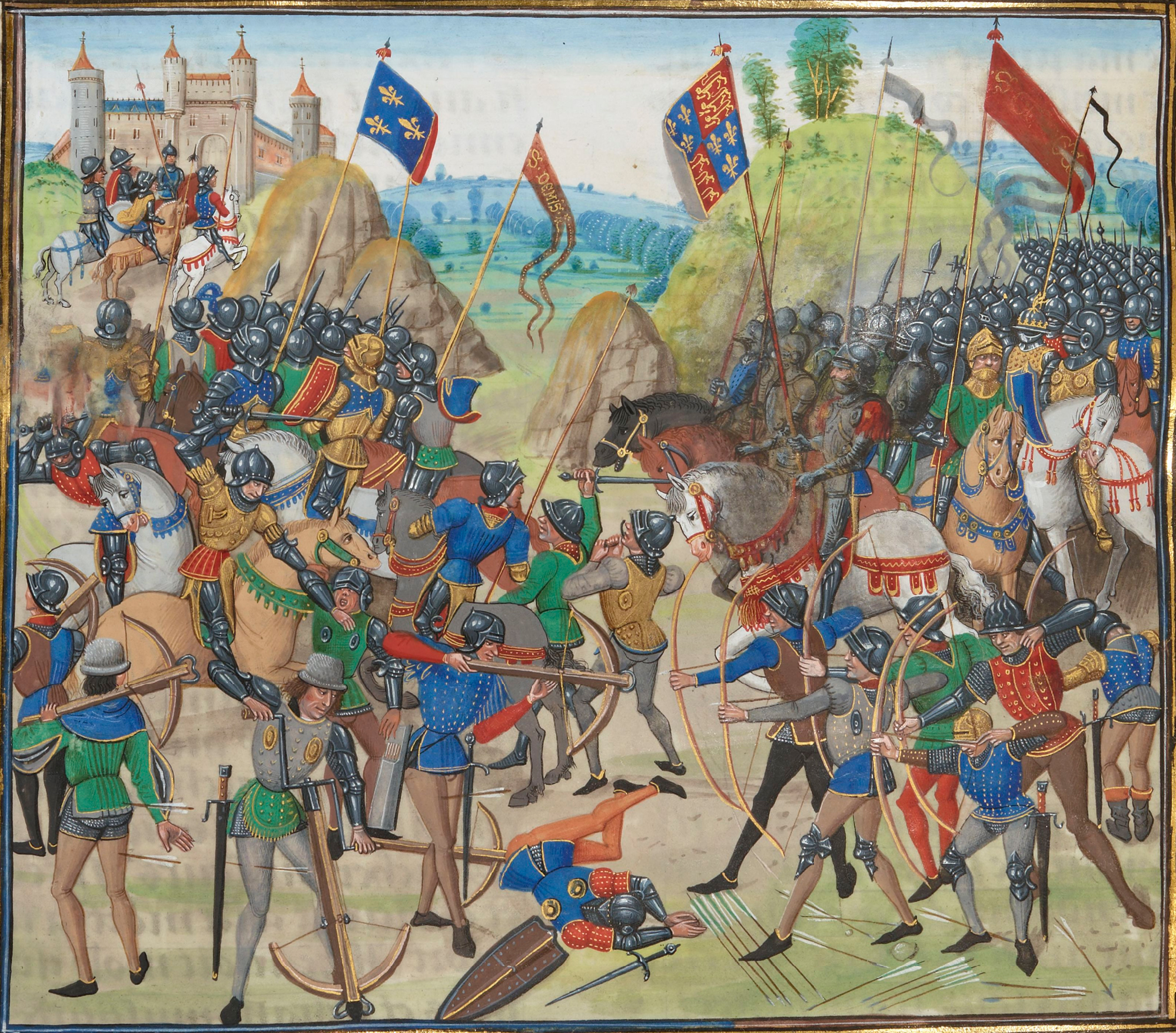
Finally we come to Loiset Lyédet, an artist who was commission by Louis of Gruuthuse to paint the miniatures for two volumes of Froissart's Chronicles. You've almost certainly seen one of them before, because they are incredibly detailed and painted in vibrant colours that really stand out. As a result of this combinations, authors such as Viollet-le-Duc and Sir Ralph Payne-Gallwey, whose works have had an enormous influence over how the development and performance of the crossbow are viewed, used Lyédet's miniatures as the examplar model for 15th century crossbows. His artwork suggested the idea that windlass crossbows were commonly used on the battlefield, which in turn caused those authors to decide that the windlass crossbow, which is first mentioned in the late 14th century, replaced the crossbows spanned by belt and hook in their entirety and were thus more powerful.
The best armoured breastplates were impervious to longbow arrows and crossbow bolts alike.
That’s what we see in modern day recreations like the above.
However, as the people doing the recreations are careful to point out - not every part of even the best armour was of the same imperviousness; and, more importantly, not all soldiers wore the best armour - which was hugely expensive.
When it comes to crossbow versus longbow, another factor was the strength and training requirements - being a longbow archer was hard. You had to be trained to it for years. Shooting a crossbow was much easier - because the various devices used to pull the string back gave the shooter a mechanical advantage, and of course the nut held the string in place while aiming (unlike the archer, who had to hold it in place with his fingers with the bow at full stretch).
As an aside, it is somewhat amusing that in fantasy works, the longbow is often seen as a “woman’s weapon”, that the pretty elven archer is a stereotype. In reality, longbowmen were muscle-men - their skeletal remains show as much; and in the literature of the time, “archers” are often used as guards and enforcers - not just because they have bows, but because the practice of their profession made them very muscular indeed - intimidatingly so. That’s because not only did they have to pull the war bow back, with its considerable draw, they had to do it over and over again in battle.
But I digress.
While it is true that the crossbow could not penetrate the best armoured breastplates, it still posed a menace to armoured men, who were not equally protected over the whole of their bodies; and most soldiers were not wearing the best armour. The relative ease of use made crossbows the better option for soldiers lacking the intensive training necessary to use the longbow. The main disadvantage of the crossbow in battle was the relatively long reload time - which some soldiers attempted to compensate for by erecting shields to reload behind, known as Pavises. Archers used these as well on occasion, as well as sometimes putting sharpened stakes in front of their formations to discourage cavalry.