Where is the logic in that defending one small mountain pass would block off the access to an entire landmass? From the Persian perspective, I see no reason why they couldn't simply have marched around the Spartan army (which they eventually did too) because it would be reasonable to assume many other paths would be available – regardless of whether someone would share such information with them or not.
Furthermore, with such overwhelming numbers, why couldn't the Persian army simply land their fleet someone else, closer to the cities they intended to attack?
They didn't strictly have to go through the Hot Gates, but it was the obvious thing to do. This didn't just apply to the Persians, but to many other armies since. Some places are just uniquely strategically situated and thus provoke much fighting over who gets to control them, as the 13 or so historical battles of Adrianopolis also attest.
To be more specific:
Where is the logic in that defending one small mountain pass would block off the access to an entire landmass?
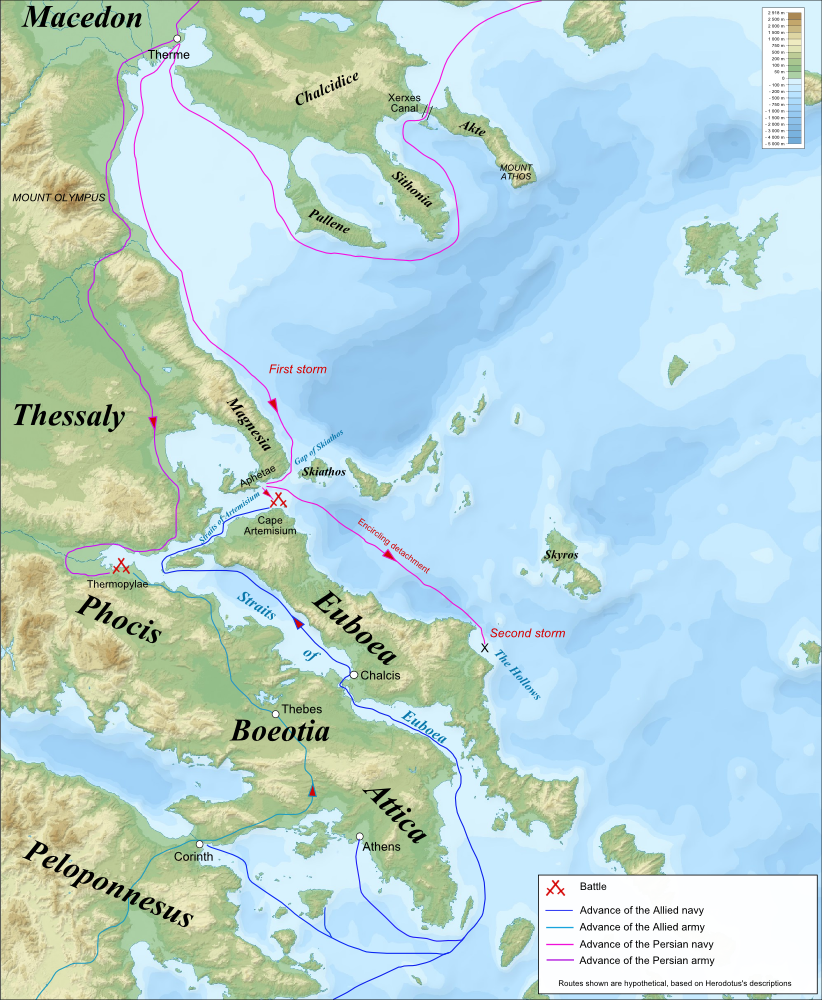
The "logic", or rather the pertinent fact, is the geography of mainland Greece. About 80% of it is covered in mountains. It is an exceedingly rugged place and travel between most inhabitable plains and valleys is restricted to a few passes. Some of these will be more suitable for the movement of large armies than others. Specifically, the Persians were trying to travel east from Malis into Phokis and Boiotia, and the only level road that would allow them to retain contact with their fleet was the one along the coast, which led through the pass at Thermopylai.
The other roads were simply not up to the task of carrying an army like that of Xerxes. Bear in mind that the path they used to turn the pass at Thermopylai is a goat path over the shoulder of Mount Kallidromon; the path is the width of a single man in places, it rises hundreds of meters above sea level, and it's a 21km hike to get up the mountain and back down not far from where you started. Taking an elite force of Persian infantry up there overnight is doable; taking the whole Persian army including the royal chariot and the baggage train is unthinkable.
A split in the goat path near the top is one of the only other roads into Phokis from the north. It was actually used by the Galatians later on, though their main force went through Thermopylai. There are a few other roads from other points in Thessaly, but they are similarly difficult, and would have required Xerxes to haul his entire army over a mountain range for essentially no reason. The road through Thermopylai, after all, was right in front of him.
To make matters worse, if you took any of those roads you'd end up in upland Phokis. This is either directly south or even southwest of Malis - but Xerxes was trying to go east! He'd have wasted a great deal of time and effort going the wrong way only to have to make his way back down into more hospitable territory, presumably along the Kephissos river into Boiotia. It would make no sense to do this. Again, the road through Thermopylai was the way Xerxes wanted to go, and the Greeks knew it. They might actually have presented Xerxes with a considerable setback if their attempt to defend the pass hadn't been so half-hearted.
On top of all that, it's important to remember that Xerxes was trying to conquer Greece. It wouldn't be right for him to turn tail and avoid battle with the Greeks that marched out to stop him. Instead, he proved that his army was up to the challenge. He used his main force to pin the Greeks in the pass while his elite troops outmanoeuvred them, scoring a total victory after just a few days of skirmishing. Bad decisions on the part of the Greeks meant that he even got to kill one of the kings of Sparta - a better propaganda coup was hardly imaginable.
With such overwhelming numbers, why couldn't the Persian army simply land their fleet someone else, closer to the cities they intended to attack?
For the simple reason that there was an enormous obstacle in their way: the combined Greek fleet. The Greek strategy was to protect the force at Thermopylai by sending a fleet of over 300 triremes to nearby Artemision, where they could block Persian access to the Greek rear by sea. The Persians were not daunted by this and actually tried to send a naval force around the island of Euboia to attack the Greek fleet in the rear, but by a stroke of luck for the Greeks, this detachment was destroyed in a storm, forcing the rest of the Persians to attack head-on. On the 3rd day of the fighting, the Spartan-led army was soundly defeated, but the Athenian-led fleet actually managed to fight the Persians to a standstill. The battle of Artemision was effectively a draw. It was only the defeat at the pass that forced the naval force to retreat, since they were now the ones exposed to encirclement by Xerxes' army.
Even after the pass was forced and Central Greece was overrun, the Athenian and allied fleet was essential to the defence of the rest of Greece. Without it, the Athenians argued, it didn't matter how well the Spartans fortified their core areas in the Peloponnese against an invasion by land, because the Persians would be able to land wherever they wished. This was the rationale behind the all-out battle at Salamis, which happened when Athens itself had already been captured and razed to the ground. It was only after the Athenian victory and the retreat of the Persian fleet that the Greeks could operate in the knowledge that their rear lines were safe.