I am very interested in what kind of protective gear they would wear, and if it changed from, say, the Viking Age to the 15th century, if there were regional differences, and if a silversmith and an armoursmith (or any other kind of smith) had the same kind of protective gear. I am also interested in learning if they wore steel-toed boots and face protection like we do.
The main source for what they wore is artwork; this favours the late Middle Ages over the early, so I'll say very little about the early period (e.g., Viking Age). In general, smiths are shown either working in their ordinary clothing, with no extra protective gear, or are shown working in their ordinary clothing plus an apron. The shoes appear to be ordinary shoes rather than anything more protective. Hands are usually bare (no gloves), and I don't remember ever seeing any face protection in use.
The one piece of protective clothing, the apron, varies quite a lot. Some of the aprons cover the belly and chest (like a modern blacksmith's apron), and others only cover below the belt. Aprons can reach to about the knee or below, or can reach to mid-thigh. An apron that only goes from the belt to mid-thigh doesn't provide much protection! Most people appear to assume that the aprons are leather, like modern ones. However, the aprons are often drawn draping like cloth, and cloth aprons have been used by blacksmiths in other parts of the world (e.g., China). Also, as just noted, some are too small to provide much protection, and might serve more as a cloth for wiping grimy hands on, for which cloth would be better than leather.
Some examples from art:
Swordsmith with a very short apron: https://i.pinimg.com/564x/cf/8c/71/cf8c712c03e1bbd134c699920dca65b3.jpg
Armour-makers with belt-to-knee aprons: https://i.pinimg.com/originals/59/91/ef/5991efbc0a73e027ecf99199f103c808.jpg
Armour-maker with a very long narrow diamond-shaped apron (and another, apronless): https://i.pinimg.com/564x/42/cd/07/42cd071f6378f99d2173969c5818ef50.jpg
Armour-maker, without apron: https://i.pinimg.com/564x/c3/1a/0f/c31a0f8dc1370298eb73395593e22f4a.jpg
Smiths with long aprons (neck to knee): https://i.pinimg.com/564x/5f/74/4c/5f744cef9aa83f3ff55ea7fb014316c3.jpg
Waist to knee apron: https://i.pinimg.com/564x/83/0d/c5/830dc5bf6f32a9e1c2bdf988596e482f.jpg
Long (but low-cut) aprons: https://i.pinimg.com/564x/6d/84/b6/6d84b6787f6ae5bd07b82771de57d19c.jpg
Similar aprons (usually waist-to-knee) are worn by many workers, such as carpenters, cooks, butchers, etc.
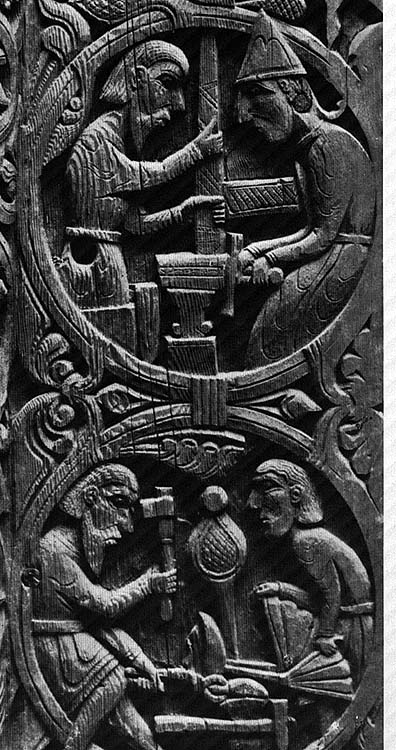
As for the early Medieval period, there isn't much evidence. I don't know of any that shows aprons (or any other protective gear) in use. However, due to the small amount of relevant art, I don't think it can be said for sure that they didn't ever wear aprons at the time. Some of the early art:
I don't find it surprising that many of the Medieval smiths are shown working with no protective gear, and that the most common protective gear worn by those who wear it is the waist-to-knee apron. In many parts of the world, blacksmiths work in just the usual everyday clothes worn by other workers, with no extra protection. Many smiths work in bare feet, or sometimes with sandals or modern footwear such as thongs/flip-flops. Depending on the weather and climate, clothing might be minimal. Some examples of modern traditional smiths with no protective gear:
https://commons.wikimedia.org/wiki/File:Blacksmith_in_his_workshop.jpg
https://commons.wikimedia.org/wiki/File:Blacksmith_in_Ethiopia.jpg
https://commons.wikimedia.org/wiki/File:Local_blacksmith4.jpg
As noted earlier, Chinese blacksmiths often wore aprons. One example:
While this smith is wearing an apron, he is also bare-footed and shirtless.