I’m aware that Mesoamerican city-states had identifying emblems or glyphs, and that Andean peoples used wiphala flags, and was curious if there was an equivalent among late Mississippian peoples. I couldn’t seem to find any information on the subject, so I decided to ask here. Thanks in advance!
For my case, I suppose it depends where, precisely, you cut off the Southeast. I will talk of the Karankawa, but do know that practices similar to these existed among a great variety of peoples in North America.
So, when it came to identifications between different groups, you're not gonna see something like a flag for the most part. For many indigenous cultures, a flag is simply too temporary and perhaps too costly in material to just pump out over and over. It's not really about representing a group either, necessarily - rather, but rather the individual person's identification and belonging to that group. What I'm about to talk to you about are body modifications.
So, the Karankawa were known for some quite distinctive markings. While they painted their whole bodies at times, they bore tattoos on their faces. This is consistently described across several sources, the dark blue color created from some sort of ashy or ashpalt ink, black in color, but would turn blueish when viewed through the skin (ie in the form of a tattoo). The defining features were a line from the corner of the eye, circles over cheekbones, and three parallel lines from the corners of the mouth downward and one in the middle. There have been a great many attempts by various artists to try to portray these, but usually they fall fairly short of the description offered so consistently.
Women had it a bit different, you see. A woman's identifying mark was a simple stripe down the middle of her face, from the forehead to the chin, right over the nose and the lips. When she developed into maturity, she'd also receive concentric rings on her breasts, which is said to have swollen them to larger size. I can't really explain the math behind that, and honestly, I'm not sure if I want to.
In any case, these tattoos were the instant identifying mark that Karankawa could be known by, a practice and pattern that seemingly existed among all their number. It did not seem to matter to what band or clan they might belong to, this practice was a universal among them, and made them stick out at a moment's glance.
This was not the only identifying feature, though. Many tribes might choose to identify with, say, styling your hair a particular way. Among the Karankawa, the predominant hairstyle favored by men was what might be termed a scalplock. It is said that the men shaved their heads, apart from leaving a small patch near the back which they could grow out into a long lock or a braid. The medicine men among these people, contrarily, grew out their hair long and full, such being described as part of their hunched-over figure dancing ritually around in a circle. So, here we can see how hair would be used to distinguish social status, as well as potentially to differentiate from nearby peoples who had tendencies to grow out the hair long by default.
The next thing to discuss is piercings. The Karankawa were famous for the piercings their men wore, one of the first traits recorded about them in the impressions of French foreigners gawking at the 'naked savage'. The impression that Karankawa warriors left was one of sheer intimidation, and perhaps this was the intended effect. The customary piercing of this people was to with needles made of cane or bone, that these needles or shoots be the actual insert itself. The first would go through the bottom lip, the others would pierce through the chest, just under the nipples, oriented horizontally. Although this image is lacking in accuracy in a fair few things, like inaccurate tattoos and probably too much hair, the piercings are just about perfect. This would serve to distinguish the Karankawa further, and similar to tattooing, could serve as a sort of rite of passage. If the tattoos and hair wasn't enough, the piercings would seal the deal.
The last thing to discuss would be scarification. Now, the Karankawa did not practice scarification per se, but rather it formed as an unintentional side effect of a particular ritual of theirs. It is recorded that, in order to become a 'captain', here standing in to mean a high-ranking warrior, a male of notable status, there was a brutal ritual that ensured only the right person would get the rank. The candidates for selection would be scratched from their scalp to their heels with combs made of fishbone until bleeding, and then they'd be left lying in the mud of reeds and marshes, with people coming to check on them. The winner was who lasted the longest, in the best condition. This person, who suffered such great trouble, would have proven himself sufficiently tough to become a 'captain'. Pretty much the toughest in the band, at that point. The unintentional side effect was that candidates would have long vertical scars on their back as a sort of keepsake of the ordeal, and so those who had these could be identified as at least candidates for the spot of top dog, even if not necessarily the winner - thus, people you don't wanna mess with.
All of these various forms of body modification served a purpose akin to flags and symbols for the Karankawa, functioning as identifying marks to let the world know who their people were, who were their people, and on some level to know who among them were leaders, warriors, or just generally important. A less permanent system of body modification, the process of painting oneself, is also recorded among them under special conditions. This, too, could serve to identify, if we say that while many tribes use black, white, and red, only this one has a red stripe over the eyes and white everywhere else, or this one has a tricolor painted on, which as warpaint could serve as easy identification of friend and foe in the absence of flags and officers to rally around.
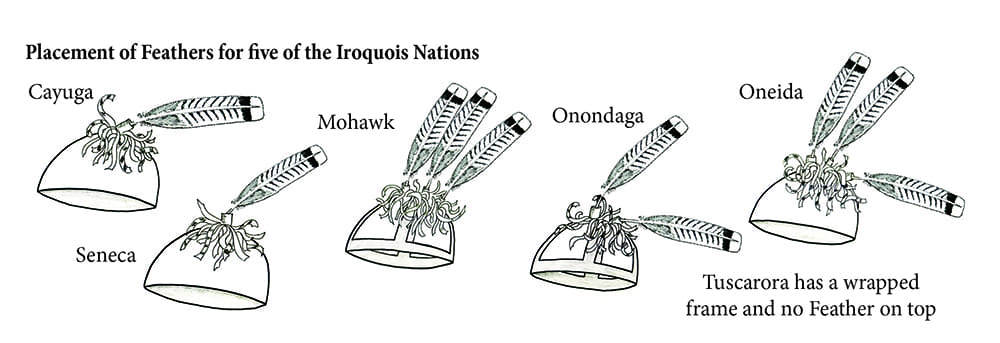
These are all the essential equivalent of national symbols to cultures who couldn't spare the cotton on a flag. It should be remembered that even the Mesoamericans defined their allegiance through featherwork patterns, and certainly headdresses and different feather styles could be used to identify different tribes further north. Here is an example from the Haudenosaunee, the Iroquois Confederacy, of what this sorta thing would look like.
While I am sorry that I cannot confirm the precise existence of flags, which my sources lead me to believe is simply not the case, I hope that this list of alternative means by which indigenous peoples have identified themselves among one another with my provided examples from the Karankawa and the Haudenosaunee gives you an answer you were hoping for.