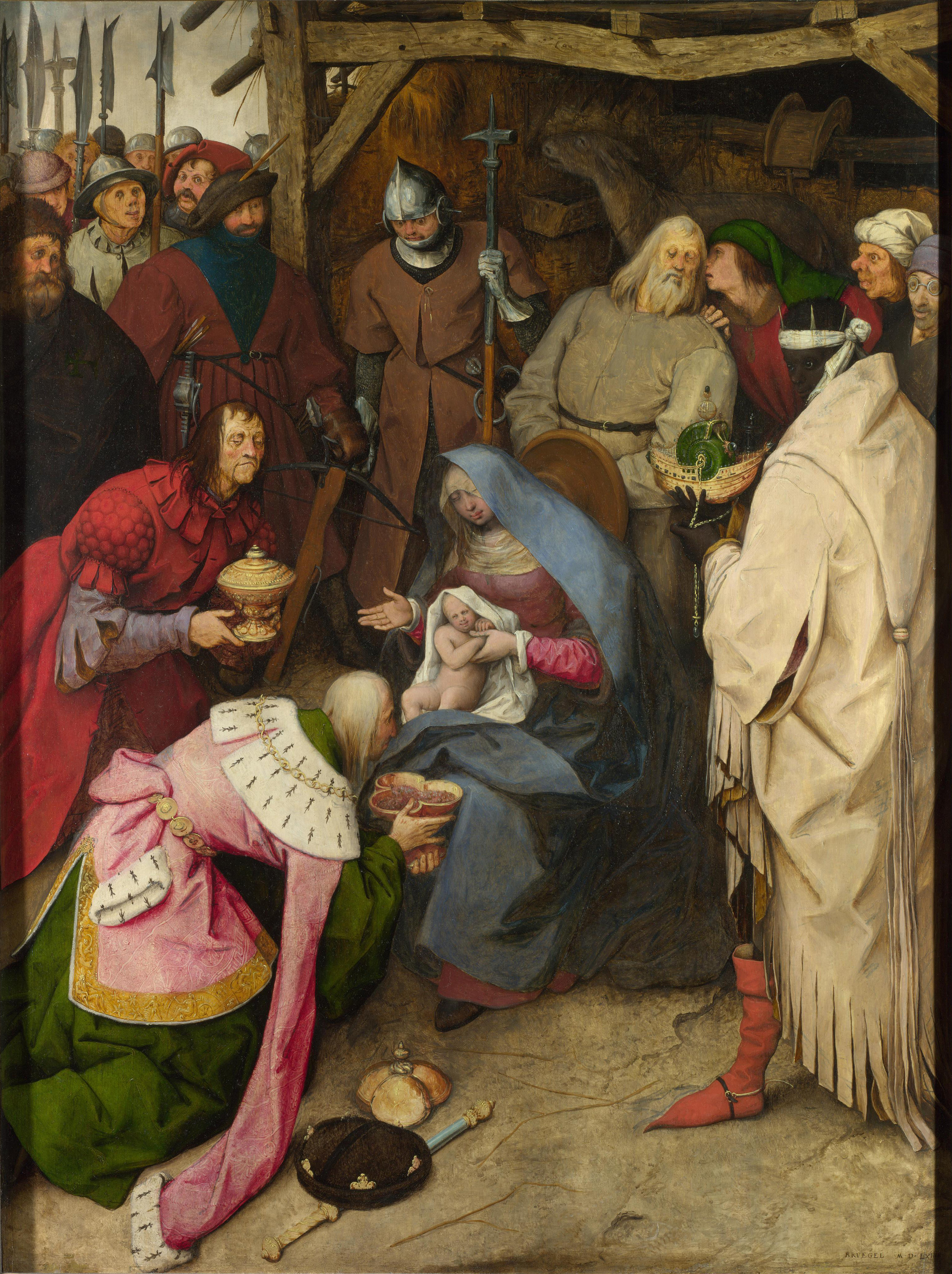
The Bruegel exhibition in Madrid includes a copy of "The Resurrection", and this painting includes a number of (presumably) Roman soldiers looking at the open and empty tomb of Christ. The uniforms they're wearing are clearly not the popular view we have of Roman legionaries with their lorica segmentata, but instead are wearing... what? Is their armour C16 Flemish armour? Would Bruegel have painted using knowingly anachronistic armour?
Unfortunately I can't find a copy of the exact painting online, but the soldiers in this painting are similar: https://upload.wikimedia.org/wikipedia/commons/b/be/Anbetung_der_K%C3%B6nige_%28Bruegel%2C_1564%29_%E2%80%93_cropped.jpg
Would Bruegel have painted using knowingly anachronistic armour?
Short answer:
Bruegel's "Romans" with their crossbows and halberds are contemporary soldiers-- usually a reference to Hapsburg soldiers and German mercenaries. The Habsburgs ruled the Low Countries at this point, and their repression was bloody, see the "Massacre of the Innocents" where the Bruegels (plural, both father and son worked on the painting) translate the location of a bible episode from Palestine to a wintry scene in the Netherlands. It's even argued that Bruegel has specifically depicted the Duque de Alba, the Spanish commander . . . so his "biblical" scenes have contemporary looking armor, because he's got contemporary concerns.
Bruegel had traveled to Italy, and when he chooses to, he uses Roman material (his "Tower of Babel" owes a lot to the Roman Colosseum). He's choosing to set Biblical stories of military oppression in contemporary settings. This is a big distinction between Italian Renaissance painters and "Northern Renaissance" painters-- the Italians are nostalgic for Rome, painters like Durer and Bruegel not so much . . . so Roman and biblical subjects are treated very differently depending on who the painter is.
Discussion
Renaissance painters were more inclined to gestures toward historical accuracy than medieval painters were, sometimes they're just nods to antiquity, sometimes a genuine desire to engage the past on its own terms, to try to learn something new about the past and render it accurately.
People were starting to think about realistic depictions-- in 1411, we get the observation that by looking at surviving statuary:
One can see clearly what kinds of arms the Ancients had, what kind of clothes they wore, what the devices of their rulers were, how they formed lines of battle, fought, laid siege, and built encampments. …
-- but historicity was only one aesthetic value, it mattered more for some subjects than others, more for some artists than others, and more in some places than others. This trend goes by the term "renaissance antiquarianism", and "humanism" and is often said to have started with writers Petrarch and Flavio Biondo in the 14th century, and the influence moves into the arts in 15th century, who have a pride in Roman history.
You find more interest in a historical depiction of Roman material in Italy than you do in Northern Europe-- this is one of the things that distinguishes "the Northern Renaissance" from that South of the Alps. So if you look at, say, Mantegna's "The Triumphs of Caesar", there's more interest in Roman history than you find in Bruegel. That's because for Mantegna and Italians, Rome is serving as a patriotic example-- a very different association than Bruegel is evoking.
He's not even making an attempt to render "biblical-ish" ersatz historical costumes, which you do see in some other painters. The Three Kings get clothing that's a mix of Christian iconography and the exotic . . . so there's a kind of "historicity" to them, not in the sense that they're depicting any real historical personage, but rather that Bruegel is looking to tradition rather than the contemporary in their portrayal.
Typically the appearance of classical soldiers' armor in renaissance painting is a mix of a bit of what they knew of Greek or Roman armor and contemporary armor. So, for example, "The Master of of the Story of Griselda"'s 1494 painting of Alexander the Great -- that sword and armor is more Cellini than antiquity, but there's some attempt to render something that is suggested by what they knew of classical armor, rather than contemporary.
And Lucas van Leyden in 1498 has a nice depiction of Hector, Alexander the Great, and Julius Caesar, all of them with the the kind of headdress we associate with German mercenaries of the time. Alexander gets to ride on an elephant, holding a kind of war hammer. The elephant is suggested by Alexander's battle of Gaugamela, and his subsequent enthusiasm for war elephants; that's in the classical historical sources but its there because it makes for a good picture. Note that the Caesar gets a short sword-- it's not exactly a Roman gladius, but it seems inspired by the idea.
Bruegel _is_ a keen observer of the material culture of his own time. He knows the art he's seen, and the familiar stories of antiquity, and while his contemporary renderings -- eg of his own time-- are quite accurate (note the mechanical detail on the crossbow, for example), he's not even attempting historicism in the painting you linked. Bruegel had traveled to Italy as a young man, and studied art there-- so he'd have known the difference between what he was painting and what Rome, Romans and the Mediterranean looked like.
He paints accurately of his own time, but is not often interested in historical verisimilitude for biblical or mythological scenes of antiquity. He's making a contemporary political reference about the brutality of occupation, and so the soldiers look like the ones doing mayhem in his home. You can compare with Albrecht Durer, whose "Christ carrying the Cross" is overseen by "Roman soldiers" who are dressed as German mercenary landesknechts . . . Same idea
Sources:
Fejfer, Rathje and Fischer-Hansen The Rediscovery of Antiquity: The Role of the Artist (Chicago:2003)
Fortini Brown, P. Venice & Antiquity: The Venetian Sense of the Past (New Haven: 1997)
Mazzocco, Angelo. “A RECONSIDERATION OF RENAISSANCE ANTIQUARIANISM IN LIGHT OF BIONDO FLAVIO'S ‘ARS ANTIQUARIA’ WITH AN UNPUBLISHED LETTER FROM PAUL OSKAR KRISTELLER (1905-1999).” Memoirs of the American Academy in Rome, 59/60, 2014, pp. 121–159
Silver, Larry. “Pieter Bruegel in the Capital of Capitalism.” Nederlands Kunsthistorisch Jaarboek (NKJ) / Netherlands Yearbook for History of Art, vol. 47, 1996, pp. 124–153
Papy, Jan. “An Antiquarian Scholar between Text and Image? Justus Lipsius, Humanist Education, and the Visualization of Ancient Rome.” The Sixteenth Century Journal, vol. 35, no. 1, 2004, pp. 97–131.
Ferber, Stanley. “Peter Bruegel and the Duke of Alba.” Renaissance News, vol. 19, no. 3, 1966, pp. 205–219.