I'm really not sure why this has been downvoted, it's a genuinely good question and a really important one.
The development of Irish American culture is endlessly fascinating, and while it's tough to get a pulse on what the Irish thought of African Americans at the time, the growth of racism in the Irish community is a key step in the process by which the Irish man became white. This evolution is endlessly fascinating to me, and I really appreciate you asking about it so I can nerd out a little.
While my area of expertise is in labor history, it's important to realize that your question is fundamentally about laborers - African Americans and the Irish were both common sources of cheap manual labor, so their struggles, competition and cooperation can help illuminate how the Irish felt about blacks.
Irish canal workers are out first look into how blacks and the Irish cooperated and sparred. On one hand, when it came to canals and other overtly physical, hands-on manual labor, working side by side with blacks for the first time gave the Irish a new perspective:
The Chesapeake and Delaware reported in 1826 that whites and blacks no longer worked in separate gangs but "labour together, promiscuously," although they were still lodged and fed on their own. "The advantages of this arrangement are two-fold - it has produced more kindly feelings towards each other, and they are found to stimulate one another to mutual exertions (Way, 1422)
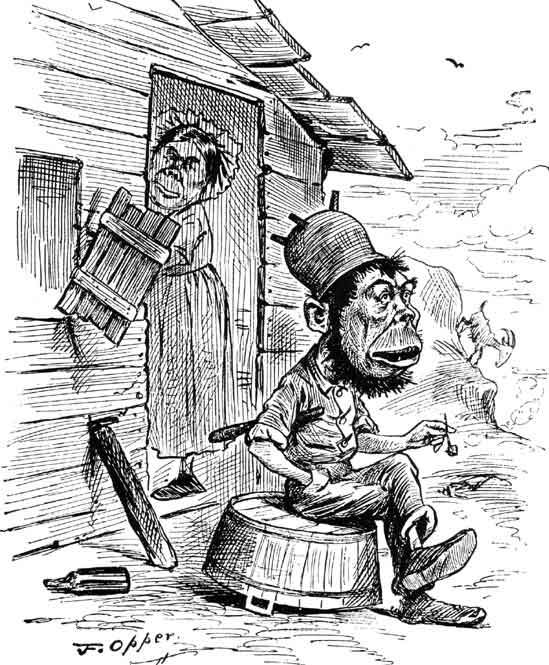
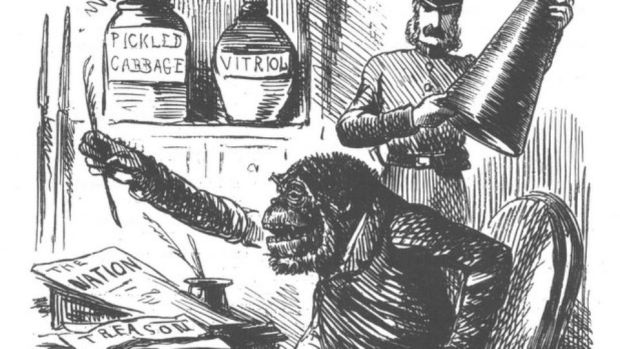
In a way, by white society, the black and the Irish were equally disgusting, just in different ways. While the racist stereotype of an ape is usually assigned to African Americans today, for instance, at the time it was just as common to see the Irish in a similar light - 1 and 2.
Thus, an alliance of Irish and Blacks seems quite natural, from an organizational standpoint, right? Employers were keenly aware of this, and the combined might of employers and yes, the Irish themselves, would come to turn the Irish against Blacks and bring the Irish to become white.
Whether using animosities as a competitive ploy or as a means of erecting barriers to a unified working class, employers had a vested interest in perpetuating the existing divisions among workers [...] divided workers were good for the industry, at least when they were not literally at one another's throats (Way, 1422).
Interethnic violence was one negative result of social particularism. Irish canallers brawled with local blacks at Elkton, Maryland, in 1804 (Way, 1419).
If I were more of a romantic historian, I'd point to the race riots of New York during the Civil War as a definitive turning point for Irish-Black race relations, but at the end of the day it's really not that simple. While the riots did bring Irish-Black relations to the forefront of American attention, if but briefly, it wasn't spontaneous in the slightest. It was the result of decades of simmering tensions, of hatred planted by employers and openly adopted by the Irish themselves.
By the emergence of the industrial era, stereotypes of the Irish Catholic had shifted for a variety of reasons. On one hand, the Irish had been around long enough that when compared to the Jew, the Pole, the Russian or the Italian, they were apparently to be preferred in most cases. The Irish also began to work their way up in labor organizations and, most importantly, in machine politics; the Irish had an immense amount of influence over the politics of New York and Boston by the turn of the century, and many who previously were attacked as 'apes' or 'beasts' now had an immense amount of political power and often immense wealth.
A great way to observe the changing opinions of the Irish can be found in the 'scientific' and 'racial management' of workers.
Again, from the canal works of the early 1800s:
James Buckingham, the British traveler [...] opined that the Irish immigrants "are not merely ignorant and poor ... but they are drunken, dirty, indolent, and riotous, so as to be the objects of dislike and fear to all in whose neighborhood they congregate in large numbers." John Mactaggart, an official of Canada's Rideau Canal, had a similar view of the canallers, some of whom lived in caves along the Ottawa River where "families contrive to pig together worse even than in Ireland ... You cannot get the low Irish to wash their faces, even were you to lay before them ewers of crystal water and scented soap: you cannot get them to dress decently, although you supply them with read-made clothes [...] They will smoke, drink, eat murphies, brawl, box and set the house on fire about their ears" (Way, 1403).
But opinions of the Irish would rather change, thanks to both the amount of time they had spent in the US and by lieu of comparison to newer immigrants. The Irish were increasingly valued as loyal workers, and especially good foremen:
The Irish, with their "cheeriness coupled with an occasional terrifying outburst of authority" typically "[made] good negro bosses." One anecdote suggested an Irish foreman can extract as much production from "an engine room full of negroes" as from one "full of German square-heads." The "type of Scot or New Englander who has no patience with any except those thrifty souls who work unwatched from a strong sense of duty, has no business trying to handle negroes" (Esch/Roediger 37).
Race thinking powerfully contributed to management, both by creating competition for jobs and thereby lowering wages, and also by setting workers against each other every hour they were on the job. When the Irish worker responded to the boss by affirming "I can lick the whole bunch and I can make them work too;' he showed at once the ways in which race management encouraged laborers to bring their cultural differences and stereotypes to work, the extent to which employers' appeals to race often overlapped with appeals to masculinity, and to the desire of some immigrant workers to ascend into the lower ranks of race management. Race management's powerful appeals dragged workers toward narrow "caste and craft unionism;' which often brought union members together as Whites and as "citizens:' but less frequently challenged race thinking by uniting all workers (Esch/Roediger 44).
Hope this shed some light on the question, thanks again for asking it!
Citations:
"Evil Humors and Ardent Spirits: The Rough Culture of Canal Construction Laborers" by Peter Way, from The Journal of American History, March 1993 Edition
"Scientific Management, Racist Science, and Race Management" by Elizabeth Esch and David Roediger, from Against Labor: How U.S. Employers Organized to Defeat Union Activism, by Rosemary Feurer and Chad Pearson