it might be because of language restrictions but by searches are really coming up duds
ill walk through by processes here
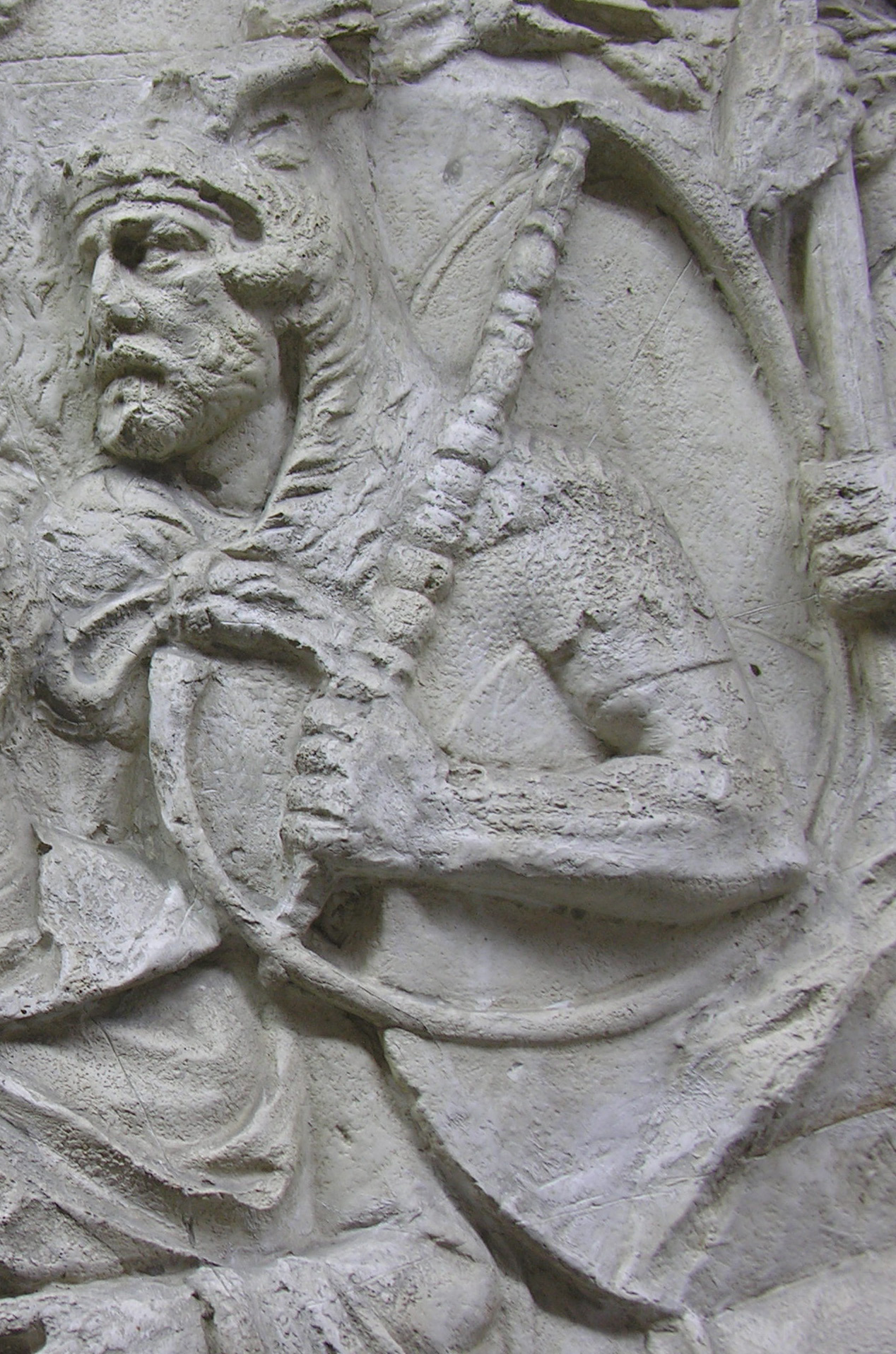
It starts with this photo here from scene 36 of the Trajan column in Rome of what was described to be bare chested berserkers
and looking at it i though "hey that sort of look like they are wearing sleeves" but nothing more came of it
a day later i see this fantastic painting someone made depicting romans in egypt and in it there is a roman standard bearer
so i look up a more detailed image of one, dead ringer, short sleeves, animal skins and the same poles
why would the berserkers be bearing standards
so i look up if there are relief carvings of standard bearers in the same style as the berserkers so i can compare
https://arts.st-andrews.ac.uk/trajans-column/uploads/TC-004-005.7-cpd-4-215x300.jpg
https://arts.st-andrews.ac.uk/trajans-column/uploads/TC-104.1-12-bright-cpd.jpg
https://arts.st-andrews.ac.uk/trajans-column/uploads/TC-061.7-15C-cpd.jpg
what i find however on the same column is men who look exactly like the "berserkers"
so i look into the origins of the standard bearers to see if they might show me why these similarities might be at play
" The bas relief carvings on Trajan's column in Rome depict scenes of Trajan's conquest of Dacia in 101–106 AD " is what i find on the wiki
"the earliest known bear-hooded Roman standard-bearer is Pinaious of cohors V Astrum whose gravestone at bonn dates to the reigh of Claudious (41-54CE)"
is what i hear form this pdf/google books or whatever you may call it
what this tells me is either the first carving is just more standard bearers, standard bearers either influence the look of berserkers or the other way around
the book on "magic in britain" i reference claims that it was the standard bearers who wore the pelts they got from slaying berserkers as a trophy which i see as sort of equivalent to the phrase of surrender "its was likely used for ceremonial practices" we hear every day
i would really like to hear either opinions on this or if anyone knows more than be and could bring light to the subject?
i also hope this does not fall under "loaded questions" as i feel like the contents of the post might be loaded with a lot of unnecessary text i tried to keep the question itself simple
Those simply aren't berserkers. First it's pretty obvious they're acting as Roman signifers since they're carrying aquilae. Second, Trajan's column is from a full thousand years before accounts of berserkers show up. It'd assume less to assert a soldier in the Napoleonic wars wearing a bearskin hat was a berserker.
Most importantly though: We do not know what beserkers were. I mean we know the term was used to refer to wild warriors, who'd occasionally 'go berserk' in a wild rage in battle (berserksgangr). We also know that the term literally seems to mean 'bear-shirt' and that's a presumed etymology. That's it.
However the literal meaning or etymology (if we assume 'bear-shirt' is the actual etymololgoy) does not necessarily say much about what the term actually involved. Nevertheless people have projected all sorts of theories onto that blank slate. Depending on who you ask, the term berserker could mean:
A metaphor for someone acting like a wild animal.
A special class of warriors who wore bear skins.
Warriors who used drugs.
Warriors who ate mushrooms; a persistent 18th century chestnut is the claim they ate fly agaric; which is pretty debunked now since it really doesn't do much more than give you horrible stomach cramps, paralysis, nausea and possibly hallucinations; hardly a benefit.
Shamanic shape-shifters who became literal bears, spiritually.
And probably even more far-fetched stuff I haven't seen. There's really no evidence there was ever such a thing as berserkers as a special warrior or unit, yet a lot of those speculations mentioned above get passed off as outright fact in a lot of popular literature.
It's a literary term that occurs mainly in sources that were composed centuries after the Viking Age. Many interpretations of the term start from taking a sentence in Ynglinga Saga (ch 6) at face value, where it says that Óðinn could cast magic on his men so that they'd go 'crazy like dogs or wolves', and nor fire nor iron would affect them, and this is what is known as berserksgangr.
However there are good reasons why this should probably not be taken as a factual statement. Ynglinga Saga is a story composed in the 13th century by Snorri Sturlusson (partially - but not this part - based on the older Ynglingatal). It is intended as a history of the Scandinavian kings (from which Snorri himself claims to descend), and Óðinn here is a human king who was skilled at magic; this is a euhemerism; Snorri, as a Christian, was trying to explain the old pagan gods had been great humans whose reputation had been posthumously exaggerated. (This is something continental Christians had been doing for the Roman gods for centuries)
In other words, what Ynglinga Saga says was definitely not what pagan Scandinavians believed. Obviously they believed Óðinn was an actual god. Snorri's account here may be little more than a way of explaining how his ancestors had believed Óðinn had given them strength and courage in battle; and at the same time explaining the term berserksgangr.
Interpreting the term as referring to any specific Norse (much less Germanic! ) practice is complicated by the fact that the Icelandic literature (as early as the early 13th century, in AM 619 4^o ) uses it to refer to foreigner heathen warriors as well. Which seems rather to give it a relation to serkr as a term for 'Saracen' or Middle-Easterner, as in Serkland (a term which is attested from the actual Viking Age in runic inscriptions). The term could derive from that, and Snorri's explaining the term berserksgangr as deriving from enchanted animal-like warriors may have been nothing more than a folk etymology on his part. (which he was certainly prone to, in his euhemeristic history Snorri also derived the Æsir from the continent Asia, Vanir from Tanais, and Thor from Trojan Hector, among other things)
So we don't know that 'berserkers' were a thing in the 11th century, much less the 1st, and there's absolutely no reason to think they had anything to do with Trajan's column. There are actual depictions of Roman standard-bearers wearing bears-skins. That's more than there is for berserkers.
Every guide to Trajan's Column that I've seen describes Scene 36 as "Trajan leading Roman infantry." Those are quite clearly Vexillarii.
I think whatever source you read claiming that those were Germans was mistaken or a misprint.
You can read in more detail about Scene 36 here.