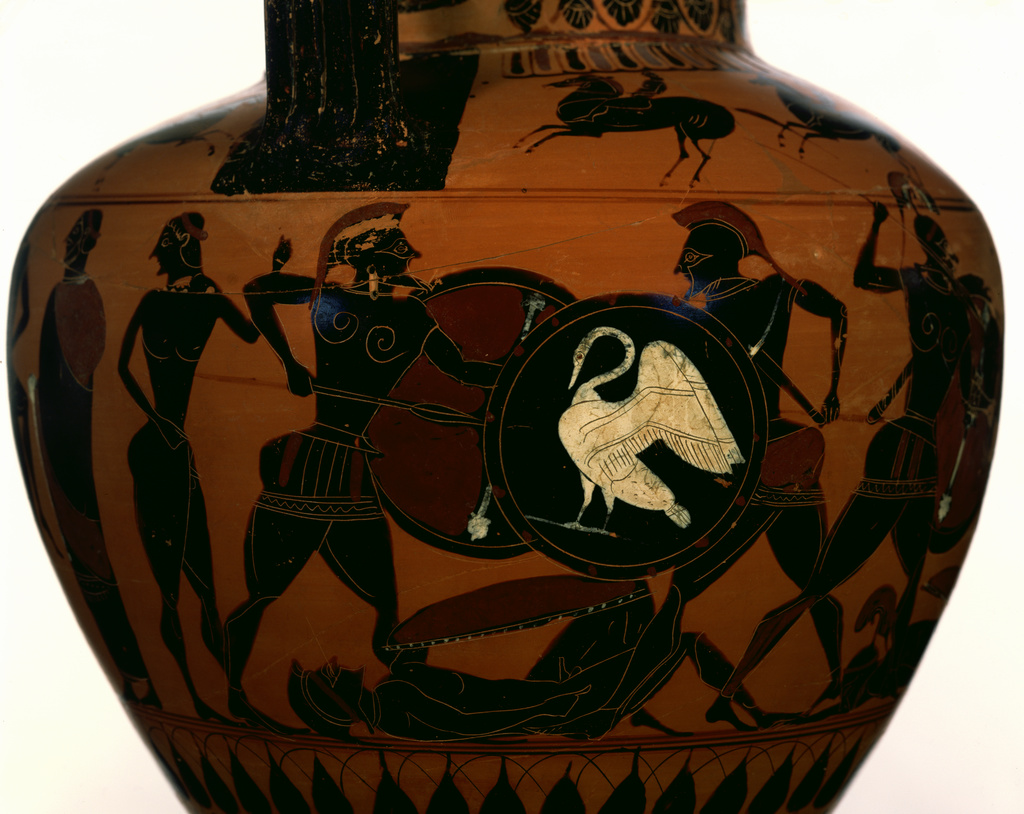
I've been looking at olpe paintings and noticed on some, some characters would be entirely white and some entirely black. Why would this be? the specific one I was looking at was one with Poseidon and Hermes being Black, and Athena being entirely white.
What you are referring to is the so called black figure pottery style which is the art style most commonly associated with Ancient Greece today, even though it was around for cca. a century (during 6th century BC or so called Archaic era). Figural and most ornamental motifs were commonly black in this style (hence the name). The black color wasn't painted on, but came from a slip which was used to outline the silhouettes of figures, and would turn black during firing. Later the details would be added by incision and/or applying paint.
There was an apparent consensus to paint female face/skin in white. However, it was also often used for shield devices (causing many to wrongly assume these were painted in real life) , animals, and for contrasting decoration on clothes, furniture etc. The colour itself was produced from a very fine white clay.
Greeks also used a limited amount of other colours such as purple, faded yellow, dark red or even pink for emphasising different elements of the motif. All of these, however, represent a consensus and/or are there to achieve polychromy or contrast (similar to 1980's comic books) rather than convey realism. So it would be wrong to conclude Greek women whitened their skin, shield deviced were painted (in white), men's beards or clothes were painted red or armour was painted purple. This is a common fallacy which is why I am mentioning it.