I didn't hear about it so much before but seems to be pretty popular nowadays.
Jeje, finally a question on the only truly fascinating topic: me!
Oye I don't get the whole sexy skeletons thing myself. You know that skeletons come in all kinds of beautiful shapes and sizes, and shouldn't be discriminated against just because they look different from some idealized normy media image. And yes, I include you in this statement, old Italian dude who painted some European "love goddess". Skeletons are only human too, ya lo sabes.
In my small opinion that has to do with the big capitalist appropriation of our fine Día de muertos traditions - but I will get to that in a bit.
¿Qué onda? Ah right, the whole history part.
Vamos I 'll try and bore you with some gringo history talk then, feel free to tune out for some tacos and pulque anytime. So the whole tradition, it goes back to like colonial times but I don't have time for that today obviously. Fast forward to when things really went down:
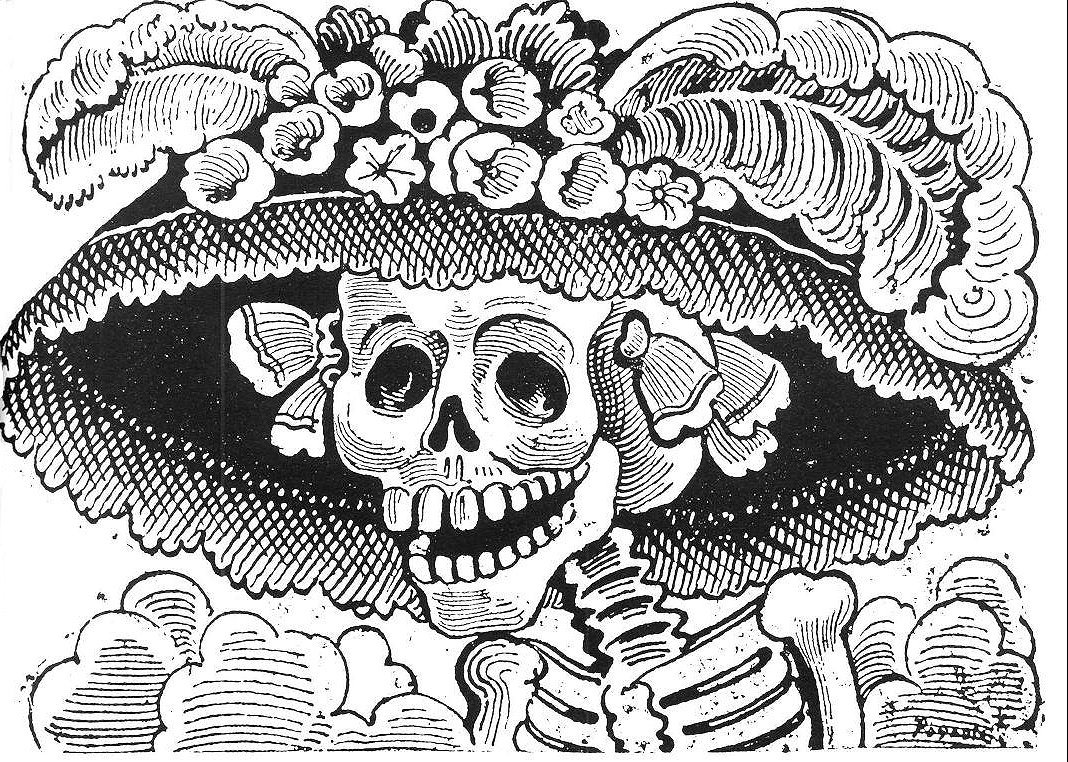
The beginnings of the current Day of the Dead celebrations, building on earlier colonial Mexican and medieval European traditions, can then be traced roughly to the 1740s, with descriptions of sugar figurines, and finally the use of skulls by the later 19th c. The illustrator José Guadalupe Posada would become a major influence on this, drawing now-famous calavera (skull) images for each Day of the Dead –
the most famous one surely being the catrina, a female dandy/upper class figure that is by now a mainstay of the festival. Right, that's me!
This was the important part but let's see what happened afterwards anyway:
Posada was creating these images during the dictatorship of Porfírio Díaz in the early 20th c. Since critique of the regime or politicians was strongly restricted, his art could offer a subtle form of criticims. This also still a current feature of the Day, with figures and costumes as humoristic criticism of e.g. famous people and corrupt politicians.
Posada's art also fit well with the post-revolutionary ideology of 1930s Mexico. His art was declared to be high art, and seen as a way to counter European art by harking back to the pre-Hispanic past, and so taken up by artists connected to the revolution's goals like Diego Rivera (who painted Posada into one of his huge paintins). Posada's work was also taken up by later Mexican artists, probably most famously by the Linares family whose calacas are now in many major museums worldwide.
We can note already with Posada then a move from the art's ritual nature to non-ritual contexts, but also to commercial opportunities that have been realized more fully by many Mexican artists influenced by Posada (like the Linares) and also inspired by the Day of the Dead iconography. Another influence to add here is that due to the many prior epidemies, in Mexico City cementaries were put outside of the city, and around the 1860s the government started being in charge of the burials leading to more central planning. At around the same time certain other customs were more consolidated: e.g. laying flowers and candles on graves, and visiting the pantheons on the 1st and 2nd of November.
This commercial potential of the Day of the Dead was then really expanded through two further, interconnected factors : political reforms and tourism. Tourism promoted through state intervention has had major impact on how the festival is celebrated in some parts of Mexico today. The carnivalesque atmosphere has been a major draw for tourists.
I mentioned how the celebrations and art fit with the post-revolution agenda, so that the PRI (the governing party during decades) started initiatives from the 1960s onwards in order to attract more tourists. This was tied to larger policies, for example to « indigenismo » ideal of highlighting pre-Hispanic cultures including through arts, dances and architecture, all the while often continuing to discriminate against current native people and also simplifying the diverse indigenous population groups of Mexico (by focusing mostly on the Aztecs).
¡Oye güey, no me...!
...
Ay perdona this guy just stole my head, I mean skull! It happens especially on this day and especially in la CDMX, but it makes talking sort of hard... anyway I got it back now, where was I? Tourism.
Okay so an American historian whose name I forget [cf. endnotes, 1] studied the effects of tourism on Day of the Dead festivities in Tzintzuntzan in the western-central state of Michoacán, where it's called Noche de muertos (cool topics all in all):
The impact [of tourism] has been to convert a relatively minor ritual event, in which a small proportion of the town participated and virtually no outsiders showed much interest, into one in which thousands of city people clog the streets with traffic, television cameras flood the cemetery with glaring lights, and the town becomes more or less a great stage prop for a ritual drama. In this drama native townspeople participate as actors but outsiders run the show.1
Before 1971, Noche de muertos rituals were made up of a mass, the construction of home altars, and a vigil in the cemetary, as well as offerings (ofrendas) made to the dead and afterwards shared with the community. All this culminated with the el doble practice, the slow ringing of church bells, accompanied by sanctioned door-to-door begging and a shared feast. These community activities with a religious grounding have since been heavily changed through state intervention.
By now the Noche de muertos is often known as la Feria de los muertos and has become much more like a carnival. The Ministry of Tourism has introduced various cultural performances including theatrical performances and regional dances for tourists. This is accompanied by craft competitions, open air marketplaces etc.
Some Mexican scholar² highlights the government of Carlos Betancourt (1968-74) as especially important for those developments in Michoacán. Under him public sector resources were given to to various municipalities and communities, esp. around the lake of Pátzcuaro (the other main city in the region with the largest festivities being Pátzcuaro).
That scholar adds to those activities mentioned that in Michoacán such resources often led to the inclusion of rock music festivals, illegal products, and supposed „village ferías“ including large amounts of alcohol consumption to make the festival more attractive for tourists – not exactly typical of the traditional festivities. He adds that cultural events and heritage in Michoacán make up an important percentage of the tourist economy, roughly 30% in 1996.
Similar developments have been noted not just for Michoacán but also on different scales for other regions, and also the famous festival in the capital Mexico City. So that « for better or for worse, these changes have had the effect of commercializing what was once a deeply religious and spiritual celebration and have turned the Day of the Dead into a globally recognized symbol for Mexico and Mexican identity. »³
On the other hand, these changes in Michoacán have been so far-reaching that tourism has added a major ritual occasion to the town's annual religious cycle, and can actually be seen as the source of the specific contemporary celebrations.
So art, tourism and political incentives all working together, in a nutshell then. I gotta run now, entonces and early feliz Día de muertos to y'all! Stay safe tomorrow!
1 Stanley Brandes, Iconography in Mexico's Day of the Dead: Origins and Meaning, 1998
² Carlos Alberto Hiriart Pardo: Noche de muertos en Michoacán. Relfexiones sobre su manejo como recurso turírstico cultural, 2006.
³ Maria Herrera-Sobek: Celebrating Latino Folklore: An Encyclopedia of Cultural Traditions Vol. 1, 2012