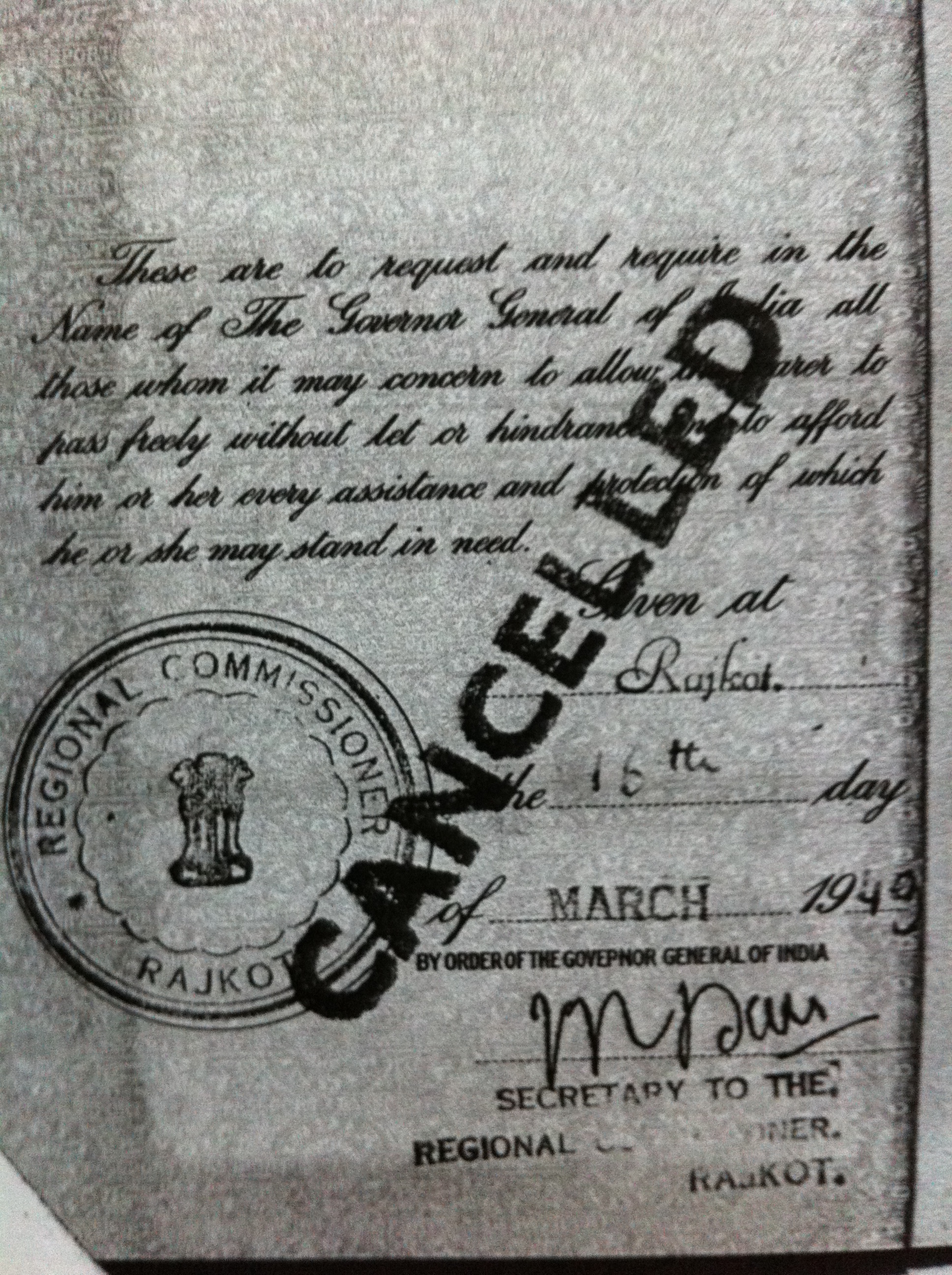
For example, here is the text for american passports, and here for old Indian passports
The current Indian passport reads:
These are to request and require in the Name of the President of the Republic of India all those whom it may concern to allow the bearer to pass freely without let or hindrance, and to afford him or her, every assistance and protection of which he or she may stand in need.
What is the history of this message? Was there some event that triggered this message to be written? Do all passports have this?
My favorite thing about this subreddit is that sometimes I read a question I've never considered before and suddenly find myself with a burning desire to know the answer, too. Tonight we're both in luck! (Sort of.)
In answer to your last question, although I can't find a solid list, it appears as though almost all countries' passports have this fairly standardized message. The only one I can find a mention of not having it is Switzerland, but I can't find any reasoning for it not being included in theirs. That leaves us with two questions: why do most countries have this message and why is it worded in this way?
The first one is easier, so we'll start there. In Daniel C. Turack's Freedom of Movement and the International Regime of Passports he explains:^(1)
With the advent of World War I stringent restrictions to travel were introduced in the interests of preserving national security. On the conclusion of hostilities, the barriers to travel were left intact for the most part. International travel in Europe, which prior to the war presented few obstacles to the crossing of national frontiers, became a nightmare as the traveller was confronted with many stumbling blocks at every frontier. Prominent among the impediments -were the passport systems, customs control and the conditions under which through tickets were issued for trains traversing national boundaries.
So, at this point, everyone had their own way of doing things. This would, of course, lead to endless problems - not least of which would be even knowing if someone's travel documents were real. To remedy this, the League of Nations convened the "Conference on Passports, Customs Formalities, and Through Tickets" in Paris in 1920. This was the first of several conferences on the topic (the last of which was in the 60s), the goal of each being to further refine standards until everyone was on the same page, so to speak.
In the name of standardization, the experts involved in these conferences outlined the physical size and shape of passports, the materials that should be used, how many pages it would have in total, the page order for personal information, and the personal information that would be required. That personal information was supposed to be in the first three pages. To quote Turack again:^(2)
...the first and second pages should contain the name of the issuing country, the bearer's personal particulars and a heading concerning children if they are to be covered by the passport; entries not written and not in Latin characters were to be accompanied by their transcription in Latin characters; the surname of the bearer was to be written in block letters or typed; nationality of the bearer should be clearly apparent. Description of the bearer could be limited to the following three headings: height; colour of eyes; special peculiarities. The third page would contain the bearer's photograph and the photographs of any children accompanying the bearer if indeed, photographs of the children were to appear in the document.
After that, because at this point it seems many countries still didn't issue blanket passports that allowed citizens to travel anywhere they wanted, there was to be a fourth specified page:^(3)
The fourth page would specify the territorial validity of the passport,the duration of its validity, the date of issue, bear the stamp of the issuing authority and if desirable, the signature of that authority.
This hearkens back to much earlier forms of what would become passports - a letter from an authority granting a person permission to go to a specific place. The idea of passports (though not the word) dates back to antiquity, but they appear to have become more common in the Middle Ages and onward.^(4) These letters would allow the traveler to prove to anyone they encountered that they had the right to be traveling as well as serving as an introduction to the authorities of wherever they were going.
Which brings us to the second question: why do modern passports say what they say? I'm going to be completely honest here and say that I can't find anything airtight about the standardization of this wording in any of the source materials I've read through. That said, deep in the written report from the 1926 passport convention, I found this regarding the objective of passports:^(5)
The authority issuing the passport recommends the holder to the protection of the authorities of the countries to which he is authorised to proceed and to the protection of the national diplomatic or consular authorities established in those countries.
That sounds an awful lot like the message we're talking about to me. As to the exact wording, my best educated guess based on the sources I've been reading is that it's a bit of a holdover from days when most "passports" were issued to people traveling for diplomatic purposes.^(6) It has that same note of introduction as well establishing what country you've come from and who in that country has granted you authorization to travel. The actual request seems to be based on a mutual agreement between countries to allow the holder to travel freely (though, frustratingly, I can't seem to find the exact agreement(s) this stems from!). It seems connected to diplomacy in the way it's worded, basically imparting, "This person is a citizen of my country and I am authorizing them to travel to your country, please return them to me in one piece."
I found a source that explicitly mentions how passports legally establish the right to travel and affirm nationality and it contains several brief mentions of this wording in American passports (and one mention of British passports). Aside from stating that the 89th Congress is (apparently?) the source of this exact wording for the US, it's of little use in answering the question and it's kind of a hot mess front to back.^(7) It also addresses the fact that US diplomatic passports give direction that a diplomat should be allowed access to American citizens without delay or hindrance which is another reason I think there's a diplomatic connection in the wording.^(8)
I think I've done everything except answer your actual question (why it says that specifically), but hopefully you'll find this interesting anyway!