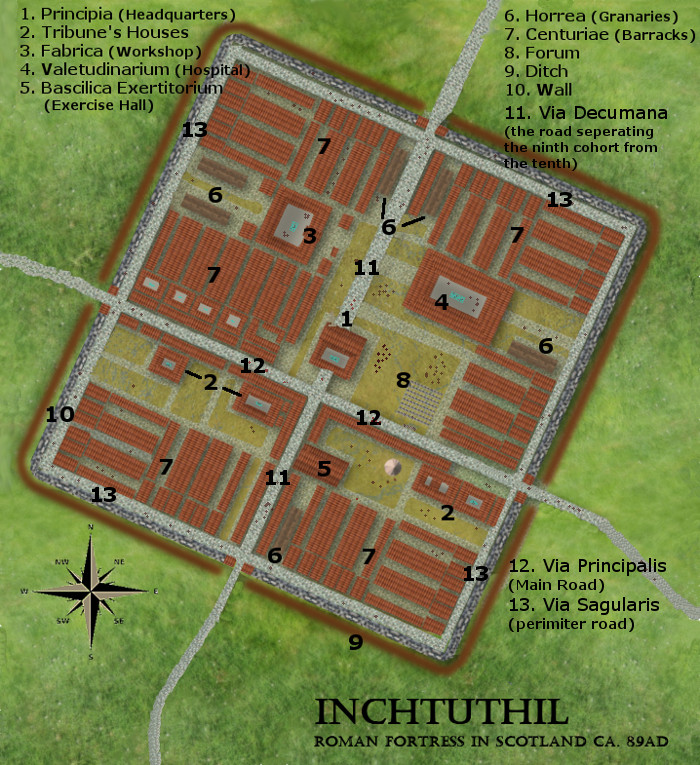
Hey, here's a picture for reference. https://i.imgur.com/t2fWvSU.png
I understand that the forts vary on a case by case basis, but they are generally pretty similar. One thing I noticed, in particular, is that all the buildings were spread out within the complex. Why is that?
Why not just building them as a single building - like a run of the mill castle? It would be a lot more space-efficient and more resource-efficient (I would assume). It may even be more time-efficient when making it, which I think would be very valuable given that lots of these fortifications were made in a hurry - possibly within a day, which I find hard to believe.
Also, it seems like modern military bases also spread out the buildings in their layouts, so I would guess this is good practice for some kind of reason that has withstood the test of time, but I'm not exactly sure why.
So, why spread out the buildings inside of the castrum?
Thanks in advance.
First: castrum is not typically used in Latin, except in very rare cases, and those probably confusion with the similar castellum, which does appear in the singular. The Latin noun is always plural, castra, though it refers to a single camp.
For the average run-of-the mill castra, there were no "buildings." The structures inside were tents, and the whole thing was put up and taken down in a single night on the march. The more permanent forts, like those along the limes in Imperial times, were constructed on analogy with the marching forts, and more or less took the same shape.
There are practical considerations for both the temporary and the more permanent forts. The spaces between the tents/buildings afforded rapid internal movement from any one side to any other side. Men could move quickly down the "lanes" (the Romans called them viae, 'roads'). Internal mobility was an important feature of successful repulsion of attack, since reinforcements could be moved rapidly from point to point. The lanes also afforded quick mustering and departure from any of the four gates.
You find it hard to believe that the castra could be built within a day, but I think you have the wrong idea about what it looked like. See here, though this pic probably gives TOO much space inside the walls. It was not only built in a day, but often within a couple of hours, or even less. Every soldier knew his job, where to dig, where to pile up dirt, and much like ants, and well-trained legion could erect a structure like a castra with terrifying speed. And contrary to what you are suggesting, the space between the rows of tents makes construction and organization go faster, because all the tents can be erected at roughly the same time, instead of each row in succession in the case of them "touching" one another. I also don't understand why a Roman army would need to "conserve space" on the march. Space from what? When the Romans are building a castra, they typically own the countryside far and wide.