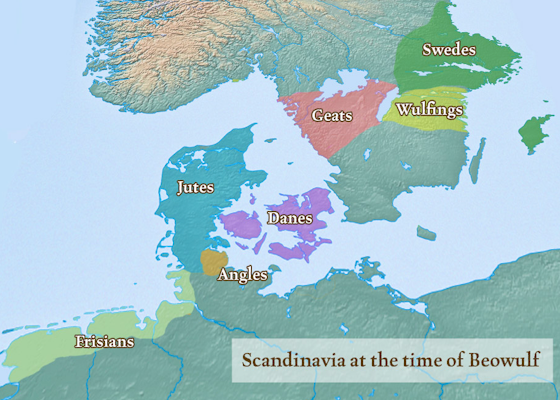
I was listening to The History of English Podcast and the host mentioned something that really caught my attention. A theory is discussed in the 42nd episode of the podcast (see link) concerning the fate of the Geats, a Scandinavian Germanic tribe originally from what is now southern Sweden. The theory suggests that as the Swedes expanded south and conquered Götaland, many Geats migrated to Anglo-Saxon England, eventually settling in East Anglia. This could potentially help explain why Beowulf, an epic not set in England but rather in Denmark and the Scandinavian peninsula, most notably in the land of the Geats, was found in the Old English body of literature. The theory apparently is supported by some evidence such as the similarities between the names of the first dynasty of East Anglia, the Wuffingas, and the ruling family of the Geats, the Wulfings, the fact that the Sutton Hoo ship burial, a funereal practice more so associated with Scandinavia than England, is found in East Anglia, and similarities between artifacts described in Beowulf as geatish and those found in the Sutton Hoo burial. All that being said, is it widely accepted in history academia that some or most Geats migrated from Scandinavia to East Anglia following the expansion of the Swedes into what is today southern Sweden? Is there more current research into this subject? I would very much be interested.
Link: https://historyofenglishpodcast.com/2014/05/06/episode-42-beowulf-and-other-viking-ancestors/
I'm not sure I've heard that theory before (I know a guy Sam Newton claimed the Wulfing-Wuffingas thing but I haven't read his book); it sounds quite far-fetched. (I don't have time to listen to that podcast now, so I might come back to it later)
The first problem with that is something taken for granted here:
Are the Gēatas of Beowulf (and Widsith) the Götar (genitive plural Göta, Old Norse Gautar) of southern present-day Sweden?
The most commonly held and repeated theory is that they are; based perhaps more than anything on the linguistic evidence; where the Old English 'ea' tends to correspond here to O.N. 'au' diphtong which turned into ö/ø in modern Swedish (and ø in Danish/Norwegian); as with 'bread, dead, read (modern English red), dream, mead"' <-> 'bröd, död, röd, dröm, mjöd' (and with 'au' in ON). Hence Geat- to Göt-. However the Götar as far back as we have records, were divided into east-and west groups by lake Vättern. (on the map on that podcats page, which is quite incorrect though, the area marked 'Geats' would be west-Götar and the area marked 'Wulfings' would be east-Götar)
However there's been dissent in that since the 19th century. Pontus Fahlbeck and Sophus Bugge in the 1880s theorized they were actually Jutes. Knut Stjerna (1912) thought Beowulf was from Öland. Historian Curt Weibull (1974) also claimed it was a misunderstanding and the Geats were Danes. And this discussion is by no means over; Just last year the reputable professor emeritus of archaeology Bo Gräslund published Beowulfkvädet - Den nordiska bakgrunden, arguing in 300 pages why the Geats ought to be read as talking about the Gutes (Gotlanders), the natives of Gotland which are a separate group from Götar and Svear (Swedes-proper, ON Svíar) although the name is of a related etymology to Götar. (also to Goths, to which it is in fact somewhat closer) Having read a lot of Gräslund's book (my understanding is an English translation of the bookis in the works; although hardcore Beowulf scholars should be able to read Swedish :)), it's a fairly convincing case, although it's still necessarily very speculative and hardly going to end the discussion. To give some of the arguments for example, one originally made by archaeologist Gad Rausing, who also argued in favor of Gotland, is that there seems to be a lot of references to the sea, and being near the sea in the text, which does not apply well to the Götar, the west-Götar had almost no coast (that map is quite incorrect here). As far back as we have any record, Norway had Bohuslän and Denmark controlled Halland, leaving only the mouth of the Göta Älv river under the control of the west-Götar and through it their sea access. The east-Götar had a larger coastal section but they lived mainly farther inland. The Gotlanders and Swedes were more coastal and seafaring peoples. Gräslunds main strength (as one might expect from his expertise) is the interpretation of the material culture, particularly since arguments from that have been used earlier to argue for the poem having been composed in Britain, while Gräslund believes it is an Anglo-Saxon translation of a Scandinavian original text.
Next problem: Did the Swedes conquer the Götar?
Beowulf is the main source implying that. And long ago in the 19th century that was enough for people to assume such a thing happened. There are also Sagas saying there were Swedish kings that ruled over the Götar (in unspecified times), and those too were largely taken pretty uncritically.
But once we have a somewhat reliable sources, we don't see Swedish rule over the Götar. Since the Götar converted earlier, it also seems unlikely they'd accept Swedish rule over them at that point. The first king that's considered historical that was known to have ruled the whole country (Swedes and Götar) was Olof Skötkonung (died 1022). It's unclear here though to what extent this would mean Swedes ruling over the Götar, who by all accounts retained their own laws and customs and so on. The only evidence in favor here is one much- debated line in the Elder Law of Västergötland (written around 1200, but of older provenance), where it says 'Swedes have the right to elect the king and also depose [him]. (Sveær egho konong at taka ok sva vrakæ). At most this would seem to imply that the þing of the Swedes was responsible for electing the national king. However, there was (still is, actually) also a tradition of an Eriksgata where the newly elected king had to make a tour of the provinces - including the Göta ones - to be confirmed. And indeed the list of kings in the aforementioned law speaks of Ragnvald Knaphövde, a king who was murdered on his tour for daring to enter Västergötland without taking hostages. (the fact he didn't feel he needed them was deemed an insult)
The way these elder historians reconciled all this was to view the introduction of Christianity as creating a temporary power shift; the Swedes ruled the Götar, lost control as Christianity was introduced and then regained their rightful position as rulers.
However, later historians take a more critical approach to the Sagas and Beowulf. The history of Swedish kings in Ynglinga Saga is viewed as essentially pure legend. The war(s) of Beowulf, even if they happened would be hard to substantiate since we do not know when they're supposed to have taken place. I mean even the century is a guess. So without those sources, and without anything resembling any direct Swedish rule over the Götar in the historical period, there's simply no reason for this rather ad-hoc theory of a country where power was consolidated, broken up and re-consolidated. Scandinavian kings were quite weak through the Viking Ages and the following centuries.
In short: Although it's not hard to find older sources taking this conflict as a given, most historians of Sweden today do not believe in a Svea military conquest of the Götar. Beowulf is considered mainly fiction on this point, as is for instance the big Svea-Göta battle in the Sagas, that at Brávellir/Bråvalla.
Migration
Okay, so AFAIK there's no evidence of any big migration away from Götaland, at least not during the period 500-700 or so we'd be talking about here. The conquest you state as the reason for it isn't believed to have happened. But even if the conquest happened it's very non-obvious why that'd lead to migration. As said, even if the Götar had to swear allegiance tot he Swedish king, the kings were weak; they had no taxation (the king's wealth came from a set of royal estates; Uppsala Öd), no standing army. No actual means of oppressing the Götar even if the king had wanted to. The nobility, which amounted to the richest farmers, held most of the power. The Götar retained a distinct identity and customs and laws until the 14th century, and it was only by the late Middle Ages that the ethnic distinction between Svear and Götar blurred into a common Svensk identity (Swedish in the present day sense).
AFAIK there isn't linguistic evidence showing such proto-Norse influences on the English language that one might expect from a large migration to England. The problem with a name like 'Wuffingas' is that the initial 'w' had been lost in proto-Norse, and the equivalent name of 'Wulfing' you see in the Old Norse poetry is 'Ylving' (Helga kviþa Hundingsbana, 10th century). "Wulfing", like "Geat" and other Scandinavian names in Beowulf has been anglicized. I'm left with the question that if the Ylfings went to England, why they'd not either keep their existing name or anglicize it the way Beowulf did. And if Beowulf is supposed to be about the Wuffings, why write a different name in it? The Ylvings of Norse literature, as well as identifiable character parallels (Othere <-> Ottar [Vendelcrow], Eadgils <-> Adils, etc) don't confirm much more than that legends with these names existed; as the sources don't tell a single story and contradict each other in many ways.
However, cultural contacts between England and Scandinavia even before the Viking Age is not at dispute; the Sutton Hoo helmet (and other grave goods) is not thought to be a coincidence in its similarity to the roughly contemporary burial helmets at Vendel and Valsgärde; you'd be unlikely to find a discussion of the one without mentioning the other. But.. associating these finds with the Geats is problematic because Vendel and Valsgärde are just north of Uppsala in core Swedish territory. To my knowledge there are no such finds from Götaland (although some helmet fragments from Gotland). In other words, in order to use Sutton Hoo as evidence of Göta influence in England, you have to first assume that the Götar actually had such helmets! Further, although it's apparently assumed here (and in other places I know), neither Sutton Hoo nor Vendel/Valsgärde are dated with accuracy sufficient to say the latter preceded the former (or vice-versa). How do you know it wasn't Anglian influence on the Swedes? Or just a Swede in England? (as Birger Nerman argued early on in 1948. Or for a recent discussion in general see Sutton Hoo and Sweden Revisited by Alex Woolf, 2014)