For example, Japanese Type 97 Chi Ha had 180hp, but Type 0 fighter had nearly 1000hp. I'd imagine they would be exactly the opposite?
The Zero's radial engine is 1.5 meters long, and 1.1meters wide, according to Wiki.
That's most of the size of the engine compartment in a Chi-Ha, behind the turret. In that compartment you also need to leave room for cooling system and the fuel system to start with.
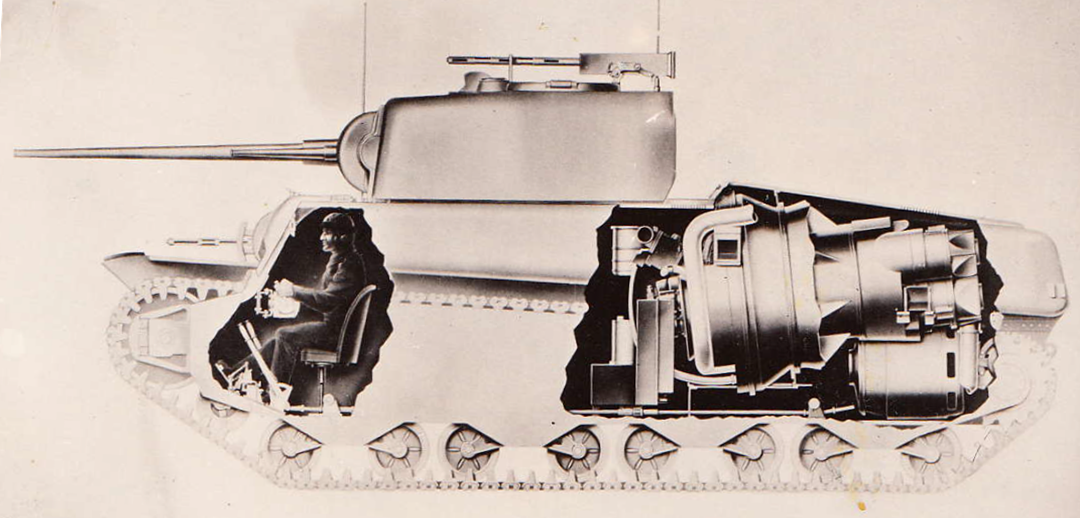
It's not as if you can't mount a huge aircraft engine into a tank. This is the M6 Heavy Tank, it used the same 900hp Wright Cyclone engine as the B-17. https://upload.wikimedia.org/wikipedia/commons/7/77/Heavy-tank-OWI-2.jpg
The tank is unreasonably huge. So huge that the Army decided it was a waste of effort and cancelled it. And this cutaway shows why. https://worldoftanks.com/dcont/fb/image/t1e1interior.png
Earlier smaller tank engines often were aero engines. They were light, and reasonably powerful. Witness the Wright Whirlwind as found in the Sherman, the 375 hp engine also found on US Army Air Corps training aircraft, for example.
Your next issue is one of reliability. Aircraft engines can run on the ragged edge, mainly because they don't run for more than a couple of hours without the possibility of a mechanic taking a look at it. A tank's engine can be running most of the day, and the tank will normally only be sent to the mechanic if something breaks, or for its 250-hour checks and the like. As a result, de-rating to lose horsepower in favour of reliability is not an unusual route for an aircraft-cum-tank engine. Cooling, I have already mentioned. An aircraft engine is going to have air wafting over it at a couple hundred miles an hour. A tank engine does not, leading to another reliability issue.
There is one engine which simply invites the direct comparison, and that is the Merlin (aircraft) vs the Meteor (tank).
The aircraft version, made of high tolerance (and expensive) parts was supercharged, cranking out some 1,000hp. The Meteor, basically the same design made of more rugged, cheaper, steel (in a tank, weight is of less important), and without a supercharger, still came out with a whopping (for tank standards) 600-hp in a package small enough to fit into the tank hull. Remember, the bigger the tank engine, the more armor you need to enclose it, making the tank heavier, and reducing the advantages of having more power caused by putting the thing in in the first place, and having a few other side-effects such as elongating track run which reduces steering. I don't know enough about superchargers to comment on the possibility of fitting Merlin's supercharger to Meteor, suffice to say, it was not done, probably for one of the three reasons (cooling, reliability, size) mentioned above.