In the first letter of Fernando Cortes to Charles V he is describing Mexico
https://archive.org/details/fernandocorteshi01cort/page/162
It seems out of place? Did the Moors or Ottomans know about America?
When is a crocodile not a crocodile?
When it's actually an alligator. Oh, yeah, and when it's also a symbol of your empire's domination over a subjugated people.
On one level, of course, Cortés is following the classic European-colonizer mode of describing phenomena in the Americas in terms familiar to them and--crucially--to their audiences back home. (This particular relación was not printed at the time, but the others were translated into Latin and read across western Europe.)
One well known example of this is, indeed, crocodiles and alligators. Very few late medieval Europeans--for this is still our context, in 1519--had firsthand experience with crocodiles, but the idea of them, and...well, more or less illustrations of them...did circulate. Thus, Francis Moore still writes in 1736:
Of Reptiles, the Crocodile, which seems to be the chief, abounds in all the Rivers of Georgia; they call them Alligators.
Without firsthand knowledge of crocodiles, of course, European colonizers often equated them with alligators. This is not the same rhetorical move Cortés makes to describe things "muy amoriscados" and "a manera de [noun] moriscos." (And, in fact, to compare Mexican temples to mosques!) There were Muslims living in Christian Iberia and Spanish knights cosplaying "morisque" at tournaments across western Europe. People had a mental conception of what that meant, and Cortés was clear it was a similarity rather than identity.
But more importantly, he was also not telling the same ideological story.
Besides ease of description, scholars have argued, colonizer writers tried to identify "New World" animals with "Old World" ones to erase that uncomfortable boundary between Old and New--they needed one, integrated world. Well, Cortés also wanted one inegrated world, but in a much more insidious way.
Remember, Cortés wrote in 1519. In 1492, Castile-Aragon finished off Granada, to bring all of Iberia under Christian control. The first decades of 16C marked official, kingdom-wide forced conversions of remaining Muslims to Christianity. "Moro" and "morisco", especially in Spanish minds, didn't just mean "Muslim." They meant political and cultural conquest.
Yes, Cortés is one dude making offhand comments in one letter. But the deeper significance of the reference was not lost on Spanish colonizers.
Their version of cultural conquest of the Americas included the staging of plays/reenactments called moros y cristianos for coerced Indigenous audiences, which you don't have to read early modern Spanish to understand. They explicitly depicted the Christian conquest of Muslims, and they were explicit analogies for the colonizing of the Americas.
Meanwhile, in Europe, that Saracen cosplay wasn't just your average genderswap Tenth Doctor. Especially when Spanish nobles outfitted themselves at foreign courts, you might think of a 16th century version of playing Indian, ramped up. It evoked a sense of Spanish exoticism in terms of the peninsula's former Andalusi days--but also a reminder of the power of Iberian Christian conquest.
So Cortés was giving Charles V, his secretaries, his court, and eventually Europe's literati a verbal picture of Mexican civilization, yes. But he was also giving them an ideological one--and, you might say, helping to build that ideology of European colonization and domination.
~~
/u/drylaw has a brilliant answer that expands on the ways Europeans, especially Cortes, described the Americas specifically to justify and promote European takeover, not just pro forma rule from a distance. (We have different but overlapping bases of knowledge here, so I really hope they'll be along to say more!)
There's a fantastic answer here by /u/sunagainstgold (thanks for the mention!) already, and I'd also like to add a few points. Adapted from some earlier answers of mine:
The Spanish drew many parallels between (Iberian) Muslims and America's native populations. They perceived the previously unknown lands and their inhabitants in relation to what they knew from Europe - as we tend to look for the familiar when confronted with the unknown. This meant especially applying institutions and negative views of the Muslims developed during the centuries-long Iberian so-called "reconquista" - wars between Iberian Christian and Muslim states - to the new Spanish overseas possessions.
This intellectual transmission can be seen in literature and art, but also in religious and territorial concepts. The transformation of these medieval concepts would continue in New Spain [i.e. colonial Mexico] in different ways with the conquistadors' decreasing influence towards the mid-16th century, and increasing importance of religious orders and gradually of creoles.
I'll briefly focus on a few more concrete examples before turning to Tenochtitlan.
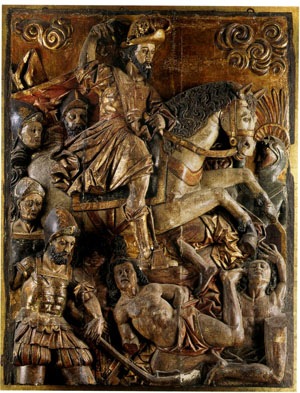
One interesting case is St. James, Spain's patron saint. He had played an important religious role in the reconquista through his portayal as James matamoros (“moor-killer”). This image came to the Americas early on – e.g. in Cortés' description of seeing St. James fighting by his side, which was taken up by later writers, including by Cortés' chaplain Gómara. This transformation of the saint into James mataindios ("indian-killer") is also evident in art from the period, as can hopefully be seen in first this church statue from Logreño, Spain and second in this Mexican retable.
But not only religious figures were invoked for the Spanish conquest. Parallels between descriptions of Christian knights in medieval Iberian romances and of Spanish conquistadors can also be drawn. Thus El Cid appears as a model for the figures of Cortés, Pizarro and other Spaniards portrayed as similiarly “heroic” conquerors.
Here we can also draw parallels with the reconquista's focus on Divine Providence or Intervention: Later (late 16th c.) Mexican Franciscan scholars like Géronimo de Mendieta and Juan de Torquemada took up especially the image of Cortés of earlier chroniclers and cast him as a “New World Moses”, who had according to them fulfilled divine plans through the conquest.
There are many other interesting cases of how early colonial soldiers and scholars drew on medieval Iberian precedents. Regarding land tenure, the notorious requerimiento had roots in similar documents used against Iberian Muslims. It essentially justified military conquest by explaining the Spanish Crown's rights over the Americas given by the Pope - all paradoxically in a language the indigenous people obviously could not understand at first.
Furthermore, for accounts of the conquest scholars like Anthony Pagden have shown that descriptions of the Spaniards' first impressions of the Aztec capital city Tenochtitlan were modelled on accounts of the Catholic Kings' conquest of Muslim Granada; and that the fictionalised speech reproduced by Cortés to show Moctezuma's “donation” of the Aztec realm to the Spanish emperor has medieval Castilian precedents.
Okay let's have a look at Tenochtitlan and its "mosques" then!
I'll continue to focus on Spanish perceptions here which I'm more familiar with than architecture. When first seeing Tenochtitlan, in the early 16th c., for the Spanish conquistadors the Aztec capital was comparable to the most important Spanish cities that they knew. Actually with its probably somewhere between 200-250.000 inhabitans, Tenochtitlan was bigger than most European cities at the time.
The accounts describe its massive market as being larger than any European one. They are impressed by Aztec ruler Moctezuma and his court. And overall impressed by the sight of a massive cities built on top of a lake (Lake Tezcoco), which included a complicated array of moats, canals and even agriculture.
The Nuremberg map from ca 1524 gives a good impression of the city - while it shows strong European artistic influences (eg with the houses' depiction), Barbara Mundy and others argue that it was partly based on Aztec maps or information.
The early reports we have, the best known being by Spaniards like Hernan Cortés himself and a later one Díaz de Castillo, show various reactions: A loss of words; comparisons to Spanish and other European cities; and (more implicitly) an equation of the conquest of Tenochtitlan with the Roman conquest of Jerusalem. At the least with the first two of these, there's a clear sense that the conquistadors did not know how describe this very different kind of city. As de Castillo puts it regarding cities and towns the Spaniards passed by:
When we saw so many cities and villages built in the water and other great towns on dry land we were amazed and said that it was like the enchantments (...) on account of the great towers and cues and buildings rising from the water, and all built of masonry. And some of our soldiers even asked whether the things that we saw were not a dream? (...) I do not know how to describe it, seeing things as we did that had never been heard of or seen before, not even dreamed about.
This impossiblity of explaining the "new" partly explains why Castillo tried but failed to compare they Valley of Mexico to European cityscapes he knew. Both he and Cortés refernced real and fictional European cities
so that the Aztec cities "seemed like an enchanted vision from the tale of Amadis" [an Iberian romance novel]. Cortés was likewise daunted by the challenge of finding a comparable city in the "old" wolrd, likening Tenochtitlan to Córdoba, Sevilla , and Salamanca all in the same few pages.
But whether the Aztec capital was deemed to be more like Venice, Seville, or the fictional Amadis, the accounts by Díaz, Cortés and the other Spaniards of what they saw and did in the Americas were inescabably framed by the concepts and language of their own culture. (Restall, Seven Myths of the Spanish Conquest, xiv-xv)
Note how Venice is taken as another comparison due to the canals. But also that large Iberian cities like Sevilla and Córdoba are referenced which are clearly tied to the Christian medieval "reconquest" of Iberia from the Muslim states. Similiarly, the romance novels like "Amadis" that serve as rhetorical models here were also tied to the Christian campains against Spanish Muslims.
So that we can see here (as in many other fields) a rhetorical linking by the conquistadors of Iberian "reconquest" and American "conquest".
Last but not least comes the linking of Tenochtitlan and Jerusalem. This serves quite s similiar purpose of legitimizing the city's conquest and (more generally speaking) the conquest itself, in spiritual terms. In Cortés' second relacion from 1522 is a note stating how
the Spaniards had taken by storm the great city of Temixtitan [Tenochtitlan], in which there had died more Indians than Jews in Jerusalem during the desctruction of that city by Vespasian and, even so, there were more people in it than in the Holy City.
This discourse was taken up by Castillo and widely used by later religious writers. In the hands of Fransciscan authors, it served the further purpose of glorifiying Cortés' campaign as supposedly "surpassing even the Romans".
I think with all these references we can note how the Spaniards followed the moment of disbelief when encountering Mesomamerican cities, with a linking back to European cities and concepts familiar to them. And for Spaniards in the 16th century, the Muslim culture of medieval and early modern Iberia had been and was a major influence on their society's development - while providing a major non-European and crucially non-Christian enemy figure to be transposed to the Americas.
But the parallels don't stop there. As with the mosques of Iberian cities like Sevilla and Córdoba, the Mexica's impressive temples in Tenochtitlan (like much of three city) were destroyed and replaced by cathedrals - as symbols of Spanish rule tied to Christian faith and conversion. Despite such destruction, Mexico-Tenochtitlan would retain a majority indigenous population and parts of its pre-Hispanic organisation throughout the colony.
In a first step, we can note the connections Spaniards drew between the Muslim and native American "others". In a second step, such rhetoric was used to justify a Spanish and Christian colonial project, which had become seriously more Spanish and Christian in 1492 with the expulsion of the Iberian Jewish population and the following forced conversion of the remaining Muslim population. That the Aztecs and other native groups would not become peaceful and Christian citizens so easily would become apparent soon enough.
Finally I should add on that note that as has been mentioned in 1519 there was still a major Muslim or crypto-Muslim population in Iberia, the moriscos, surely very much well-known to Spanish hidalgos overseas; whom I discuss more here.
Edit: map, link and paragraph
The Spanish expansion into America was perceived by Spaniards as an extension or continuation of the reconquista, which had been completed in 1492 - the same year Colombus 'discovered' the New World. Indeed, Franciso López de Gómara would recall in 1523 that ‘the conquest of the Indies began when that of the Moors was over.’ In 1492, Pope Alexander VI also bestowed the title Los Reyes Católicos (the Catholic Kings) on Ferdinand + Isabella. In 1494, the Treaty of Tordesillas effectively divided up the New World between Catholic Spain and Portugal; a Papal bull the year earlier effectively justified this bestowal as being for the purpose of conversion. That is, Spain legitimised their conquests in the Americas by claiming that it was a project for spreading christianity and bringing new souls under Catholic dominion. The area was created by God, and thus the Pope - as his ultimate representative on earth - of course had the right to grant authority over it to his chosen servant(s), who would put in the grunt work solidifying Christian control.
The reconquest of the Iberian peninsula from the Moors was justified in similar terms. The Moors were the 'other' - in culture, skin tone, and most importantly religion - to which the Spanish monarchs could craft a unified Catholic Spanish identity out of disparate areas and peoples. Any war against the infidel other was ultimately and undeniably justified as a holy one to extend Christendom.
With that in mind, it seems less surprising that Spanish explorers - often veterans of the reconquista, but if not then definitely steeped in a deep awareness of it - would immediately start comparing this new 'other' of Native Americans to the other they had been battling in a holy war for over half a millennium. Just as they took Spain (back) from the Moors for Monarch, Pope, and God, they would take this New World from its barbaric inhabitants and expand Christendom. These aims apparently did not conflict with more rapacious ones of personal gain; Weber, for example, details one soldier in Mexico who explained that Spaniards left for the New World ‘to serve God and his Majesty, to give light to those who were in the darkness and to grow rich as all men desire to do.’ Indeed, he even describes the reconquest of Iberia as the 'crucible' in which this conquistador mindset was forged.
Soldiers in the New World thus frequently attempted to describe the strange things they witnessed in comparison with their known 'other' the Moors. Hence the popularity amongst New World Spaniard soldiers - for example, Coronado - of 'Santiago Matamoros', a battle cry invoking Saint James, the killer of Moors. Accounts of Coronado's expedition also label Kivas (Pueblo Indian religious structures) as 'Mosques'; dark skinned Native Americans as 'Turks'; bows and arrows as 'Turkish bows'; Native wives as 'Moorish women'; and so on.
Understanding the mindset of these Spanish explorers makes their use of the Moor in attempting to understand (or at least rationalise) Native Americans less surprising. The Moor was their perennial 'other', the non-Christian enemy - of course these new, dark-skinned, heretic others would seem similar. The Moor was the enemy of the reconquest, and so were these new others (if they opposed Christian dominion, that is); thus, more cynically, the Spanish had a vested interest in associating Native Americans with Moors: if those back in Europe understood these new Natives as heretic Moors (a well understood other, and a known enemy) they would be less opposed to Spanish expansion into this vast New World, as it would be justified as expanding Christendom at the expense of the infidel.
In 1513, the Spanish created the requerimiento, a document that essentially commanded Native Americans to acknowledge the Church, the Pope, and the King/Queen of Spain as their rulers. It was to be read out to them, to offer them the chance of peaceful recognition and capitulation. If they then refused, the Spanish would, ‘with the help of God ... make war ... take [Native Americans] and [their] wives and [their] children and ... make slaves of them ... and shall do ... all the harm and damage that we can.’ In reading the document and offering salvation, the Spanish absolved themselves of any legal responsibility. As the document went on to explain, ‘the deaths and losses which shall accrue from this are your fault, and not that of their highnesses, or ours.’ Obviously, most if not all Native Americans could not understand European languages at this point. Soldiers also supposedly employed underhand tactics such as reading it under their breath, or while approaching a village in an armed ship. Thus, this document should be viewed as a Spanish attempt to placate their enemies in Europe, who viewed their expansion with suspicion and worry. The Spanish associations of Native Americans with Moors can potentially be viewed in the same way, as an attempt to influence domestic European opinion in favour of the conquest of vast amounts of territory.
So it boils down to two things:
First, the Spanish, in attempting to understand a new 'other', naturally used comparisons to a known and seemingly similar 'other' - the Moors.
Second, those comparisons can also be seen as a means to justify colonisation to potential opponents (such as England), by covering economic motives with religious justification. This is not to say that most Spanish did not truly believe in the religious aspect of their colonisation - the two seemingly contradictory aims were apparently melded together in a conquistador mindset crafted in the reconquest of the peninsula.
**edit** --> this need for justification was also felt by the conquistadors themselves. That is, agents of colonialism like Cortes needed to justify their acts in religious terms to avoid censure by domestic opponents of colonisation (such as Bartolomé de Las Casas) and retain the Monarch's support - as they ultimately derived authority over the lands they had conquered by being agents of the crown.
Bibliography:
Weber, David J. The Spanish Frontier in North America. New Haven: New Haven, 1992.
Gutiérrez, Ramón A. When Jesus Came, the Corn Mothers Went Away: Marriage, Sexuality, and Power in New Mexico, 1500-1846. Stanford, Calif: Stanford University Press, 1991.
Muldoon, James. ‘John Wyclif and the Rights of the Infidels: The Requerimiento Re-Examined’. The Americas 36, no. 3 (1980): 301–16.
Probably not, in so far as it is unlikely that there were Ottoman navigators who ran into the New World prior to Cortes. By Cortes' time the Ottomans were interested in expanding their empire to North Africa, particularly the Maghreb, as well as eastward into the Safavid territories in Iran, and westward into the Kingdoms of Bohemia and Hungary. When the Ottomans wanted access to the Indian Ocean trade (the same impulse that led Columbus and most of the Spanish/Portuguese exploration), they would simply take the overland route through Arabia or the Black Sea.
Chances are what is happening in your letter is that Cortes was simply describing something foreign with something well-known. While Mexico was nova terra for the Spanish by the time of his incursions, the Muslim world was not. The Spanish kings had been in a state of intermittent warfare with Muslim rulers for at least 500 years at this point. Spain had been largely Muslim throughout most of that time (though Cortes, being born in the north, might not have grown up in a town with Muslim architecture). Cortes belonged to a long tradition of Spanish "hidalgos," knights, gentlemen, nobility, etc. that were especially interested in fighting Muslims. The Spanish, like the Ottomans, were interested in conquering the independent Muslim emirates in North Africa. As a Spaniard and a hidalgo, Cortes' upbringing involved either seeing, living in, or learning about Muslim culture, art and architecture. When he saw the temples and clothing of the Aztecs, he leaned back on describing them with something he and the King of Spain knew a lot about.
There are a couple of interesting things happening here. The first is a problem that any person who encounters something completely alien goes through: incommensurability. How do you describe something foreign with vocabulary that can be understood? This was a major concern for explorers, missionaries and ethnographers of the 16th and 17th century, especially in the New World. While Europeans had some idea about "China," "India," and "Asia," they had no idea that the American continents even existed. The culture of the Aztecs and other indigenous Americans was bizarre, but in order to achieve their goals (trade, conquest, conversion, some combination thereof) they needed to be able to communicate what was over there to their patrons and sovereigns back in Europe. For Cortez and his men, their familiarity with the Muslim world was a useful way of describing the New World.
This incommensurability leads Cortes to make some interesting observations as well. One is that he is comparing the indigenous culture to an "infidel" culture by contrasting them to the "moors." The word moor has a particular meaning for the Spanish, because those are what they called the Muslims of their newly conquered Granada and North African territories. Cortes, by linking the two together, is creating an image of a people that need to be converted (as some moors did, if by force) or exterminated and enslaved. Second, in this particular passage he notes differences in status, socioeconomic or possibly in terms of nobility. In doing so, he is appending a rather "European" sense of hierarchy onto the Aztecs. As historians, these are useful notes for understanding the point of contact between Spaniards and indigenous Americans, but they also ought to be treated with some skepticism, because Cortes may be unintentionally distorting the reality of Aztec culture through his own (mis)understandings.
Some further reading:
On the Ottomans and their own imperial expansion, Giancarlo Casale's Ottoman Age of Exploration sums up the Ottoman goals pretty well.
If you have access to JSTOR or another database, J.H. Elliot's "The mental world of Hernan Cortes" explains much about his upbringing and encounter with indigenous Americans. Conversely, if you do not have access to a database, I can provide my copy.
In terms of how the Spanish dealt with incommensurability and the ethnographic and legal problems it presented as they created their New World empire, Anthony Pagden's Fall of Natural Man is still one of the classics.