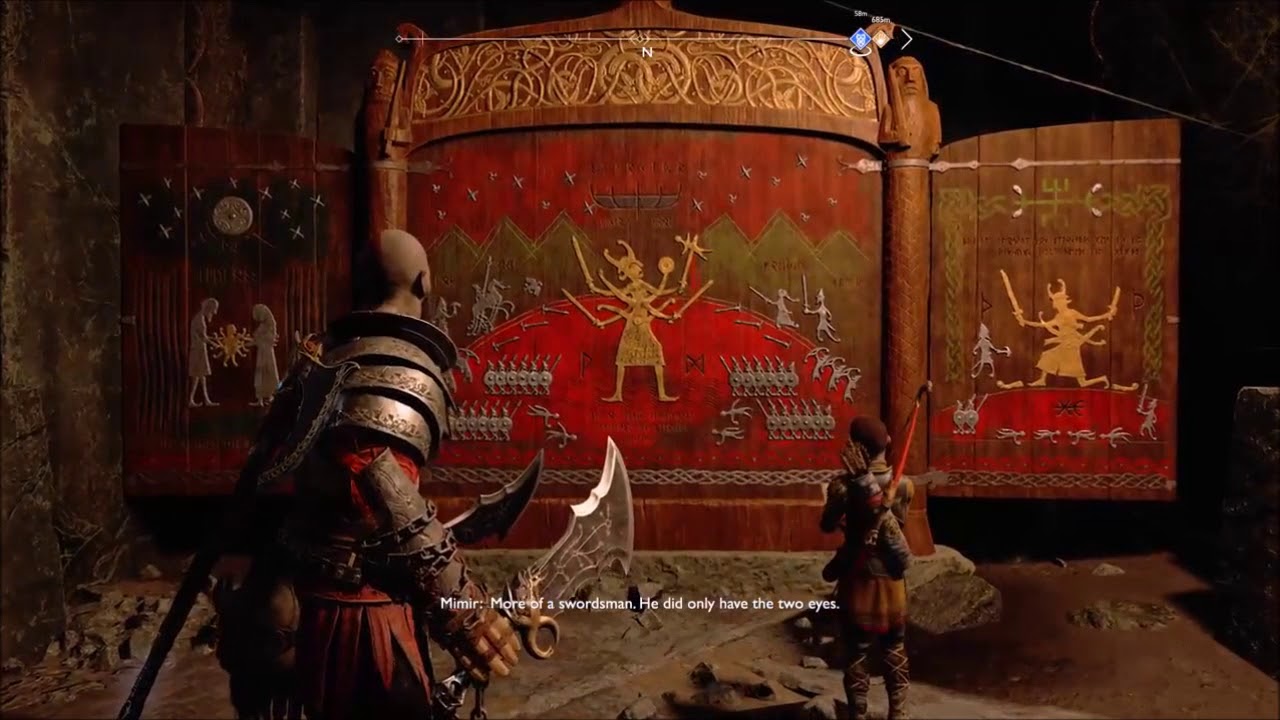
The question came to mind while I was looking at various books of religious art and noticed that Scandinavian/Viking art was sorely lacking. Every piece depicting a Norse deity or religious narrative seems to come centuries later and usually by a Christian artist or as part of some operatic illustration. This seemed weird to me since the practice of devotional art, and the creation of pagan sculptures, seems to go as far back as 20,000 years ago with the various Venus Figurines, and it is a practice that continues to this day.
Did it simply skip the Vikings?
Additionally, at the end of God of War (the PS4 reboot) we see a mural depicting various deities and the narrative of the game in an art style that seem to be based on a traditional style. Was this style Vikings and is it the style that would have been used for devotional pieces?
The objects I can think of which we think directly feature depictions of gods are rune stone carvings, idols, votive objects, carved wooden decorations and tapestries.
One obligatory caveat here is that this is a culture which doesn't have a clear separation between religion and daily life, art and craft, tool and bauble - a sacred idol, while important and awe-inspiring, is in some sense just as practical an object as a spade; everything about it is for something, not something created just for pleasure or for its own sake. So there are no purely religious objects, and no pure art objects - that's something we anachronistically ascribe to them.
The video game mural seems to be inspired by rune stone carvings, though I don't recognise the subject. Here are some examples referencing known or probable mythological figures, where you can see the resemblance:
Spectacular destruction or appropriation of cult sites and cult objects (and, in some episodes, cultists) were a prominent part of the story of the conversion of Scandinavia, which may explain the absence of the wooden idols we see referenced in the written sources. Another reason is the fact that they were mostly wooden, and gradually disappeared once they stopped being maintained or replaced. Though one stone idol from a "horg" or outdoor altar site survives at Rosseland in Norway, the site is archaeologically disturbed, hard to date and generally isn't very informative.
We do have some hints at what the idols may have looked like. A small number of small votive statuettes and a lot of tiny gold bracteats have been found: https://imgur.com/a/dlE9xej There are surviving idols or person-shaped votive or magical objects from the farm cults of the christian period, as well as Sami and other Finno-Ugric idols from modern times (meaning 1600-1800) which may have influenced or carry some influence from norse styles - but we have no sure way of definitely showing that any of these are representative of the style and practices of the viking age cult practices of the "lordly farms". Basically, there's a big blank spot waiting to be filled by a very lucky archeologist or historian.
In a similar vein, the stave church wood carvings depict scenes from the common germanic legendary heroic material - suitably reinterpreted to a christian context - and appears to be a continuation of a viking age or even earlier style of decorative craftsmanship which almost certainly would have included depictions of mythological scenes.
The high status ship burial at Oseberg contained revler - woven picture tapestries, in the same women's art tradition as the bayeux tapestry - which we're pretty sure depicts a divine trio, a religious procession and sacrifice:
Like the Bayeux tapestry, these would have decorated the long walls of a lord's hall, just as they were later used to decorate church walls and stone halls, functioning both as status object, educational device and insulation.