In my history class today my professor mentioned that there is a theory where Marco never actually traveled. This being due to his descriptions and the difficulty and tracking his itinerary.
This theory was popularised by Frances Wood's Did Marco Polo go to China? (1995), in which she argues that Rustichello da Pisa's account of Marco Polo's travels in the east were in fact based on information compiled from hearsay, folklore and the accounts of Muslim merchants, and that Polo hadn't really travelled much beyond Constantinople. This argument derives not so much from any difficulty in tracking his itrinerary as from some apparent omissions in his account which one would expect any medieval traveller to China to mention. Most notably he makes no mention of the Great Wall, of tea drinking or of footbinding, the latter two of which later 14th century travellers made frequent note of. Furthermore, he is not mentioned in Chinese records, and some aspects of his account are demonstrably based on folktales, if not outright lies (see below).
Wood's argument has, however, been generally dismissed by historians, for most of whom there's really no doubt that Marco Polo did travel through China (though that doesn't mean he travelled to everywhere he described). The 'omissions' can be explained away without much difficulty, and the lack of Chinese records simply reflect the fact that the Polo family weren't as important in China as Marco/da Pisa's account claims (see below).
Take the omission of the Great Wall, for example. While the Chinese of the Song-Yuan period might have liked to imagine that there was a single 'Great Wall' defending China, which they depicted in contemporary maps, it was in fact no more than a discontinuous series of long-negelected ruins by Marco Polo's time, and would not be transformed into the continuous and imposing wall we know today until the Ming Dynasty. With that in mind, it's omission from Polo's account is hardly surprising, and in fact it isn't mentioned by any European before the 16th cenury.
As for tea drinking and foot-binding, Polo may simply not have been exposed to these. He seems largely to have been active in Mongol circles as he moved through China, communicating through Persian and apparently having limited direct contact with the native Chinese. It's unlikely he had much, if any, contact with the kind of housebound, upper-class women whose feet would have been bound at the time (footbinding only spread to the lower classes in Ming-Qing times), nor would he have had much exposure to tea, which was not popular among the Mongols, and in any case may not have been worth mentioning in a book concerned largely with marvels and wonders.
Now that all said, there are some serious issues with Polo/da Pisa's account. In some cases, such as the story of Prester John's kingdom somewhere near Mongolia, or the description of dog-headed people in the Andamans, Polo and da Pisa were clearly inserting popular literary motifs, folk tales and mythology into their narrative. In other cases, Polo and his family were themselves being propped up as major players in the Mongol world, governing Chinese cities on behalf of the Khan or aiding in the siege of Xiangyang by teaching the Mongols how to build counterweight trebuchets. These are certainly fictions given that Chinese records make no mention of Marco or his family, and in some cases they directly refute his claims (for instance, records attribute the introduction of trebuchets at the battle of Xiangyang to Muslim engineers about a year before any of the Polos had even set foot in China).
It's impossible to say whether Marco Polo was himself a fraud, or whether Rustichello da Pisa was trying to turn him into a hero to make the narrative more interesting. What's clear is that the final product, the "Livre des Merveilles du Monde", was essentially a romantic work focused on 'marvels' and epic battles rather than a down-to-earth work of geography (in contrast to the earlier accounts of John of Plano Carpini and William of Rubruck). It was meant to entertain as much as inform. Yet it does often show restraint in its treatment of marvels, distinguishing between what Polo saw himself and what he heard from others, and at times even striving to dispel certain popular myths (such as that of the unicorn, which is explained to be the rhinocerous).
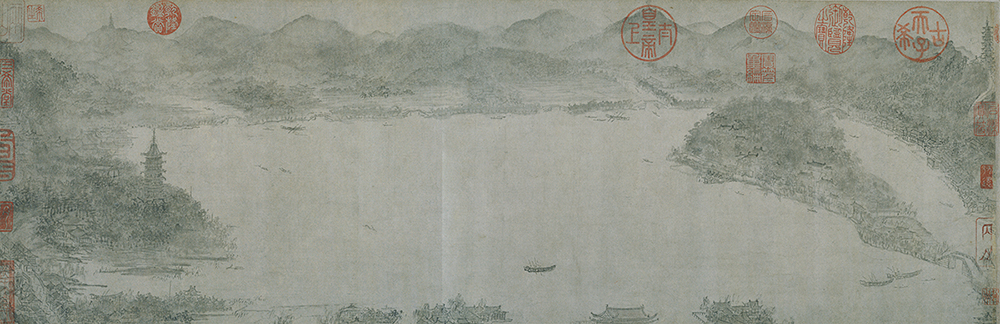
What really puts beyond doubt that Marco Polo did visit China is how he often gives detailed and accurate descriptions of specific places or customs that could hardly be anything but eyewitness accounts. Take for example his description of Hangzhou (Kinsay), in which he describes the famous West Lake with its pleasure boats:
Inside the city there is a Lake which has a compass of some 30 miles: and all round it are erected beautiful palaces and mansions, of the richest and most exquisite structure that you can imagine, belonging to the nobles of the city. There are also on its shores many abbeys and churches of the Idolaters. In the middle of the Lake are two Islands, on each of which stands a rich, beautiful and spacious edifice, furnished in such style as to seem fit for the palace of an Emperor.
On the Lake of which we have spoken there are numbers of boats and barges of all sizes for parties of pleasure. These will hold 10, 15, 20, or more persons, and are from 15 to 20 paces in length, with flat bottoms and ample breadth of beam, so that they always keep their trim. Any one who desires to go a-pleasuring with the women, or with a party of his own sex, hires one of these barges, which are always to be found completely furnished with tables and chairs and all the other apparatus for a feast. The roof forms a level deck, on which the crew stand, and pole the boat along whithersoever may be desired, for the Lake is not more than 2 paces in depth.
Compare these descriptions with some early 13th and 14th century paintings of the same lake. Notice how the the boats and their crews match Polo's description.
Even some of the stranger aspects of his account seem to have a basis in truth. For instance, he describes a Yunnanese custom, brought to an end by the Mongols, in which wealthy travellers would be invited to rest in local houses, only to be murdered so that "in this way the goodly favour and wisdom and repute of the murdered man would cleave to the house where he was slain". At first this sounds like something made up by the Mongols to justify their rule, and it probably was partly twisted by Polo's informers, but it does in fact reflect a practice of 'construction sacrifice' once widely attested across Southeast Asia/Yunnan, in which a person (usually in infant) would be sacrificed so that their spirit could act as a household guardian, just as Polo describes. It's hard to imagine Polo learning of this obscure custom in Constantinople.
All in all, whatever exaggerations, tall tales or outright lies were inserted into the narrative, there's more than enough genuine information in the account to confirm beyond any reasonable doubt that Marco Polo did in fact travel the Silk Road to China, and return by way of the Indian Ocean.
Main sources:
The Travels of Marco Polo, trans. Henry Yule.
Peter Jackson (1998), 'Marco Polo and His 'Travels'', Bulletin of the School of Oriental and African Studies, Vol. 61, No. 1, pp. 82-101.
D. O. Morgan (1996), 'Marco Polo in China - or not', Journal of the Royal Asiatic Society, Vol. 6, No. 2, pp. 221-225.