We rarely talk much here about women in the ancient world, so I want to look at a particular ambiguous category of women in the ancient Near East, during the first Babylonian dynasty (1830-1530 BCE) – "second wives" (in the context of plural marriage, not widowers remarrying)
This is a difficult term to use, as it implies a greater amount of choice and consent than would have necessarily been available to these women, who in many cases were barely better off than an enslaved one. In some cases, second wives started out as slaves who were then freed and “promoted” with a marriage contract; in others, they were poorer young women (potentially those who’d been previously married) who were adopted by a family and then married to a man who was already married to a woman of or close to his own social status. A third option was for the second wife to be the sister of the first, perhaps particularly if the first were unable to have children – this might actually be the basis for the tradition of those brief pre-wedding adoptions. (In yet another situation, if a first wife were a celibate holy woman, she could either provide her husband with an enslaved woman to bear children for her or allow him to take a second wife.)
In any case, her lesser status would typically be enshrined in the contract, making the woman a wife to the man but still a slave to his first wife, with the potential to be sold eventually if she was displeasing to her mistress. She was expected to pretend the first wife’s likes and dislikes were hers as well, and perform basic tasks for the first wife, like washing her feet and carrying a chair for her. Laws and proverbs of the period reflect the situation by talking about the need for a second wife to obey the first, or the social chaos that ensued when a second wife acted as the mistress of the house.
While it’s worthwhile to have a separate term for this type of relationship, you can’t help but think of how precarious the position of these women was – while they had to be legally free in order to be married, they were effectively sex slaves meant to produce children, with household duties. Said children, incidentally, would be considered the children of the higher-status first wife rather than their actual biological mother.
I suspect this all sounds very familiar to people with Hulu …
Further reading:
Marten Stol, Women in the Ancient Near East (De Gruyter, 2012)
(1/2)
The Old Women speak: magic and ritual in the Hittite world
Note: This is an offshoot of a much longer overview of Hittite religion that I'll be posting eventually.
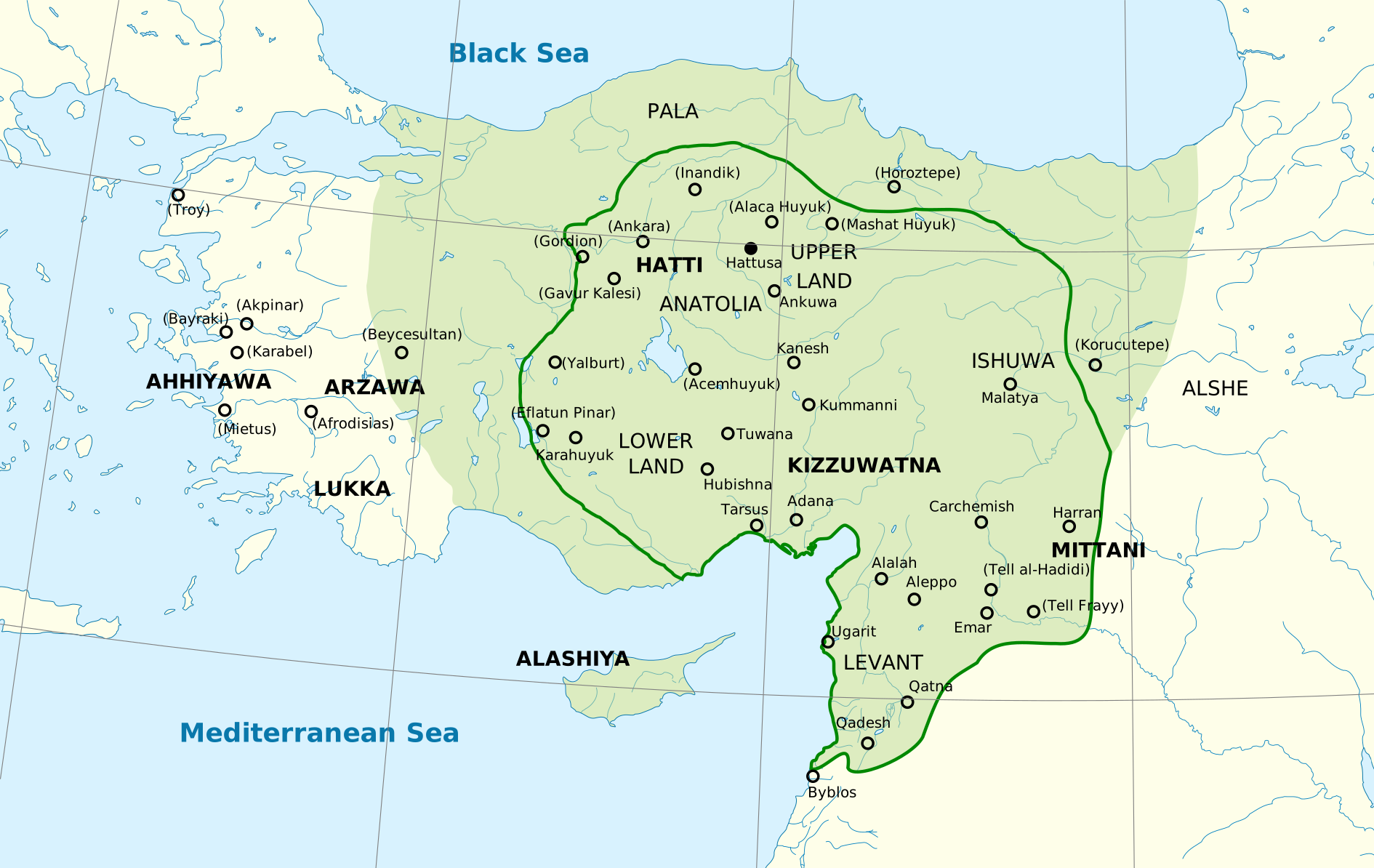
The Hittite empire was a multiethnic state based in what is now central Turkey. At its height in the 13th century BCE, the empire controlled most of Turkey as well as northern Syria.
Hittite religion was an amalgamation of not only Anatolian/Indo-European elements (Hittite, Luwian, and Palaic), but also Hattic (indigenous Anatolian), Hurrian (northern Mesopotamian), and Mesopotamian (Babylonian and Assyrian) religious beliefs and practices. Due to the nature of the surviving evidence, overviews of Hittite religion must necessarily focus on the state cult - that is, the formal religious ceremonies which frequently took place in palaces, temples, and rural sanctuaries. These ceremonies often required the participation of one or more members of the royal family in addition to priests, musicians, dancers, and other cultic personnel. Today I'm going to focus on one particular set of participants in Hittite rituals, the so-called "Old Women" (perhaps better translated as "ritual practitioners").
The Hittite term for the Old Woman was ḫašawaš, the genitival form of the substantivized ḫašauwar, "birth," suggesting that midwifery was their chief area of expertise. The Old Women were concerned with much more than childbirth, however, and were extremely versatile ritual practitioners, able to purify a house, cure depression, or appease an angry deity. The association between midwives and magic is known from many cultures and time periods. In ancient Greece, for example, midwives used both drugs (pharmaka) and spells (epôidai) to relieve the pains of childbirth.
Although most of the Hittite rituals from the cuneiform archives of Ḫattuša (the Hittite capital) are anonymous, a few dozen rituals are associated with an author. These rituals provide the name of the ritual practitioner, his or her religious office, and occasionally his or her town of origin. An example:
Maštigga, the woman of Kizzuwatna, [says] thusly: "When a man and a son, or a man and his wife, or a brother and his sister quarrel, I treat them as follows..."
Of these rituals with purported authors, thirty-six are attributed to an "Old Woman" (Sumerian MUNUS ŠU.GI), and we know the names of a little over a dozen Old Women. These rituals address a wide range of topics, including sorcery, sexual impotence, domestic disputes, uncleanliness, communication with the dead, purification after a death, childbirth, and entreaties to disgruntled deities. Most rituals derived their power either though summoning and bargaining with the gods (for which we use the Latin phrase do ut des) or through sympathetic magic.
Hittite gods were addressed directly through prayers or rituals. First, the gods were summoned through an offering of food and drink. Frequently the god was invited to come along a path marked by colored thread or flour and scented with wine or oil. In the ritual embedded within the myth of the disappearing grain god Telepinu, for example, the speaker sprinkles the path of Telepinu with fine oil and urges the god to go along that path.
Here lies an oil plant. Let it anoint the heart of Telepinu. Just as malt and beer bread are united in a soul, so Telepinu, let the words of the people be united with your soul likewise. As emmer is pure, let Telepinu and his soul be pure likewise. As honey is sweet, as butter is mild, let the soul of Telepinu become sweet likewise.
I have summoned the paths of Telepinu with fine oil. Go, Telepinu, on paths sprinkled with fine oil.
After the gods had been summoned, the ritual practitioner requested that they benefit the ritual client or refrain from harmful action against him. In a ritual attributed to Kuwatalla, the Old Woman asks the gods to intercede on behalf of her client.
The Old Woman takes two figurines of dough afterwards and holds them facing the Sun God. She then libates and speaks thusly: "O lord Tiwad, give him over...the man who imposed feudal service upon [my client]! If he, the lord of curse and oath, is alive, may the Sun God above hand him over! If he is dead, may the Sun God of Earth hand him over!"
Kuwatalla’s ritual client, an anonymous man who viewed himself as the victim of unjust conscripted service, sought recompense through divine means. Kuwatalla’s libation appeases the Sun God of Heaven and the Sun God of Earth, who are afterwards more inclined to act on her client’s behalf.
The use of sympathetic magic was more common in Hittite rituals. Sympathetic magic creates an analogous relationship between a spoken incantation, figure, or image and a ritual subject, typically a person or an issue such as evil or sickness. By manipulating the image, a ritual practitioner can affect the subject represented by that image. In a ritual by the Old Woman Puriyanni, an analogy is drawn between water and salt and evil in order to purify a household.
The water which is poured into large clay bowl and the salt which is poured into it, she sprinkles it in the house and upon the ritual client and speaks thusly: "Water is taken (lit. led) from the river, and salt is furnished by the high rock face. Subsequently water does not go [back] into the river, and subsequently salt does not go [back] into the high rock face. [Likewise] may the evil, spells, sickness, and impurity not come back into this house! As water is pure, let them be pure: this house, the household gods, the client’s body, the floor, the pediment, the fireplace, and the threshold. May they be pure!"
By creating a link between the water and salt and the evil which is within the house, the Old Woman is able to cleanse the household of its impurity. The water and salt she is sprinkling on her client and his house cannot go back to their sources, she announces, and neither can evil return to the client’s house. The ritual indicates the private nature of these rituals; it is an ordinary individual’s house that is being purified, not a temple, palace, or other elite structure.
Purification was the most common ritual performed by the Old Women, and a client could be cleansed through ritual bathing or being sprinkled with water, which was often drawn from springs or rivers with cultic connections. Wine, ointments, or other purifying agents could also be applied to a ritual client, and a white robe was provided at the end of the treatment to symbolize the new purity.
A more aggressive form of sympathetic magic was utilized in the dupaduparša ritual attributed to the Old Woman Šilalluḫi and the previously mentioned Kuwatalli. Through an analogizing incantation, the Old Woman creates a magical relationship between reed baskets and anyone inclined to commit evil acts against her client.
The Old Woman holds two reed baskets from behind while the ritual client, facing her, takes hold of them with his hands. They twist them and break them. The Old Woman speaks thusly: "Who carries out evil against the ritual client, may the gods break him as a reed! Let them strike his testicles! Let them put him under [the ritual client’s] feet." [Afterwards] the Old Woman puts the reeds under the feet of the ritual client.
The rituals contained within the Hittite archives are examples of magic that fall within the parameters of acceptable religious practices. The Hittite law code indicates that certain other magical acts were black magic and hence taboo. Through sympathetic black magic, for example, a Hittite could kill his opponent by creating a magical relationship between a snake and his opponent. Law 170 reports that "If a free man kills a snake and speaks another’s name, he shall pay one mina [of silver]. If he is a slave, he shall be put to death." Law 44B emphasizes the importance of the proper disposal of ritual waste, stating that "If anyone performs a purification ritual on a person, (s)he shall dispose of the remnants in the incineration dumps. If (s)he disposes of them in someone’s house, it is sorcery (and) a case for the king."
The Old Women were such revered figures that even the royal couple called upon their services. In the “ritual of the ox,” an Old Woman carries out a ritual to protect the royal couple from slander.
[The Old Woman holds up a piglet.] Then the Old Woman calls him out by name, the one whom she is treating. "Let him go infiltrate my house, and let it, the piglet of Panunta be joined to him...it roots the meadow, and it turns up plants. It roots the mountain, and it turns up water. Let it root [evils] out of his twelve body parts! ...Let it remove the short years! Likewise the anger of the gods and the slander of the community! Likewise the slander of the palace servant! Likewise the slander of the palace woman! Likewise the slander of the royal bodyguard! Likewise the slander of the SANGA priest! Likewise the slander of the priest! Likewise the slander of the priestess!"
Through a scapegoat ritual, an Old Woman could transfer contamination from a client to an animal such as a goat or, on the pars pro toto principle, discarded body products such as trimmed hair or nail clippings. Rituals of passage used two halves of an animal or a gate of branches to remove contamination. The myth of Telepinu contains the divine counterpart of the Old Women, Kamrušepa, who is frequently invoked in the rituals of the Old Women. In the myth, the goddess addresses the hawthorn tree.
(As) the sheep goes under you, you pluck its fleece. Pluck the anger, wrath, sin, and fury from Telepinu too.
Substitution rituals, particularly those known as the “removal from the earth” (taknaz da-) could be carried out by an Old Woman after unfavorable oracles or omens. These rituals rescued a client from the threat of death through a substitute object, figurine, or animal.
This post is going to be a little strange because most of the replies to this thread will be about things that happened before 626 BC. I want to talk about something that didn't happen.
Traditional scholarship will tell you that the period around 700 BC saw a total transformation of the Greek way of war, with massive implications for the socio-economic and political development of the Greek states. This was the period of the so-called "hoplite revolution". This revolution was triggered by the invention of a new kind of shield: the concave, double-grip, bronze-rimmed aspis which became the iconic weapon of ancient Greek warriors. The shield was heavy and cumbersome and didn't protect individuals very well, but when large masses of men carried them, they could join up to form an impenetrable formation: the phalanx. This formation was so superior to the earlier forms of ill-organised mass infantry fighting that all Greek states had to adopt it or perish. Within a generation or two, all the Greek city-states had switched over. But this would have serious consequences for the narrow aristocratic elites that ruled their communities. Unlike the earlier warring method, which had allowed room for heavily armoured elite champions to take the glory, the new hoplite equipment and tactics required numbers and close cooperation between equals. This made the phalanx a crucible for a new egalitarian ideology, which resulted in pressure for political reform from the new 'hoplite class' and, ultimately, to Greek democracy.
Sounds great, right? Didn't happen though.
It's good practice to be suspicious of grand theories that seem a little too neat. If a particular explanation makes it look like one single thing was so directly the cause of a whole host of sweeping changes that it appears like a natural and inevitable process, it's most likely that things didn't actually happen that way. Human societies are complex and take many forms. Can a shield really change their entire culture and political system so dramatically?
As it happens, there is also not a shred of evidence to support the 'hoplite revolution' theory. Admittedly, the Archaic period (c. 750-500 BC) of Greek history didn't leave much source material for us to study, and any theory is going to be generalising from a handful of sources. But this grand theory in particular is cobbled together from the tendentious interpretation of scraps of evidence that really have no explicit relationship to each other. Besides, there's often plenty of material that goes against the general picture. If the hoplite shield was so absolutely superior, why do other forms of shield remain in use until centuries after its introduction (and why do heavily armoured warriors continue to use javelins and bows as well as thrusting spears)? Indeed, if the hoplite was such a game-changer, why does the word 'hoplite' take more than 200 years to appear in the sources? If the few vases from mid-seventh century BC Corinth showing lines of heavily armed warriors are evidence that the phalanx had attained its full form (which, for the record, they are not), does the complete absence of such images on vases from the ensuing 150 years mean that phalanx tactics were abandoned? There are hundreds of vase paintings of hoplites engaged in individual duels from this period - maybe their shield was quite useful in that context too...
The source base for the supposed political implications of this supposed revolution is equally weak. What little we hear of political revolutions in this early period never makes reference to hoplites as a social and political force. In fact most of these events clearly weren't mass movements but elite initiatives, with one small faction of friends and their entourage trying to seize power from another. The first major political reforms of which we know some details - the reforms of Solon at Athens, more than 100 years after the introduction of the hoplite shield - didn't do much to democratise the state, but rather redefined the rights and privileges of the wealthy elite. Meanwhile, other states never made any move toward democracy despite the fame of their hoplites; states went from tyranny to oligarchy and back again, or never got rid of internal tensions pushing toward and away from a broader political franchise. There were apparently huge regional differences in political development, so how could we argue that one particular trajectory is somehow inevitable due to the nature of a piece of weaponry?
There's a lot more to say against the technological determinism, the teleology, the unfounded generalisation, and the blind glorification of Greek culture that is inherent in the notion of a 'hoplite revolution'. But the main thing is that it never happened. Mainland Greece in 700 BC had only just recovered from the demographic decline that had set in at the end of the Bronze Age; it was starting to reassert its presence on the land and to settle overseas. It would be over a century before large hoplite armies took the field and even longer before the world saw either a phalanx or a democratic system of government.
Tonogenesis in Chinese
First, a little background on, well, my background: I'm a working linguist, although I specialize in second-language acquisition (not historical ling, which this will be about). I have only a basic scholarly familiarity with modern Mandarin Chinese/普通话 although I hope to develop more fluency some day. I became interested in the question of how and when tones came about in Mandarin when I took a seminar on historical linguistics, which is a subfield of study looking at how languages change over time and why. Unsurprisingly, it was a pretty complex equation, which I found easiest to break down by "what, where, and who" before tackling the "how."
Without further ado...
WHAT
Modern Mandarin with its four tones (plus a fifth neutral tone) is a prestige version of the Beijing dialect, synthesized into a verbal and written standard by the ruling class during the early 20th century. Several shifts occurred prior to the establishment of the modern standardization, separated diachronically into four rough chunks. These include 1) Pre-Archaic Chinese (or proto-Archaic), 14th C. BCE – 11th C. BCE; 2) Archaic Chinese, from 10th C. BCE – 3 C. BCE; Middle Chinese, with three spans from 2nd C. BCE – 10th C. CE, and contemporary varieties thereafter. When exactly tonogenesis occurred during these periods, and how each individual tone emerged, has been the subject of ongoing debate among Sino-Tibetan linguists.
WHERE
“Chinese” itself is an umbrella term for a language sub-family in which the line drawn between a dialect and a distinct language sometimes has more to do with politics than practical reality. Dialects are not always mutually intelligible when multiple cultures have been woven together, sometimes forcibly, under one cultural banner. Even in established dialects, differences exist which can muddy both synchronic (contemporary to an era) and diachronic (over time) analysis: “We can make meaningful generalizations about not only individual dialects, but about dialect groups...for instance, the southern dialects typically have larger inventories than the Mandarin group” (Chen, 2000). Oral language has also been influenced by trade and military pressures during China’s long history, as well as human migration patterns due to phenomena like famine and disease. In addition, China has a vast and diverse geography. Whereas the northern plains are more open, leading to more widespread linguistic hegemony, the waterways and mountain ranges to the south created pockets similar to the isolation of Basque from the Romance family: “Only limited attempts at applying the comparative method to the pronunciation of earlier stages of Chinese have so far been made: were a systematic reconstructive effort to be mounted on the basis of the diversity found in modern Chinese dialects, it would probably not lead to stages of the language nearly as old as the earliest texts and inscriptions: due to widespread language leveling in the North, most of the linguistic diversity is now found in southeast China, an area not settled by Chinese speakers before (and often much later than) the second century BCE” (Sagart, 1998). As a further distinction between labels, Coblin (2000) notes that what most historical linguists call “Old Mandarin” dates to the period directly after Middle Chinese, and is primarily concentrated in the northern areas mentioned. This is not to be confused with Old Chinese (Archaic Chinese), which preceded the three stages of Middle Chinese.
WHO
One of the critical elements allowing analysis of the language, considering the length of its history, is the division between spoken and written language in China. Writing was considered the province of scholars and the elite ruling class, with scribes dedicating their lives to preserving the practice. While oral language has been in flux as long as it has been in operation, the logographic writing system (with both lexical and phonetic content) has remained fairly consistent for such a long span. This allows scholars of Chinese to trace its progression over both space and time, whereas oral language was subject to the pressures of change examined previously. However, this process is not so simple as it might be if one was analyzing a written language with more explicit correspondences between its alphabet and pronunciation markers. Much of the direct phonological/phonetic reconstruction performed on Middle Chinese has been derived from poetry and rhyming dictionaries to locate tonality, as tone was not directly marked on characters/graphemes. In other words, if you found a word that was written the same way but was being framed in the context of rhyming poetry, you could determine through context that it took a different tone and was therefore a different word altogether.
Another factor which facilitates reconstruction has been the availability of historical texts and other inscribed items, such as bone oracles, referencing aspects of Chinese phonology. Baxter (1992) notes that some of these items lend themselves better to analysis than others. Poetry from Old Chinese is more salient for reconstruction than the more obscure oracles which date further back to Archaic Chinese, as these latter items do not have as much data, both in terms of overall corpus and specifically phonological content. Sagart (2006) notes that Old Chinese has a particularly unique situation in its historical corpus of poetry: rhyming sequences which correspond with regularity to character pronunciation. Even so, we do not find reliable synchronic linguistic analysis from native speakers until scholars during the Middle Chinese era generated a significant amount of phonological notation for Old Chinese. Accordingly, Baxter states that this is the likely limit of sources available for reconstruction of earlier forms. The earliest known foreign grammar was generated by a 14th century Korean scholar who provided descriptions of phonological features but did not reference any kind of “history or geography of the sound system recorded,” so there is no earlier material from outside quarters, either. Coblin notes that there was a significant gap of a century and a half between this analysis and the arrival of European missionaries, who also attempted to learn and chronicle the prestige variant of the local language in some extensive, if romanized, detail. Again, this paints a synchronic portrait of Mandarin as it existed at that time, but does not directly reveal the origins of tonogenesis. What reconstruction scholars are left to work with then is something akin to a mystery novel: several “snapshots” of the crime scene rhyme scene as it unfolded, and the subsequent results.
Part 2 a' incomin...
Ancient Medicine
Medicine has been a part of human culture by virtue of the ubiquity of disease and injury. I will very quickly summarize some of the more relevant aspects of medicine in a wide variety of ancient cultures. Feel free to inquire about specifics If you feel like it.
Egyptian medicine: The Kahun Gynecology papyrus has been dated to around 1825 BC (1). It describes methods to diagnose pregnancy, various gynecological diseases and their treatments. Other relevant papiry are the Edwin Smith and Ebers Papyrus. The first one describes surgical procedures being done as early as 2750 BC (2) the Ebers papyrus includes incantations and herbal remedies for a variety of diseases (3).
Babylonian medicine: The first description of migraine comes from medical texts from 2000 BC (4). Mesopotamian cultures used herbs, minerals and animals as the basis of treatments.(5)
Indian medicine: Aryuvedic medicine date to around 6000 BC (6). It Diseases were attributed to magic forces and the treatment consisted of rituals and prayers. However Aryuvedic medicine also includes diet, herbal and mineral remedies, yoga and meditation as well as masagge therapy(7). Evidence of dentistry including drilling of teeth as early as 6000 BC has been linked to Indus Valley civilizations (8)
Chinese medicine: The belief that mind, body and spirit affect heakth can be traced to 3000 BC (9). Acuppuncture has been recorded as early as 1000 BC (10).
Welcome to Volume I of 'The Story of Humankind', our current series of Floating Features and Flair drive!
#Volume I spans the first great epoch of humanity, from the earliest reaches of our history to 626 BCE, and we welcome everyone to share history that related to that period, whatever else it might be about. Share stories, whether happy, sad, funny, moving; Share something interesting or profound that you just read; Share what you are currently working on in your research. It is all welcome!
Floating Features are intended to allow users to contribute their own original work. If you are interested in reading recommendations, please consult our booklist, or else limit them to follow-up questions to posted content. Similarly, please do not post top-level questions. This is not an AMA with panelists standing by to respond. Such questions ought to be submitted as normal questions in the subreddit.
As is the case with previous Floating Features, there is relaxed moderation here to allow more scope for speculation and general chat than there would be in a usual thread! But with that in mind, we of course expect that anyone who wishes to contribute will do so politely and in good faith.
Please be sure to mark your calendars for the full series, which you can find listed here. Next up is Volume II on December 1st, spanning 776 BCE to 202 BCE. Be sure to add it to your calendar as you don't want to miss it!
If you have any questions about our Floating Features or the Flair Drive, please keep them as responses to this comment.