The second part of your answer is much easier to answer than the first: No, there is not a historical basis for this. Raiders and warrior of all statuses, even berserkir, wore clothing and armor. If you've read Beowulf, recall how big of a deal it is that Beowulf decides that he shall meet Grendel with no armor or weapons. This description is accompanied by a boast about it.
ðá hé him of dyde ísernbyrnan
helm of hafelan sealde his hyrsted sweord
írena cyst ombihtþegne
ond gehealdan hét hildegeatwe
"Then he took off his iron-hauberk from himself
the helm from his head, and gave his decorated sword
choicest of iron, to his retainer
and ordered him to care for the battle-gear."
There's a good reason why this is framed as a remarkable boast; it is so unusual as to be unthinkable! This is not what warriors did when going into battle. Old English poems such as The Battle of Maldon, which describe Viking raiders, make no mention of them being unarmored, as well. So, it's safe to say this is not a historical reality.
That being said, identifying where this idea came from is actually very difficult. Not very much has been published on the phenomenon. Still, I can offer a few points on its development.
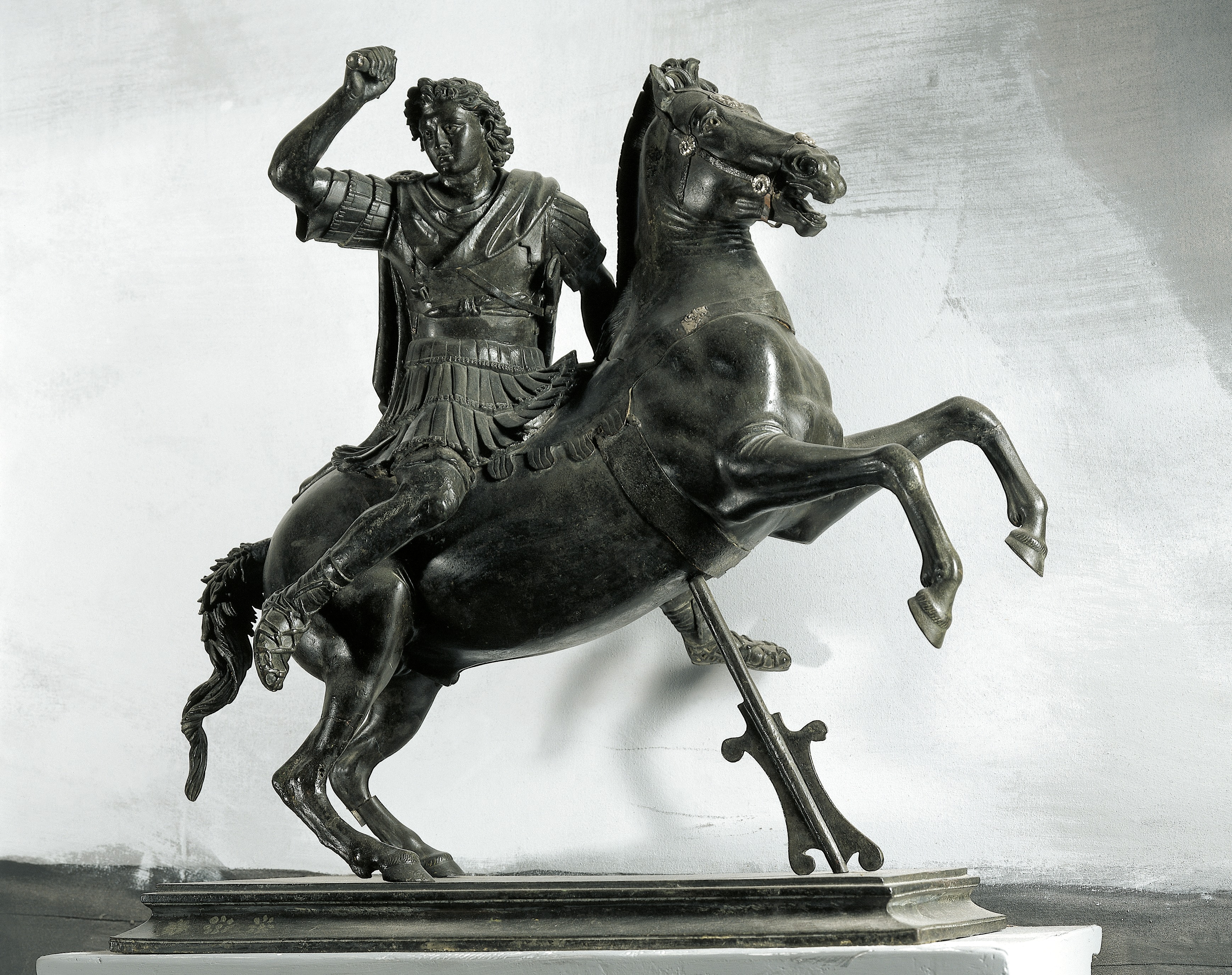
The first hints towards this stereotype are already seen in 1876, with Carl Emil Doepler's costume design sketches for the premiere of Wagner's Der Ring des Nibelungen. The sketches clearly draw on Classical roots, mimicking Greek armor so that Siegfried looks an awful lot like Alexander the Great. However, because they're German, and too much of a "noble savage" for things like "leather" and "bronze", Siegfried is wearing fur! Fasolt anticipates later developments even more strongly. His furs are haphazardly wrapped around him, basically guaranteeing his pectoral muscles will freeze to death.
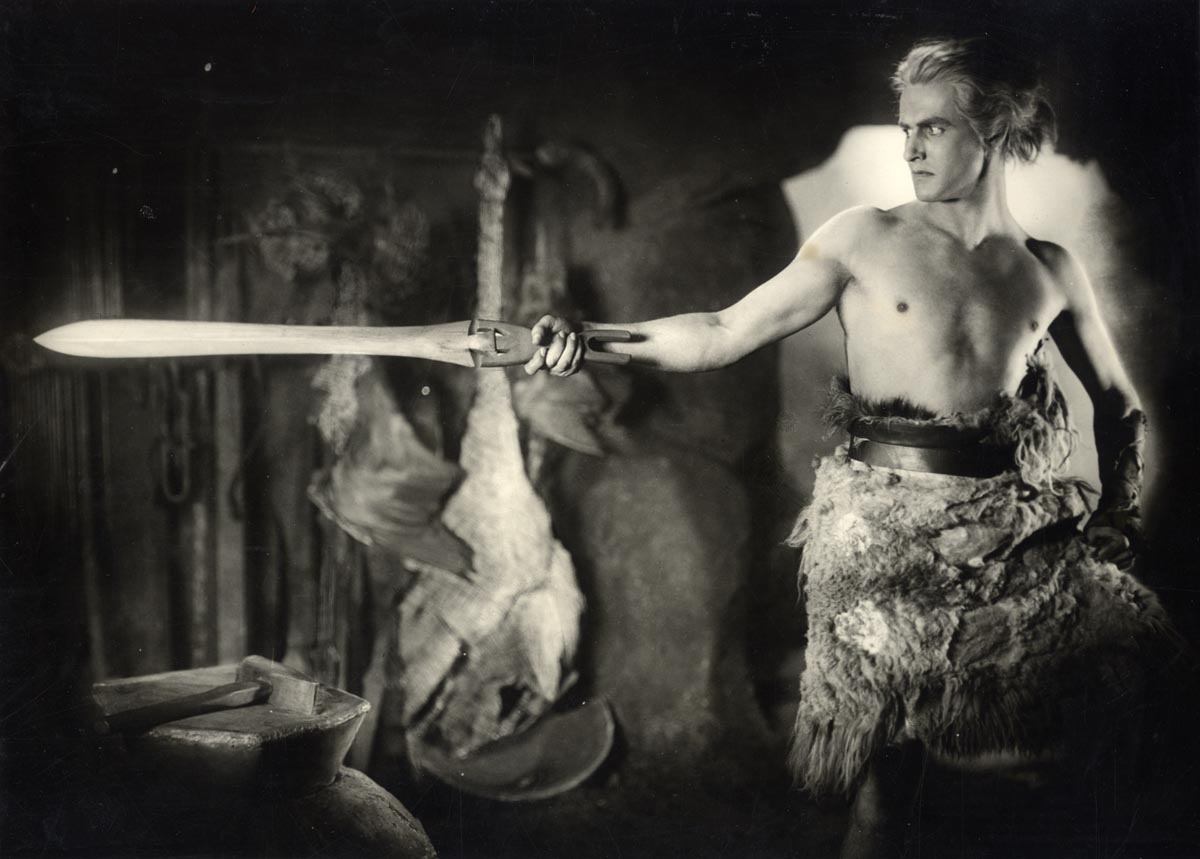
The next big development along this path also comes from adaptations of the Nibelungenlied. In 1924, German director Fritz Lang created a film adaptation of the epic poem: Die Niebelungen. Siegfried appears to have forgotten that he's not invulnerable (yet); he entirely fails to wear a shirt for the entire movie, including the fight with Fafnir. Now, in the medieval poem, Siegfried bathed in Fafnir's blood once the dragon was slain, and in a reference to the Iliad, becomes completely invulnerable until slain by dishonorable means. But, if any hero surpasses Beowulf's stature, it's Siegfried, so this again is a literary invention.
Marvel Comics here deserves a shoutout, too. The second comic ever containing the superhero version of Thor shows him like this; he's technically wearing clothes, but not by much, and his muscles are huge. Jon Karl Helgason has written on Marvel's Thor as a reflection of American ideals of masculinity in the 1960s, so I'll refer you to his book Echoes of Valhalla on that front.
Another significant development towards the modern stereotype comes from pulp fiction, specifically the Conan stories. Robert Howard created the character in 1932, and his world is meant to be an early version of Eurasia, kind of like Atlantean myths. His world has both Asgard and Vanaheim, therefore drawing explicit connection to Norse myth and therefore, the Vikings. While early illustrations are a little more modest, the 1982 film really leans into the "shirtless barbarian". Schwarzenegger, of course, was a professional bodybuilder and basically the idol of American ultramasculinity. He was an object of admiration and some fear, and that same secret admiration gets passed along this chain to the Vikings (see, for instance, the praise for the subject of the meme "Technoviking")
After that, I think it's pretty well set that the "northern barbarian" (i.e. the Vikings) gain the suicidal fashion sense as a cultural marker, alongside red beards and horned helmets. Obviously, this was not immediate or universal - the 1984 1993 videogame The Lost Vikings does not have them shirtless, though horned helmets make an appearance. However, I think this shows the most significant influences that went into the origin of the trope.
EDIT: Frank Frazetta did a series of paintings for Conan stories, and this one says a lot about Conan's influence of the "style" of Vikings in popular imagination.