The other day I was brooding about a fantasy serial i recently watched, arguing with myself that in an ill attempt to be "woke" they cast what would look more a New York average crowd than a north European Middle Age setting. The reason behind my lament was that regions and states should have been rather homogeneous since isolation should have brought to quasi-incest in hamlets and villages rather than marrying "outside" and inter ethnic promiscuity, thus fixing what we now could call types (which is how we could be able to recognize a German from a Spanish at a first glance and that would have worked fine until WWII).
But then I got myself thinking: was it really the case? At the verge of the Western Roman collapse, Rome itself should have been a hub of people from all over the Known World, thus including Abissinians and Numidians, and Levantine people, and lots of those "barbarian" people that were accepted as foederates and that maneuvered the last emperors as puppets. And we have people from Scandinavia and people from the Iranian regions, and they invade pretty much everywhere in the Western Roman Empire. So to speak, we have waves of both very fair hair/skinned AND very brown hair/skin tribes spreading everywhere in places where maybe there wasn't much homogeneity to begin with (because of slavery and commerce)..? I mean if i think to a "spaniard" type the first thing that comes to mind is not your typical Vandal or Visigoth...
Is this the case? Was the high Middle Ages in Western Europe a melting pot of faces and races that somehow normalized and got fixed maybe only much later? Or were they homogeneous like I expected them to be in my fantasy serial?
So first things first, I will direct you to this excellent answer by u/sunagainstgold that discusses European ideas of categories of people, and specifically color.
Now I'd like to address some more general points in the OP:
"regions and states should have been rather homogeneous since isolation should have brought to quasi-incest in hamlets and villages rather than marrying "outside" and inter ethnic promiscuity"
First, I think the term that might be better is "endogamy", or marrying within a particular group. It's worth noting that endogamy does not mean that everyone in a particular place is related or married to each other - you can have very many endogamous groups living together.
A second point is that frankly I would recommend discarding two preconceptions. The first is an idea of ethnicity - the idea that there are coherent national/ethnic groups that have a distinct ethnogenesis and more-or-less remain intact from that period to the present day is basically a construct of 19th century romantic nationalism. Even in the cases of such peoples as the "barbarian" invaders of Rome, like the Vandals, Goths, or Franks, the idea that these people were all from one common origin (let alone looked similar) is mostly discarded - modern historians will note that they, like many similar peoples before and after, (Central Asian Kazakhs and Turkmens specifically come to my mind) more likely were disparate groups that came together over time and ultimately invented shared stories of a common origin, assuming that they actually bothered to make such claims at all.
The second idea to discard is that not only do such distinct and coherent groups exist, but that they have some sort of identifiable physical characteristics is also something from the same period, and is closer to pseudoscience.
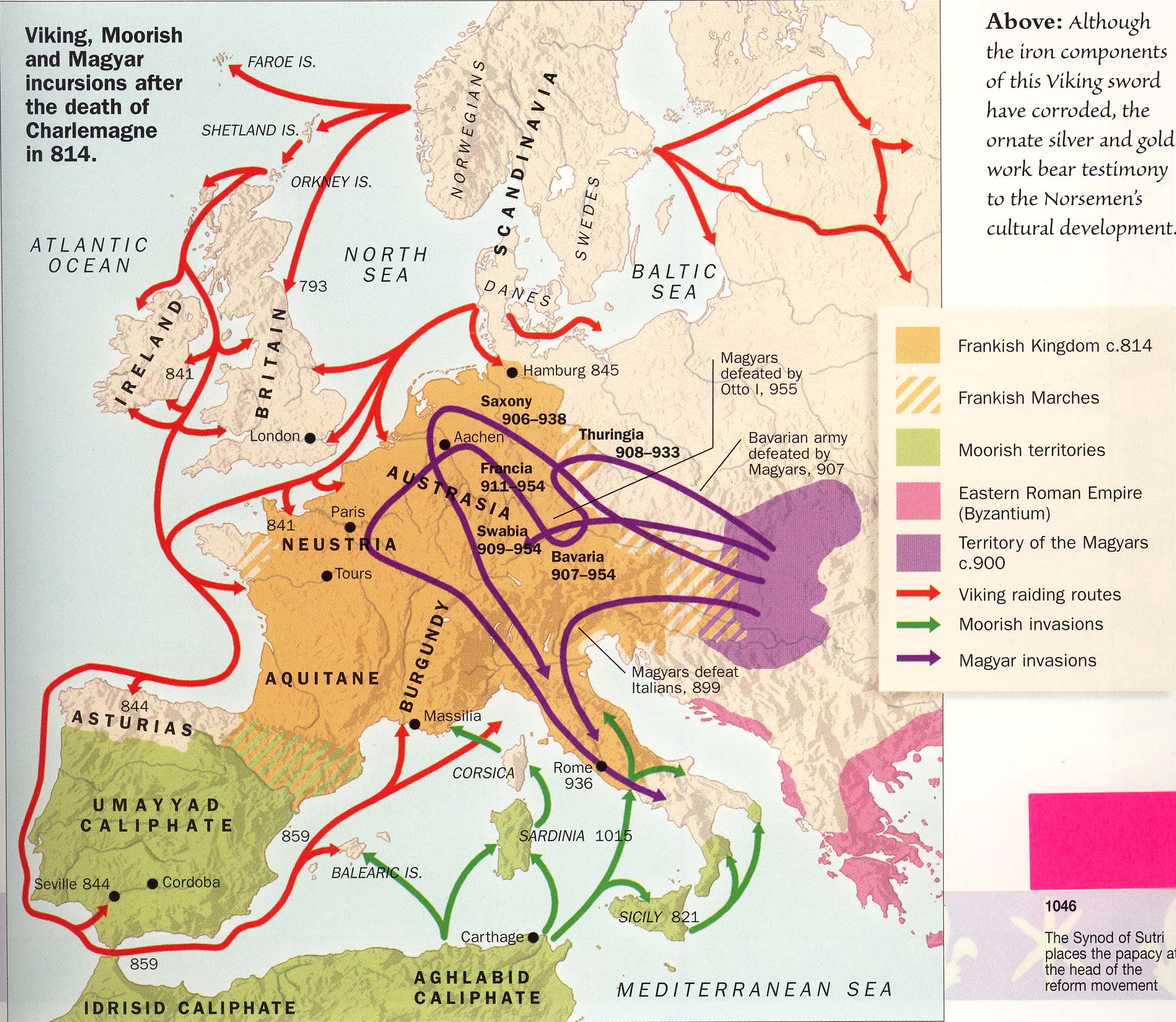
A final point is that even in the early Middle Ages, while the vast majority of people spent most of their lives close to their agricultural homes, an awful lot of people moved around vast distances across the whole continent, plus neighboring continents. So even in this period, parts of Europe weren't hermetically sealed off from other parts of the world.