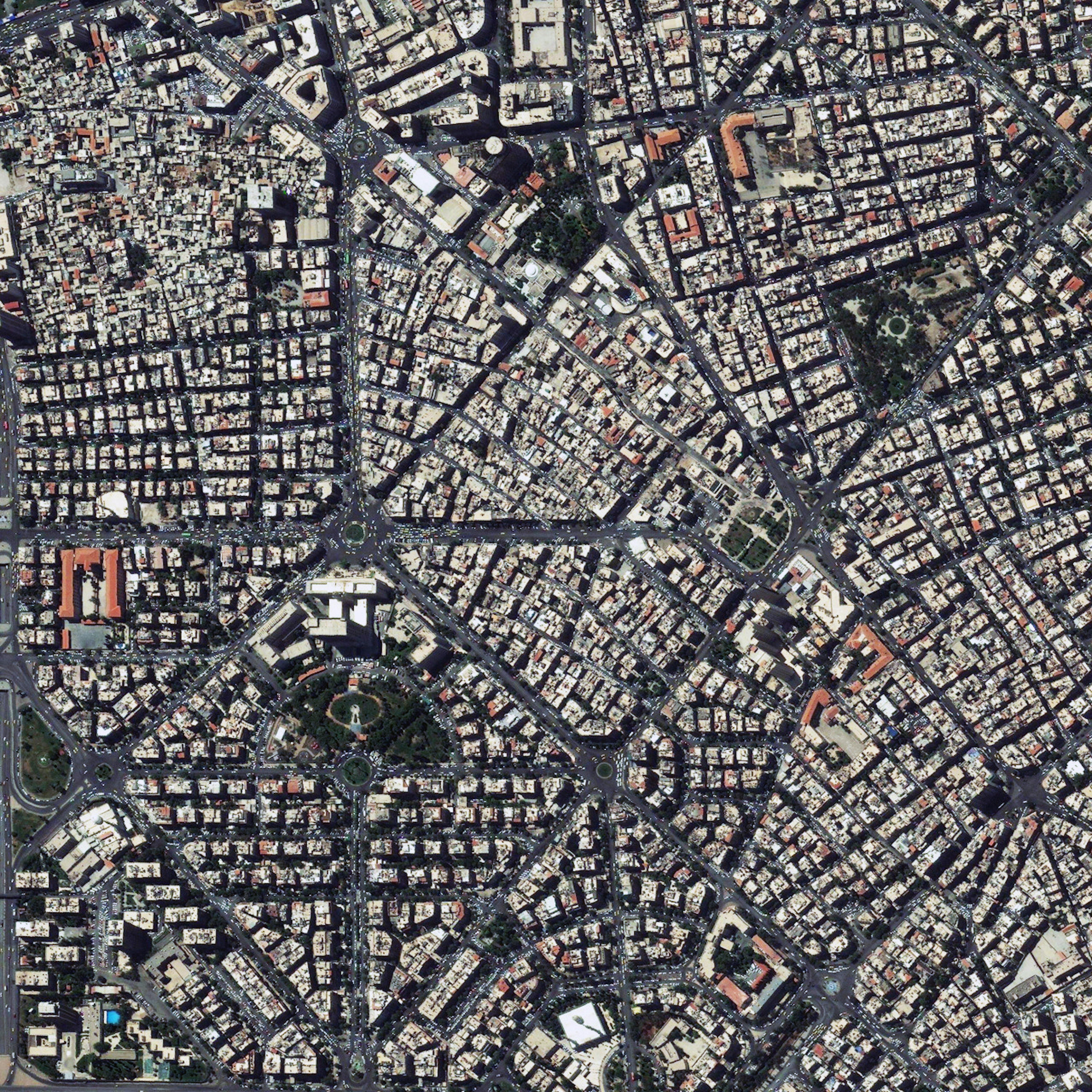
I recently saw this picture on the Daily Overview. The wide straight avenue immediately reminded me of pictures I've seen of Paris. Is this just a coincidence? Or is this from when France controlled Syria (if so did they do this in other colonial capitals)? Or perhaps something else?
No, it’s not a coincidence! Much of the Middle East’s urban development in the late 19th and early 20th century was modeled after Haussmann’s 19th century reconstruction of Paris (i.e., Casablanca, Algiers, Tunis, Alexandria, Cairo, Damascus, Beirut). In all honesty, many cities throughout the world were modeled this way, as it was considered a new, modern, and efficient style of urban planning.
It allowed for vehicular traffic (carriages, later replaced by cars), easy access to neighborhoods, the flow of air (this was thought to counter disease by ventilating ‘pestilential vapors’ from crowded neighborhoods), and made it difficult for people to block the streets in times of protest.
In much of the region, the ‘old’ cities were next door, frequently with dramatic contrasts (Tunis and Cairo are excellent examples) between the wide, straight boulevards of the new section, and the narrow, labyrinthine, winding alleys of the old section. Moving into the new neighborhoods was a seen as a sign of “modernization,” which tended to be embraced by the upper class and the emerging middle class; old neighborhoods were often neglected to make them seem less desirable and so they tended to be inhabited mostly by the poor.
Today, Cairo is probably the most extreme example, where the old city (called ‘Islamic Cairo’ in the tour books) was supplemented by the Parisian style area known as “Wust al-Balad” (downtown) to the west, along the Nile (where Tahrir Square is), in the 1860s and 1870s; and now the whole thing is being replaced by new, American suburban style development to the southeast of the metro area, extending way out into the desert.
But to answer your question, much of this development in Damascus dates to the same period (late 19th, early 20th centuries); the French had interests in the region before WWI and the mandate (that’s one of the reasons why they wanted mandatory power).