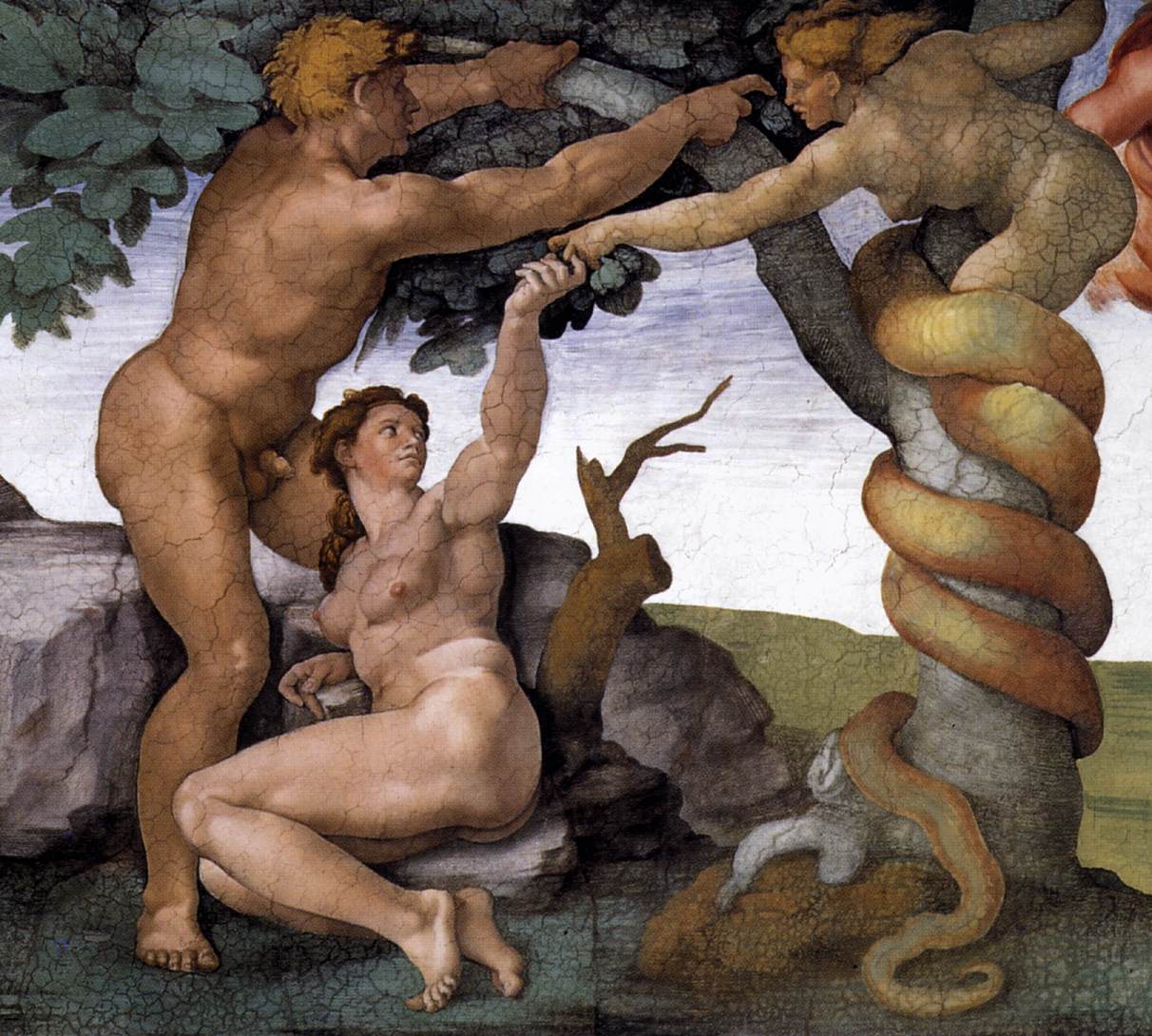
The seemingly vast majority of paintings (and sculptures) from the Renaissance through the early 1900s which portray women in the nude always seem to have "perfect" breasts. These are probably B to C cup breasts which are very symmetrical, feature small pink nipples with little areolas, and they never sag or show any stretch marks or veins.
I'm sure some of them are artistic interpretations, but many are capturing real life. Are they simply painting very young women (including those whom it would be illegal to portray today), were most women incredibly in shape and naturally tended to have smaller breasts, or was there a trend as with today where slimmer and more picturesque women were valued?
I'm aware of other cultures that valued large women and we can talk about whether this is most, many, or simply some artwork.
I’m a little late to this, but here’s one way of looking at the question:
Consider a different but related issue: why are most penises in Western art from antiquity through the Renaissance (and later) so small? Were men simply less well-endowed? Michelangelo’s David provides a good example: proportionally, his endowment is remarkably modest (every so often a student of mine would ask about this).
One important reason has to do with differing cultural views on the sex organs and related physical characteristics. Today we tend to think of large penises as signs of virility, masculinity, and power—generally, all positive characteristics (although it’s more complicated than that). This wasn’t always the case. In antiquity, there was a convention of showing heroically nude men with small penises—an indication of their control, their education, and their status as proper citizens from the right part of society. Old men, manual laborers, foreigners, and others “lesser” men could instead be depicted with large genitals; it might signify their lower status, it might be for comic effect, it might show some moral failing, or perhaps it might be a combination. (One notable exception to this large/small divide is when "proper" Greek men were depicted in erotic art: in these cases they could be shown with large, erect penises. Essentially, the ideal Greek man could have it all: a small, unobtrusive penis in public and a large, sexually active member in private.)
Renaissance art picks up this tradition (the small penis part), and it becomes further intertwined with the philosophical question of what makes us human—i.e., what separates us from animals. Our ability to reason was a key factor (perhaps the main factor), and this ability to reason—a gift from god, in the Renaissance humanist view—was constantly at odds with our “baser” animal instincts. Sexual urges were among the hardest animal instincts to control, and thus a small penis was a visual representation of a man’s powers of reason (i.e., what made him human) maintaining control. Hence we see works like the David with comparatively small penises. The same goes for the most heroic figure in Christian art, Christ himself—good luck finding a well-endowed Jesus in the art of the Middle Ages or Renaissance.
Keeping this in mind can help us understand why so many breasts from the period also follow a particular ideal—i.e., modestly sized and largely ignorant of the realities of gravity. I’m not aware of the breast being tied to reason, control, and humanity in the same way as the penis is, but it does have its own long history of significance in art (fecundity, sexuality, maternity, charity, etc.).
If we look at the work of Michelangelo, we can see instances of when non-ideal breasts are used for a particular emphasis. For example, the large, sagging breasts of the old Cumaean Sybil or those of the woman whose breasts won’t give milk for her crying child in the Flood image (both from the Sistine Ceiling).
Compare those with the small, perky breasts of Eve prior to the Expulsion.
The differences highlight how Michelangelo was clearly making a choice to show certain women (the old, the doomed) one way and others (the mother of humanity, before her fall) another way. Clearly Michelangelo knew what “real” breasts looked like—he’d done dissections, drew from life, and portrayed naturalistic breasts when it suited his goals. But art—especially from this period—is rarely about objective reality.
Consider too that the Virgin Mary is perhaps the most commonly portrayed female figure in art from the Middle Ages and Renaissance—and that she’s exalted as a saint nearly on par with the figure of god. It would thus be inappropriate to portray her with anything but perfect breasts.
As for private works of art done with more explicitly erotic content (e.g., especially in the 18th century), here we can assume the focus was on a particular physical ideal (as opposed to being proper for a woman of a particular standing).
If you keep looking around you'll note that there is a greater diversity of breast types in Western art than what we usually see in popular images. But since the most reproduced images tend to be ones that (a) fit widespread stereotypes of what is "beautiful" and (b) are deemed appropriate for popular consumption, we rarely see that variety.
I’m relying for the above info on some notes from teaching, but you can find more on the above in:
A. Victor Coonin, From Marble to Flesh: The Biography of Michelangelo’s David, The Florentine Press, 2014
Timothy J. McNiven, “The Unheroic Penis: Otherness Exposed,” Source: Notes in the History of Art, 15, 1995, pp.10-16, https://www.academia.edu/33607774/The_Unheroic_Penis_Otherness_Exposed.PDF
Roland M Strauss, Helena Marzo-Ortega, "Michelangelo and Medicine," JRSM, 2002, https://www.ncbi.nlm.nih.gov/pmc/articles/PMC1279184/
Leo Steinberg, The Sexuality of Christ in Renaissance Art and Modern Oblivion, 2nd ed., Chicago, 1996
#/media/File:'David'_by_Michelangelo_Fir_JBU002.jpg)