Torcs are those golden neck bands you see on drawings of Gallic/Celtic soldiers. I've read that people of means owned them, and that the Roman legions liked to loot them from the bodies of slain warriors.
But looking at them, I can't imagine how you'd get them on and off your neck, as they look pretty small.
Was their size actually larger than the images seem to portray? Was there a hinge?
Some of the torcs (like these) found are likely to have never been made for being born in the first place, but for a funeral or votive purpose (torcs seemingly being a characterisation of Cernunnos, at his hand or on his antlers, maybe as a divine "torque-giver"). Other torques, such asStettisham Torque or the Torque of Vix were heavy jewelry (more than 1kg) probably displayed on special occasions; and some other might have been born as bracers or decorations (as Romans later did).Generally, more heavy, rigid or small the torc, more likely it wasn't supposed to be a collar but a display of devotion, power or wealth : indeed, they seems to have been used as means of exchange and as a result of monetarization in proto-historic Gaul (possibly its first motivation as gold coins as prize for head-hunting being casted into jewellry)
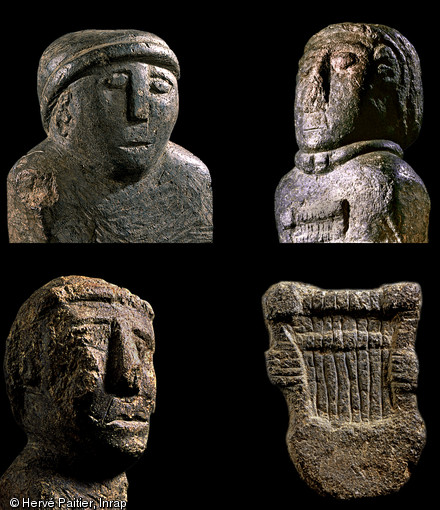
That being said, you're right, a lot of ancient depiction (both Greek-Roman and Celtic, as with the "Bard of Paule") attest of a wide bearing of torcs as collars in the protohistoric Celtic peoples. That their design was borrowed for the aforentioned purposes does point to their importance, after all.
Torques owe their name to the latin torquere, to spin, bend, whirl. While not all torques were made so, the "typical" model by the second Iron Age was made of interweaved wires of metal (generally iron, silver or gold) forming a flexible cable with solid endings (whose variety, from balls to bumpers, likely denotes ethnic differenciation) which was fairly easy to bend by curbing the collar by the endings.
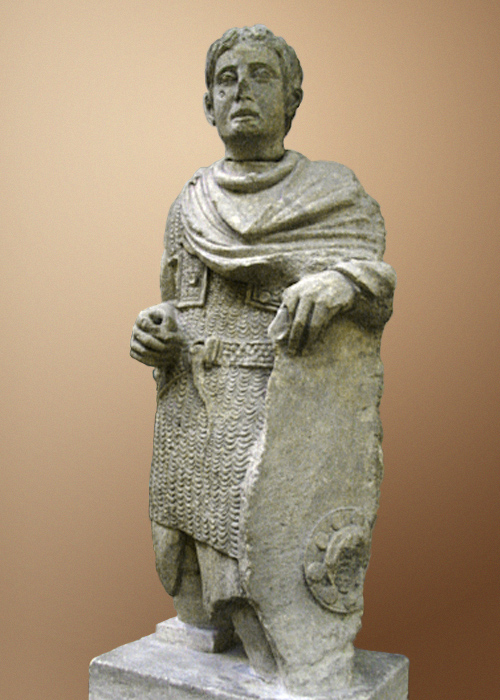
Other models, seemingly more rigid and made of a single metalic piece weren't necessarily that heavy (the Torque of the Prince of Lavau) or rigid to begin with (silver and gold could bend relatively easily, and that Gauls produced iron swords that could bend easily for votive purposes does indicates that they could produce soft iron objects for practical use). You can see, for instance, that the "Warrior of Vacheres" bears a relatively wide torque as part of his military equipment as the "God of Euffingeix" does.
Not all torques were this wide, however, and the recently discovered statues of Trémuson show a rather narrow torque, similar to the Dying Gaul statue. Then again, it was far from outside Gaulish (and Celtic in general) jewellers to make relatively easily bendable collars from relatively soft metals (gold and silver aren't exactly known for their lack of plasticity). In fact, some torques found rather look distorted and unfit for being used as collars precisely because they were bent out of shape.
While a distinct feature of the proto-historic Celtic civilizations, torques themselves were likely much more diverse in aspect, use and flexibility depending on their destination : some were definitely too small and rigid to be collars, some too open or heavy to be anything more than exceptionally born, others wide and/or flexible enough (thanks to the famous mettalurgic mastery of ancient Celts) to be used as collars.