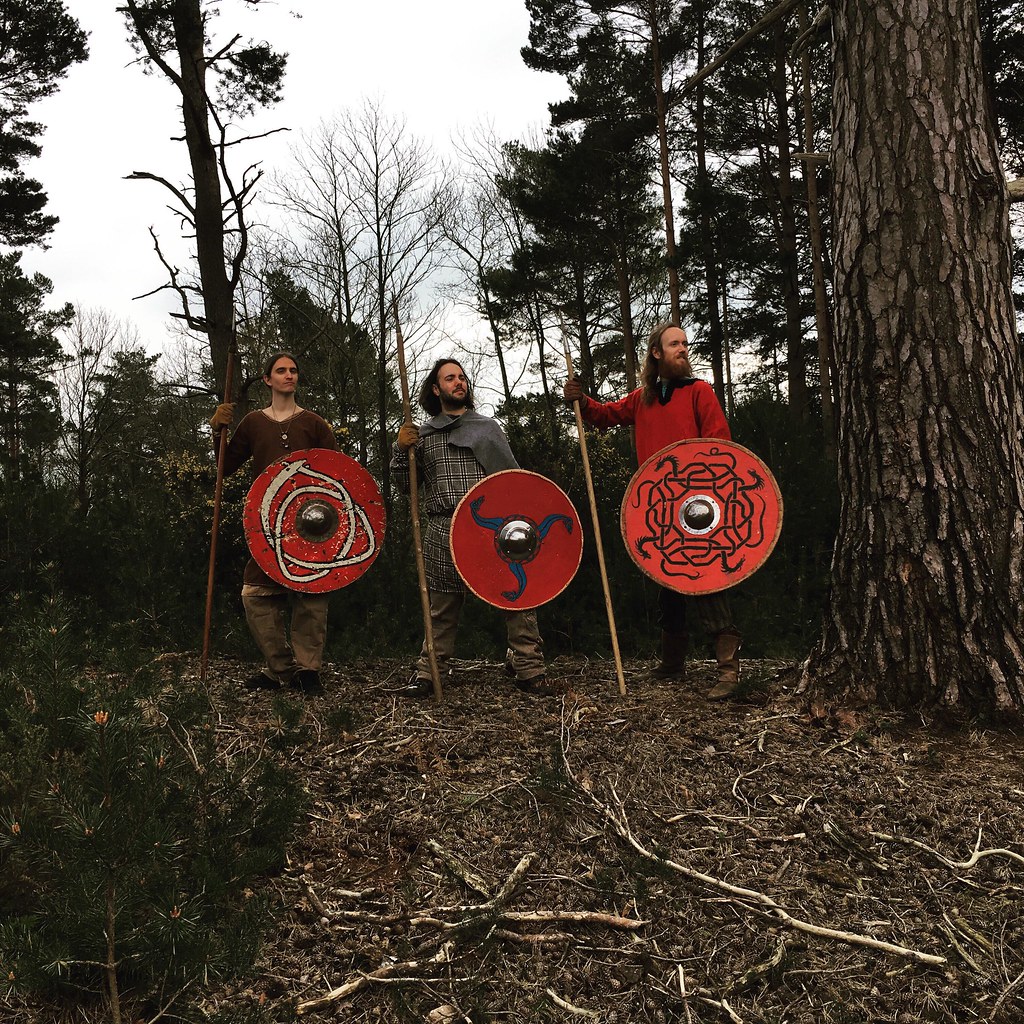
The basic item of protection was the shield. The poorest warriors might have no protection other than their shield - the minimum equipment was usually spear, shield, and a sidearm (perhaps a large knife). The most common type of shield was a round shield, often about 80cm in diameter. The body of the shield was made from wooden planks arranged side-by-side. There would be a hole in the middle, and a piece of wood across the hole for the grip. The 10th century Trelleborg shield shows this basic construction:
A metal cover - the boss - often just a simple dome, would cover the front side of the grip hole:
The shield above is probably from before 500AD, so this type of shield was used throughout the period. The front of the shield might be covered with cloth (e.g., linen) or thin rawhide glued on, and the edge might be reinforced with rawhide or metal, and there might be other metal reinforcements. The final result might be like the shield carried by this re-enactor:
Shields might also be painted more colourfully:
Other types of shields were used. Art shows Carolingian soldiers with domed round shields, and late in the period, kite shields were in use:
The next most common item of protection was a helmet. Most helmets were relatively simple open-faced helmets. A common construction method was metal plates riveted to a frame - the spangenhelm. This was the most common type early in the period, and was still being used around 1000AD:
Towards the end of the period, one-piece helmets become common:
The earlier helmets often have cheek-pieces, and later helmets often have nasals. Some helmets had mail to protect the neck. This helmet (the Coppergate helmet, from the middle of the period) has all three of these:
There were other types, such as spectacle helmets:
which sometimes had mail over the lower face as well as the neck, and early in the period, there were some lamellar helmets:
Next, and the last important type of armour, was body armour. This was less common than shields and helmets. The most common type of body armour was a mail shirt. This was usually short-sleeved, and might be short, just to the hips, or long enough to cover the thighs. The re-enactor on the right here:
wears a typical mail shirt (and a one-piece nasal helmet, and carries a typical shield). Artwork shows Carolingian warriors with scale armour:
but we have a lack of archaeological evidence. On the other hand, a type of armour called spangabyrnja, which might be scale, is mentioned in Viking sagas (and appears to be considered inferior to mail).
Thus, the three most common combinations of armour were (a) shield, (b) shield and helmet, and (c) shield, helmet, and mail shirt. This group of re-enactors shows all three:
I can mention one further type of armour: splint armour. Metal splints, which are usually reconstructed as forearm and/or shin armour, have been found:
These are not common. Reconstructions are not certain. For more on these, see http://thethegns.blogspot.com/2011/12/splinted-armour.html
Other references: two of the re-enactor photos are from http://darkagessociety.co.uk/photo-gallery/