Was there a law against or for it? If for, how did they get people to participate? If not, was this ever notably abused?
I was wondering this when my European history teacher was talking about ancient Athenian government and he didn’t have an answer, so I though it would be a good idea to ask here. Thank you!
Not that we are aware of. We are terribly uninformed in many aspects of Athenian law as it was actually written, but there aren't any cases of this happening nor would it be terribly consistent with the general ideology of the Athenian court. Athenian court cases were, by and large, tried by the assembly, or more precisely by a subset of jurors from within the assembly. From the laws we have and our many surviving court speeches the absolute nature of the assembly, and its existence as a collective, seem to have been extremely important to the Athenian conception of justice. There was no appealing a court decision of the assembly, and it's only fairly rarely that we are told, as in the Apology, how the breakdown of votes in the assembly looked. More typically we are simply told that the assembly supported one side or another, and it seems to have been typical in court speeches for orators to speak as if the assembly was of one mind, and that its judgments represented the collective opinion of the citizen body as a whole. There are obvious rhetorical reasons for this--it makes arguments of character much easier--but this seems to have been a fairly typical understanding of the assembly as jurors.
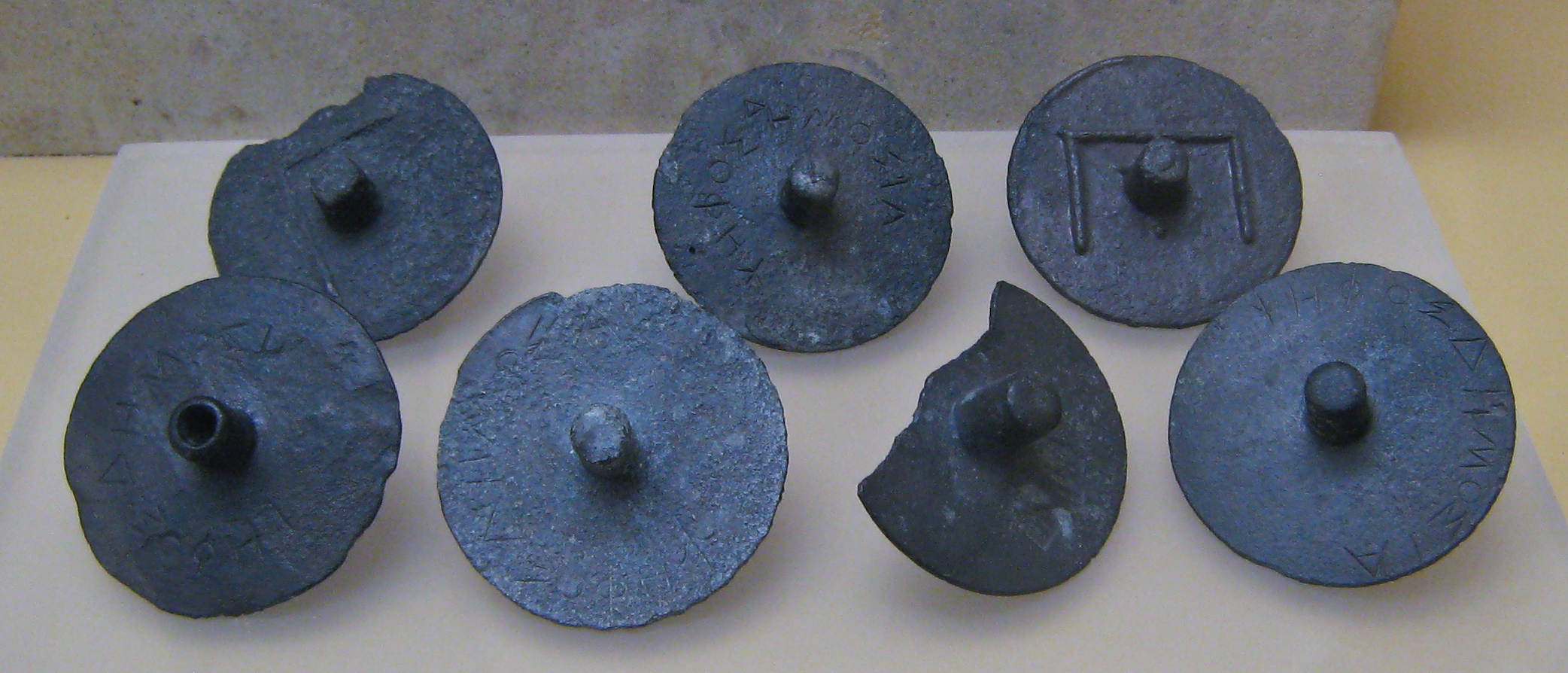
The biggest reason why it's not likely that the Athenians had such a law is that voting in court was secret. Not all votes of the larger citizen assembly were secret, some were done by a show of hands, but when the assembly met as a jury it voted by secret ballot. Two urns, a voting urn and a discard urn, were set up, and jurors walked between them, casting the vote to be counted in the voting urn and discarding the other. This is what the ballots looked like. The text just says "public vote," it's not any indication of the plaintiff or defendant. The ballots were these funny little spindle things, the axles of which were either hollow (plaintiff) or solid (defendant). The juror covered the ends of the axles with his thumb and finger so that nobody could tell which ballot was which, and only released them once his hand was inside the urn and could not be seen. Therefore, unlike in a modern court where the other jurors may know (or not, depending on what happens in the room) the votes of their peers, at Athens a juror's vote was known only to himself. It's possible to imagine a case in which a juror broadcast his vote to everyone, and that no doubt happened, but apparently the understanding was that that was his problem.