Some Disappointing Answers Concerning Sparta!
As far as we can tell from Athenian sources, there was no very precise distinction between the types of infraction you're describing. The Athenians distinguished 3 military crimes: astrateia (draft evasion), lipotaxia (desertion/leaving the formation) and deilia (cowardice). In practice, though, people were rarely brought to trial for these things, and when they were, the accuser was likely to argue that the accused was guilty of all three. You can picture how a single act (such as running away from battle) could easily be described by any of these terms or all of them in combination. We have no comparable evidence for Sparta but it seems likely that their conception was similarly fuzzy - there was really just the one category of military crime, namely not doing what was expected of a citizen in war. In any case, while we have plenty of information about what would happen to Spartans accused of being "tremblers", we only have evidence of a single case of someone being actually made to suffer these punishments. The Spartans, like the Athenians, usually didn't bother to press charges for military crimes, and probably thought the punishment was unreasonably harsh.
We don't know. This is a matter of debate among experts because there is no explicit evidence. That's probably why you've read contradictory accounts. We have a few isolated incidents where particular people were granted Spartan citizenship (such as seers who had provided the omens for important battles), but no evidence of any rules around mothakes or other outsiders aspiring to citizenship. In my view, it was not possible, since it went against the common principle of Greek citizenship (you had to be born a citizen). In Sparta as elsewhere, the decision to award citizenship to even a single person was hugely momentous and usually taken by all citizens in assembly. This notion seems supported by the fact that even some very prominent mothakes (like Gylippos and Lysander) never became citizens.
Again, we don't know because we have no evidence, and scholars disagree.
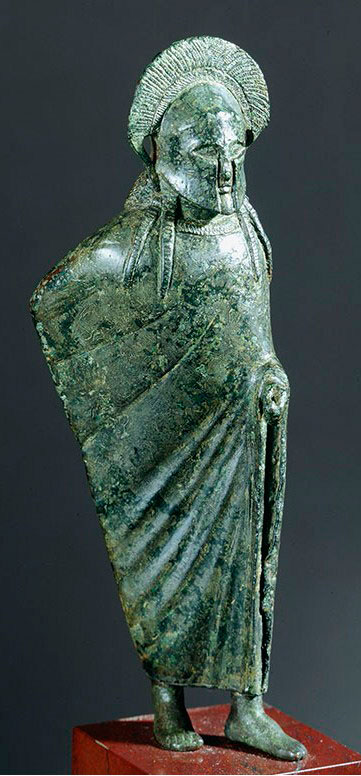
Most reconstructions of the Spartan hairstyle are based on this statuette showing carefully arranged braids or plaits of hair. The idea of a rat tail most likely comes from Frank Miller's graphic novel 300, which was first published in 1998, when these things were in vogue. Miller clearly depicts Leonidas with a rat tail (though the other Spartans have more authentic-looking airstyles).