Great, and important question. This has long fascinated me, and I think the basic answer is: no one really knows. Some theories purport to explain both the rise and fall, others purport to explain just one or the other. All of them have significant political implications making this a controversial area and one that is hard to study, but let's try a few:
I'll also just mention at the outset, a good study by the Brennan Center that discusses many of these explanations and more: https://www.brennancenter.org/sites/default/files/publications/What_Caused_The_Crime_Decline.pdf.
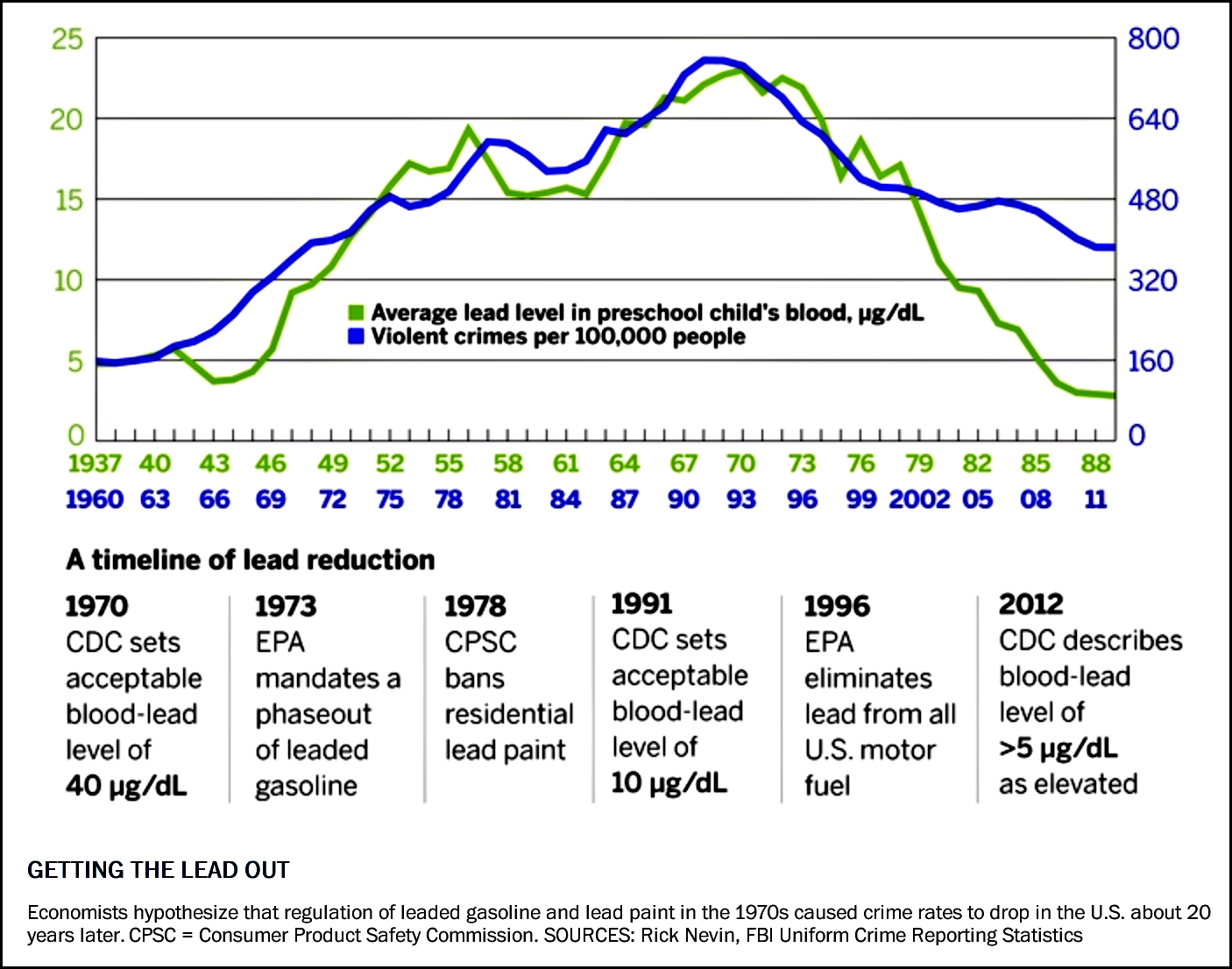
Major sources of lead include leaded gasoline (which enters the air and then can affect just about anything) and lead paint. Americans were exposed to more and more lead up until the 1970s. The EPA took on leaded gasoline in 1973 and the CPSC banned lead paint in 1978. The subsequent declines were the unintended fruits of this effort according to this theory, and the fault lies mostly with Thomas Midgley (who invented both leaded gasoline and chloroflourocarbons making him perhaps the most ecologically destructive person in history).
International crime trends also provide correlational support for this argument as do more localized studies (areas within the US with higher environmental lead had higher crime). For a pretty comprehensive survey of evidence see here.
One problem with both of these explanations is that they are "cohort" explanations (i.e., the answer lies in different behavior based on different years of birth, the basic idea is that people born in 1980 behave differently across the lifecycle than those born in 1970). Cook and Laub argue that cohort effects don't actually fit the data. Rather, behavior seems to have changed across cohorts which is incompatible with both abortion and lead.
Crack Cocaine: The cresting of the crime wave coincides with the emergence of crack cocaine as a drug of choice. Many violent crimes are linked to the drug trade -- both crime committed directly by drug users and the violence associated with the drug trade. The emergence of crack, a particularly addictive and popular drug, might then explain the growth of the violence. Efforts to combat crack (the war on drugs) may have succeeded, leading to the downturn. This was certainly the mental model held by many politicians in the 1990s. This kind of thing is hard to study given the difficulties of measuring illegal behaviors like crack usage. There seems to be a pretty clear link between drug use (including crack) and crime at the individual level (see meta analysis) but it's less clear that this lines up as an appropriate system level explanation.
Policing/Law Enforcement/Incarceration: A cluster of criminal justice changes in the 1990s -- the broken windows approach mass incarceration, increased policing budgets, CompStat -- are often credited with the decline in the 1990s. Certainly, mayors and police commissioners liked getting the credit. This seems more capable of explaining the decline than the rise unless you think that there were particularly bad policing tactics in use as crime rose.
Structural Changes in Society: Various social and economic factors have been posited -- the strong economic environment of the 1990s (although then why no upsurge in crime during the great recession?), the graying of the American population (the elderly engage in few violent crimes), and so on. Social conservatives often make arguments about "moral poverty" and so on to explain the rise (though I've rarely seen it argued that unusually good morals in the Clinton administration explain a decline).
Of course, it may well have been some combination of all of these. It may have something else entirely. I have my own pet theories not reflected above. There are real problems in the data that prevent reaching conclusive answers: which of the two major crime datasets you use has a substantial effect on results. The sources don't even really agree on when the "peak" was and when the "decline" was.