Was there any symbolic meaning behind its representation - maybe a link between the aggressive nature of both the USSR and bears?
Was this link used in self-representation by the Soviet Union?
Was this link already established in representations of Tsarist Russia?
What bear is it? Was reading a Chinese source on the Sino-Vietnamese War which amusingly referred to the USSR as a 'paper polar bear'.
Was this link already established in representations of Tsarist Russia?
Yes. The Russian academics Andrei Rossomachin and Denis Khrustalev argue in this article and this article (both in Russian) that outsiders, particularly Englishmen, began to remark on the exotic presence of bears in Muscovy starting in the mid-16th century.
These authors also note that very quickly, representations of the despotism of Russian Czars become equated with the fierceness of bears.
So, in 1585, only a year after the death of Ivan the Terrible, the German pastor P. Oderborn published satirical essays on the life and work of the Moscow Tsar (“The Life of John Vasilyevich, the Grand Duke of Muscovy”), where, in particular, he described his favorite pastime: in peacetime, the Grand Duke was entertained by hunting, games, dancing, ancient performances, spectacles and debauchery. On the hunt, he did not like a large number of horses and dogs - he took prisoners with him and threw them to the bears. Then he watched the bears tear the captives to pieces
What is clear is that by the 19th century, the trope of the "Russian Bear" as a shorthand representation of national character was accepted in Anglophone writing and in cartooning. In the Napoleonic Wars, we see cartoons of Russia represented as a bear, captive of Napoleon or later, a bear and Jack Frost as aspects of Russian winter.
this New Orleans newspaper from 1854 contains an article speculating on the ongoing Crimean War. In the article titled "Carrying the war into England" the author raises the prospect of a Russian invasion of that island, but concludes that:
....fighting on native soil, , for loved homes and [illegible] firesides, British valor be evinced in a manner never heard of or witnessed before. It would be then indomitable; the lion of England would drip his shaggy mane in the blood of many a Russian bear...
They also mention These representations of Russia and England as a bear and lion also show up in political cartoons in the late 19th century and early 20th century. This cartoon from Punch Magazine in 1878 depicts Russian Bear and British Lion surrounding and menacing the Shah of Afghanistan, reflecting the two powers competition in Central Asia.
A little later, in 1905 you have this French postcard depicting the Russian bear (with a cap on his tail representing France and 'fraternite') menacing a Japanese Geisha who is backed by Britain-as-navy. This would seem to indicate that this representation of Russia-as-bear was not only an Anglophone one, but was understood by France by 1905.
This period circa 1900-1918 was replete with cartoons depicting various nations as animals. /u/EnclavedMicrostate wrote an answer in this thread about a Hong Kong map from 1898 in English and Chinese depicting competition for influence in late-Qing China. As expected, Russia is depicted as a bear. Ditto, in this cartoon various powers, including British Lion and Russian Bear are competing over the dead or dying carcass of Qing china.
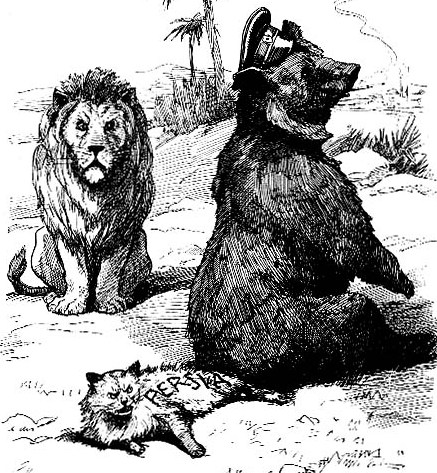
For the year 1911, I have this cartoon, again from Punch Magazine. It depicts Anglo-Russian jostling for influence over Persia, and echoes many of the themes from the cartoon from 1878. There is also this newspaper article from the Canadian Jewish Times, also from 1911, which concerns Jewish conditions in Russia. It includes this (quite racist) statement:
...Even South Sea savages are becoming gradually civilized, but the Russian bear still lags behind, and there does not seem a ray of light in that benighted country, even in the far distant future. The only salvation for the Russian Jew appears to be emigration...
Even after 1918, newspaper coverage of Soviet foreign policy very frequently talk about the "Russian bear". For instance this article about 1939 Winter War asks in the 2nd paragraph "whether the Russian bear will exert his full strength".
This article from 1954 despairs of NATO unity, saying "it wasn't obtainable when the Russian bear breathed hard on the necks of European nations. The incentive is less now."
Ditto, this article from 1964 talks about Albania "twisting the tail of the Russian bear"
From these uses, it seems a pretty clear case of an already established trope of Russian Empire as a bear being held onto and Soviet Union regarded as "the same bear".
I'll also mention that a google news archive search for "soviet bear" is not a stock phrase. It turns up sentences about how 'the soviet union will bear responsibility' or other references to non-ursine use of the word 'bear'.
All the cartoons and newspapers I have used as examples have come mostly from Britain, or else France and America. As for Soviet self-representation, I can only think of statues like the Motherland Calls as an example of official representations of the Soviet identity.
There was the instance where the 1980 Moscow Olympics chose Misha the Bear as the mascot. But, my sense (bolstered by those Russian academic articles I led with) is that Russians view bears as the Western view of Russia, and only accept the association grudgingly.