For a writing project, I need late a Victorian/early Edwardian character to visit a colonial settlement that was abandoned shortly after construction (think built in 1700 and abandoned in 1715), in the foothills of the Catskill Mountains in New York. Except I'm having a hard time imagining what would be left.
Would buildings still stand? Could any be inhabitable, with a lot of TLC? What other remnants could be seen (stone walls, wells, animal coops, etc.)? Would trails carved through the woods be detectable, or entirely overgrown? Any additional information would be greatly appreciated.
There's a few issues with your premise:
There would not really be an "English colonial village" in the "foothills in the Catskills" built in 1700. The first English town founded in Ulster County (which was much larger then, and is where the foothills of the Catskills are) was founded in 1715, at the end of this period. It was also a mixed community - while majority English, it had many Dutch. Of the other seven towns in Ulster County founded before that, they were all overwhelmingly Dutch, except for New Paltz, which was founded by French Huguenot refugees who had, until arriving in America, been living in Germany as refugees there, after being persecuted in France.
In 1900, there wouldn't be any "remnants" left of any colonial buildings that would be visible in that area, short of an archaeological dig. That is, there would be preserved and restored buildings from the 1700-1715 period (and the colonial period in general), but there wouldn't be a whole settlement of "remnants" left in one place. In 1900, Ulster and Sullivan counties (having been one county back in 1700-15) had a population of over 100,000 people. Most of them were rural. Every bit of inhabitable land was taken, and had been sold and re-sold several times over.
If a suitable plot of land had been big enough for a town in that area but then had been abandoned, it would have at some point during the 1800s either become a new town and been bulldozed over to make way for the selling of new town lots used for businesses, schools, churches, government offices, etc. Or else, it would have been split into rural lots and bought by farmers, who would have needed to clear the land for farming. A lot of land, too, would have been bought by railroad companies, telegraph companies, and telephone companies, all of which would have cleared any such remnants, too, if not cleared already.
Any kind of "remnants" almost assuredly would have been of a single isolated farmhouse, somewhere out in the country where a farmer hadn't quite cleared away all the bricks of the original farmhouse, or something like that.
I would recommend you track down the following books:
Dutch Houses in the Hudson Valley Before 1776 by Helen Wilkinson Reynolds, 1929
Pre-Revolutionary Dutch Houses and Families in Northern New Jersey and Southern New York by Rosalie Fellows Bailey, 1936
Both books were published by the Holland Society of New York, and while not completely comprehensive, they are nearly so. They include descriptions and histories of all the known pre-1776 houses in those areas of New York and New Jersey at the time of publication (including the area of the Catskills), and they also include photographs of most of them.
Since the publication of those books, a few more buildings have been identified, but A) many of those are only partial artifacts of the colonial era, i.e., a wall or portion of an original colonial structure survived but the rest of the house was built much later, and B) none of them were ever large finds of an extended settlement. They were isolated farmhouses or barns.
While I know less about Pennsylvania, most of this applies to that state as well. It wouldn't have been much different there. Pennsylvania was only founded in 1682, and before 1715, the vast majority of the population would have been in the immediate vicinity around Philadelphia. The English settlers tended to go to Philadelphia; the surrounding communities weren't English colonial villages, but predominantly Pennsylvania Dutch. The colonial buildings that survived to 1900 were already well-known to historians by that time.
If you're going for historical accuracy, then, you're better off just using for your writing project some of the real colonial buildings in the area that still exist today as a place this character is visiting. If it's historical fiction of the "what if" type, then I can give some examples of some of the architecture in the Catskills area in the early 18th century.
The Hudson River Valley communities in that period would have likely been made up of predominantly "Dutch Colonial" architecture, even the towns with a majority English-speaking population. But every town, whether a "Dutch town" or "English town", have had some examples of "Georgian" (a.k.a. "English Colonial" or just "Colonial") architecture as well. Some towns might have had some "German Colonial" architecture, too, though this would have been less common.
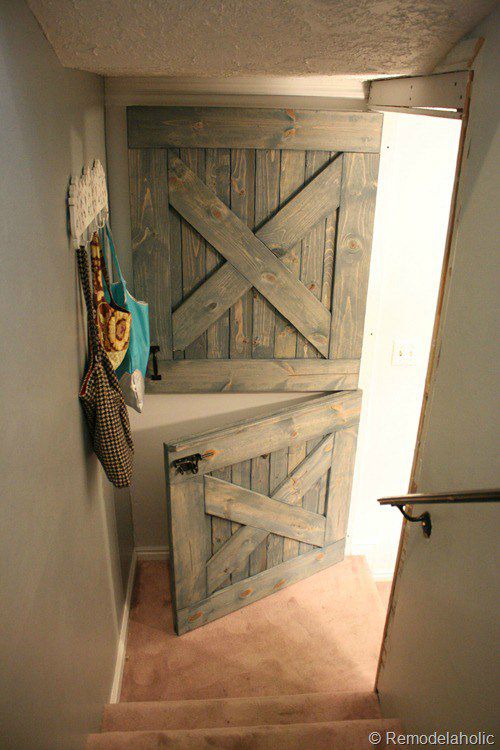
Dutch Colonial architecture was typified by gambrel roofs (called "Dutch roofs" at the time) often with gabled dormer windows if it was more than a one-story home. If it didn't have a "Dutch roof", then it usually had gabled ends, often coming nearly all the way down to the ground. They usually had a two-part "Dutch door" as their front door, and if the house had a back door (usually only large, fancy houses of the upper class did), then it would have been a Dutch door, too.
The best example of a series of preserved colonial houses all within the vicinity of each other in New York state happens to be not too far from where you're talking about, in Ulster County - perhaps it would be a good setting for this Victorian character of yours. This would be the Huguenot Street Historic District in downtown New Paltz, New York. (I wouldn't normally link to Wikipedia on Askhistorians, but I'm doing it here because someone was kind enough to take photos of all the historic houses in the district, so you can get a taste of what the buildings were like.) Three of the buildings are genuine artifacts of the period between 1698-1725. Two more are partial artifacts from the period, though much of the current structures were built in the 19th century. A sixth building is a modern reconstruction of the original 1717 church built in the town. There are several more buildings in the historic district, but were built much later than the timeframe you mentioned.
Interestingly and revealingly, even though New Palz was founded by French Huguenots, all the surviving buildings are in the Dutch Colonial architecture style. All these buildings, except for the reconstructed church, would have been there in 1900.
Some other surviving Dutch Colonial architecture in the area that still exists includes the Madame Brett Homestead built in 1709 (the wing behind the flagpole was added later) and the Storm-Adriance-Brinckerhoff House built in 1759 (the two wings were built later). Both are across the Hudson River from Ulster County, in the area of Fishkill, Dutchess County. While the latter post-dates the relevant era, it's fairly typical of what a larger house from 1700-15 in the area would have looked like at the time.
Further South, in Westchester County, you can see the Old Dutch Church at Sleepy Hollow, which was completed in 1699. It has a typical gambrel "Dutch roof" in the Dutch Colonial style.
In the Georgian architecture style, surviving colonial-era buildings in the Hudson Valley include the Tobias Van Steenburgh House, built in Kingston in 1700, the Dirck Brinckerhoff Mansion built in Fishkill supposedly in 1718 (I believe only the wing at the back is alleged to have been built then, but either way, the rest of the house certainly does date to about the mid-1700s), and the Cornelius Wynkoop Stone House outside Kingston that dates to the 1760s.
(cont'd...)