We have the Renaissance where it seems (to my uneducated brain) that realism and "lifelike" qualities of famous works of art and sculpture grew at roughly the same pace. In other words, it seems like the technical execution of making a sculpture or painting seem lifelike and "real" were becoming better and better, and at some point it would no longer be possible to make a sculpture or painting look more lifelike.
In ancient Roman times, we have numerous examples of lifelike sculptures (such as Laocoön and His Sons) that are still striking today in their realism and obvious artisan skill. However, most paintings or mosaics that have survived seem much more simplistic, as if the level of technical execution for paintings did not keep pace with the realism of sculpture from the era.
I realize how I'm phrasing this question is probably driving some of you nuts, but it's the best way I know to ask it: why do Renaissance paintings seem so much better-executed than ancient Roman paintings, given that (again, to my layman brain) Renaissance sculpture and ancient Roman sculpture seem much closer to each other in how realistic they are?
I answered a similar question last year:
Since our understanding of ancient painting derives primarily from a few literary sources (above all, the 35th book of Pliny the Elder's Natural History) and the frescoes of Pompeii and Herculaneum, we aren't really in a position to evaluate its technical achievements. That said, the Greeks and Romans certainly recognized a canon of "old masters," of whom the most celebrated was probably Apelles. Pliny the Elder, at least, was a fan:
"Single-handed, he [Apelles] contributed more to painting than all the others together, and even went so far as to publish some treatises on the principles of the art. The great point of artistic merit with him was his singular charm of gracefulness, and this too, though the greatest of painters were his contemporaries."
Apelles was the court painter of Alexander the Great (who made it illegal for any other painter to represent him), and was so favored that the king - or so were told - allowed the artist to marry his favorite concubine. Apelles, it was said, made this concubine his model for his famous painting of Aphrodite rising from the sea. Many anecdotes survive about the incredible verisimilitude of his paintings.
Unfortunately, no painting by Apelles (or any other Greek master) survives. Many of his masterpieces were brought to Rome, where they were displayed in porticoes and temples. Even in antiquity, however, these had begun to decay. Pliny, for example, describes the fate of Apelles' painting of Aphrodite rising from the sea:
"The lower part of the picture having become damaged, no one could be found to repair it....Time, however, and damp at last effaced the painting, and Nero, in his reign, had it replaced by a copy, painted by the hand of Dorotheus [a contemporary artist]"
We do possess a few impressive examples of fourth-century Greek painting, above all the frescoes in the Tomb of Philip II at Vergina. But the famous Alexander Mosaic from Pompeii (image), thought to be a copy of a painting by a contemporary of Apelles, shows us what treasures we've lost.
Although many wall paintings, some very well-executed, are preserved at Pompeii, Herculaneum, and the villas around (and, occasionally, elsewhere), we know less about the great painters of the Roman tradition. The sort of wall decoration that survives at Pompeii was usually executed by craftsmen working from the ancient equivalent of pattern books; the real prestige pieces created by highly-regarded Roman artists, which have not survived, may have been qualitatively different.
In short, we've lost all the best classical paintings, but have copies of many of the best sculptures (which were of course more durable). The best Greek and Roman painters were just as accomplished (by ancient artistic criteria, if not ours) as the best Greek and Roman sculptors.
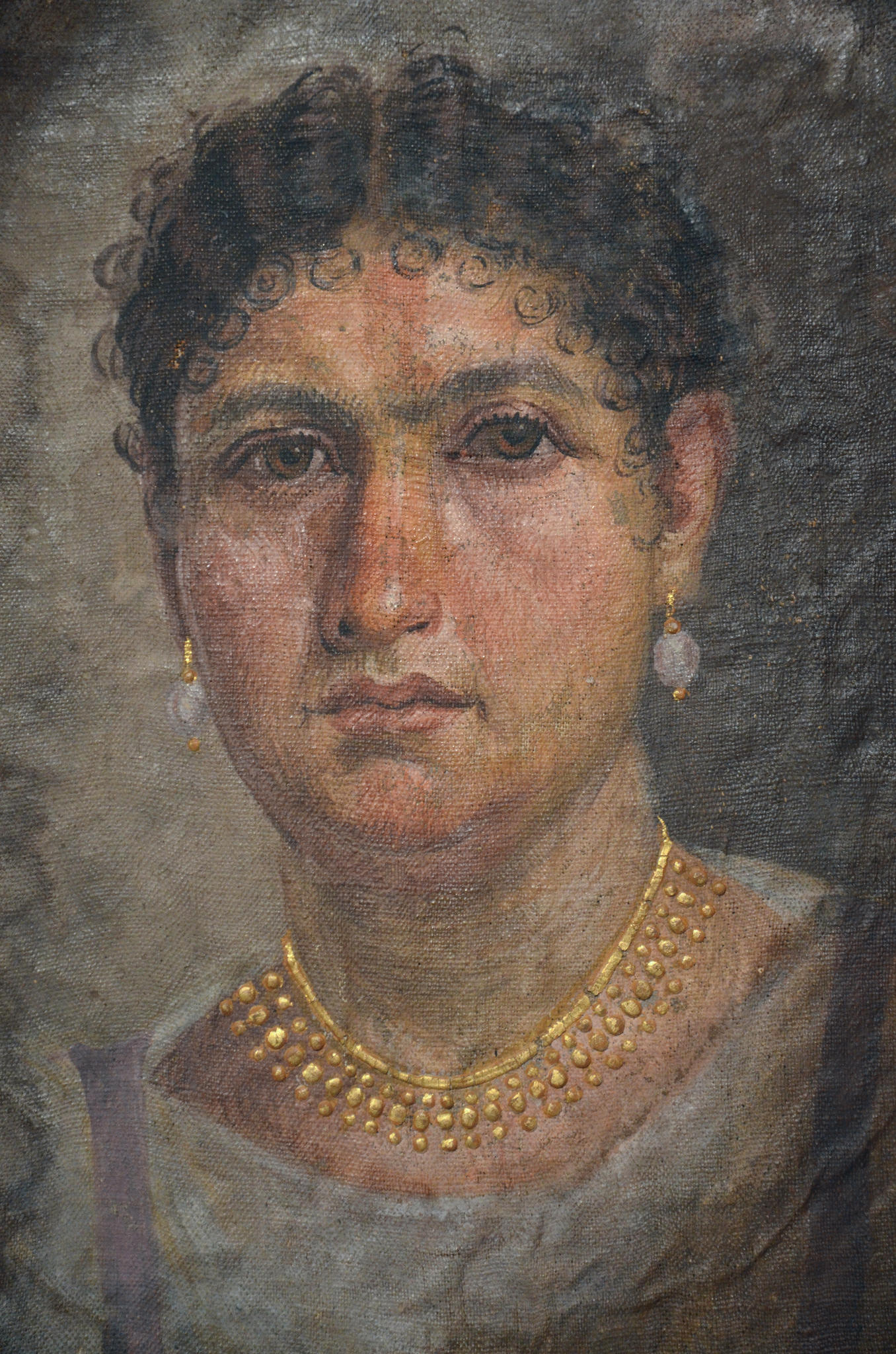
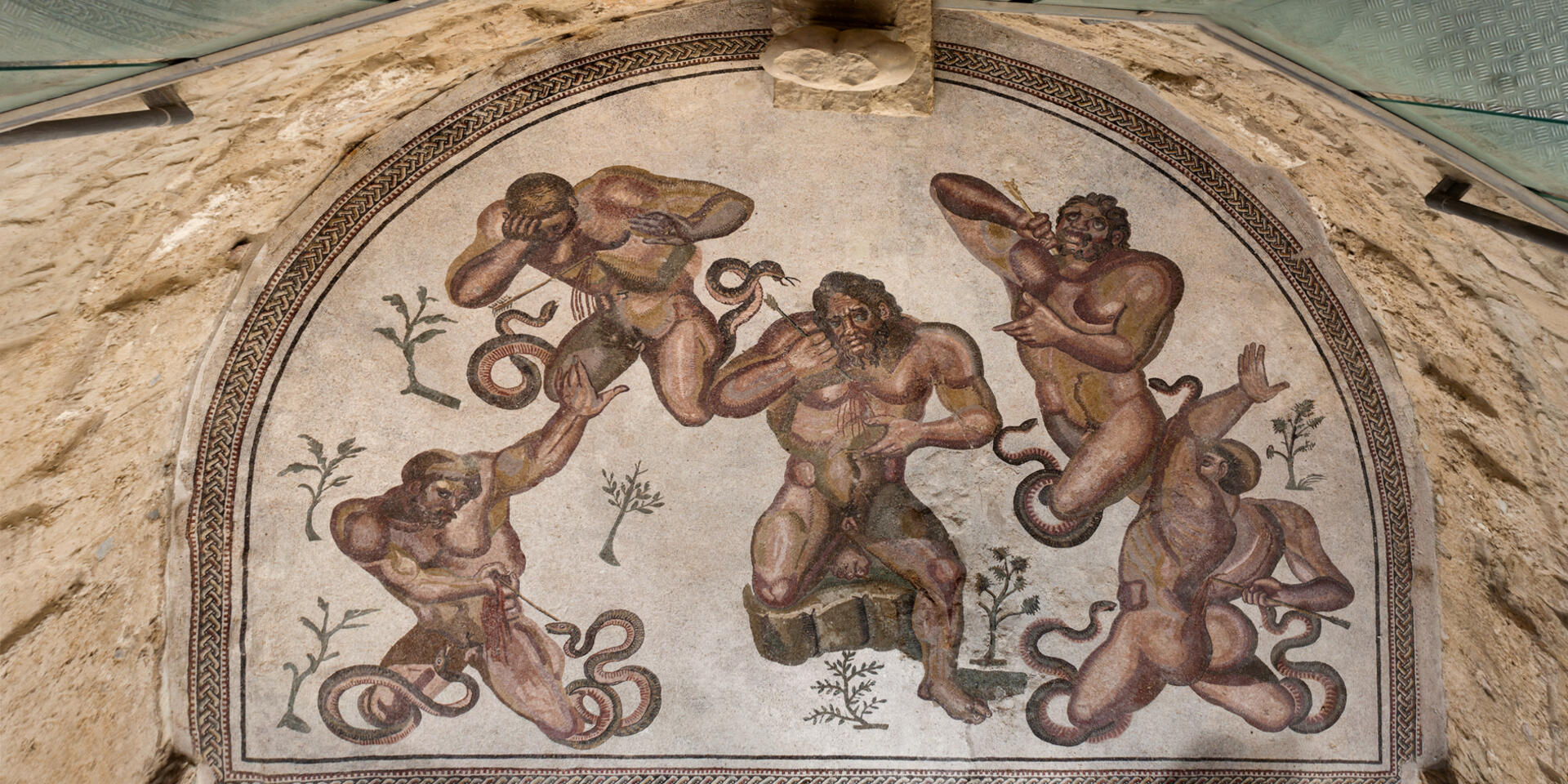
As mentioned, about a year ago we had this question and I'll repost my answer for the quick links to pictures. The primary response to this type of question is that actually, as many don't realize, Romans made extremely realistic paintings and mosaics too. Particularly these are in domestic frescoes and Romano-Egyptian mummy portraits.
Many of these "portraits" are shockingly life-like, particularly (3) "Aline," at the Neues museum, which has a fine-line aesthetic quite unlike the majority. I only included a few of the 100's, many of which are quite haunting such as this woman at the Antikensammlung in Berlin, 1. And if we're looking for realism in mosaics besides the two I posted, there's also the Oceanus at the Bardo museum which is quite detailed 2a, and a few flickr photos for more zoom 2b.
Why does wikipedia and most basic textbooks not show these expressive pieces of art when talking about Roman mosaics? Well, that is another question all together.
In the popular imagination there exists that gulf [between Roman realism in 3D and 2D art], but Roman art history shows many examples of realism in mosaics and paintings. Shading to give depth is also found in mosaics and painting. Realism is also found in weaving and making gold glass, among other media.
Roman frescoes have exquisite shading 1 2. Realism is commonly seen in Fayyum mummy portraits made in Roman Egypt. The detail of these is staggering 3 4 5 6 7 8 9 10. Mosaics could attempt realism and depth as well 11 12.
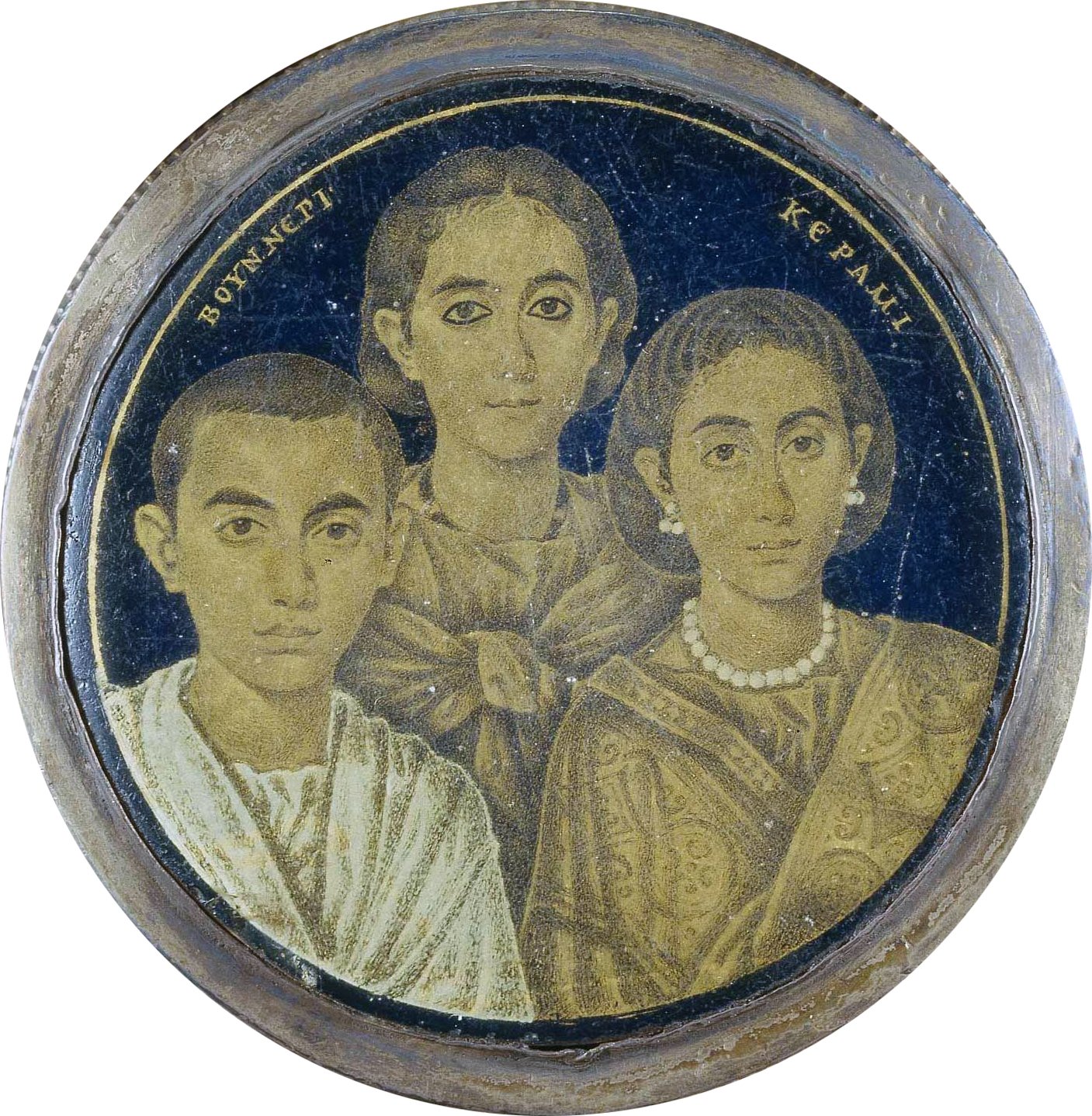
Roman artists also created realism in other media particularly gold glass portraits 13 14 and fuzed glass bars cut to make mosaic inlays 15. Earlier Greeks could create realism in woven objects 16 as later Romans would as well 17.
When most people imagine the Roman empire ending and the Byzantine empire beginning, realism in mosaic art was still flourishing 18 19.
Although notably there are many examples of great Fayyum paintings and gold glass portraits in museums, some are forgeries.
–