There's two pretty distinct parts to your question so I'll discuss them separately.
How do we know what Ancient Greece looked like?
The most famous remains of Classical Greece are literary texts, painted vases, ruined buildings, and statues (the latter usually Roman marble copies of bronze Greek originals). These may not seem very promising for someone looking to reconstruct, say, a street scene. But there's actually a lot there that can help us get a sense of the physical world the Greeks lived in.
At the most basic level, the geography and vegetation of the Mediterranean is still largely unchanged from the way it was 2500 years ago. We can explore the arid, mountainous landscape, the rugged coastline, the little islands and fertile plains, knowing that these would have been the same spaces where Ancient Greeks travelled and farmed and sailed and built houses. We can measure the climatic differences that explain, for example, why the Greek states in Sicily produced a surplus of grain. We know they grew barley and wheat, vines, olives and figs. We know they kept sheep, goats, and cattle. We know they used the same trees for timber and toolmaking (willow, ash, cornel, cypress) that still grow in the Mediterranean today.
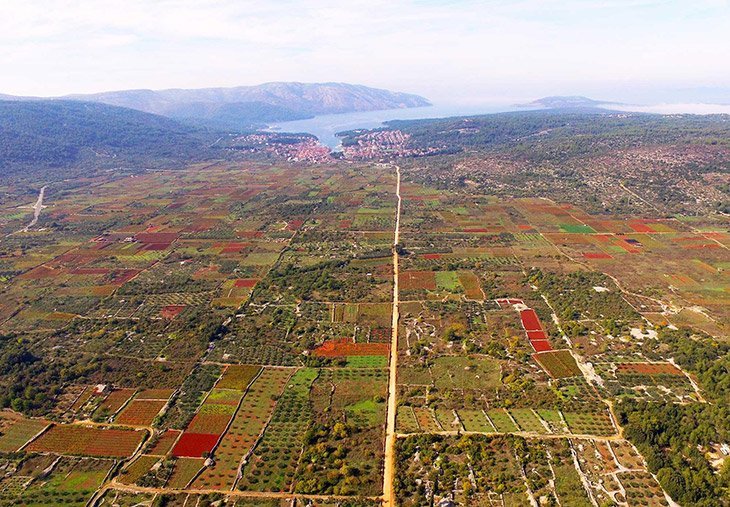
Indeed, we can still see the traces of some of the ways the Greeks shaped the land around them. On the island of Hvar, off the coast of Croatia, you can still clearly see the grid pattern of the roads separating the agricultural lots assigned to each citizen of the Greek settlement of Pharos in the 4th century BC. A similar pattern, much older, was revealed in the excavations at Metapontion in Southern Italy. On the Greek island of Samos you can visit the aquaduct that Polykrates ordered his subjects to tunnel through 500m of solid rock. Many modern docks and harbour moles around the Aegean go back to ancient times.
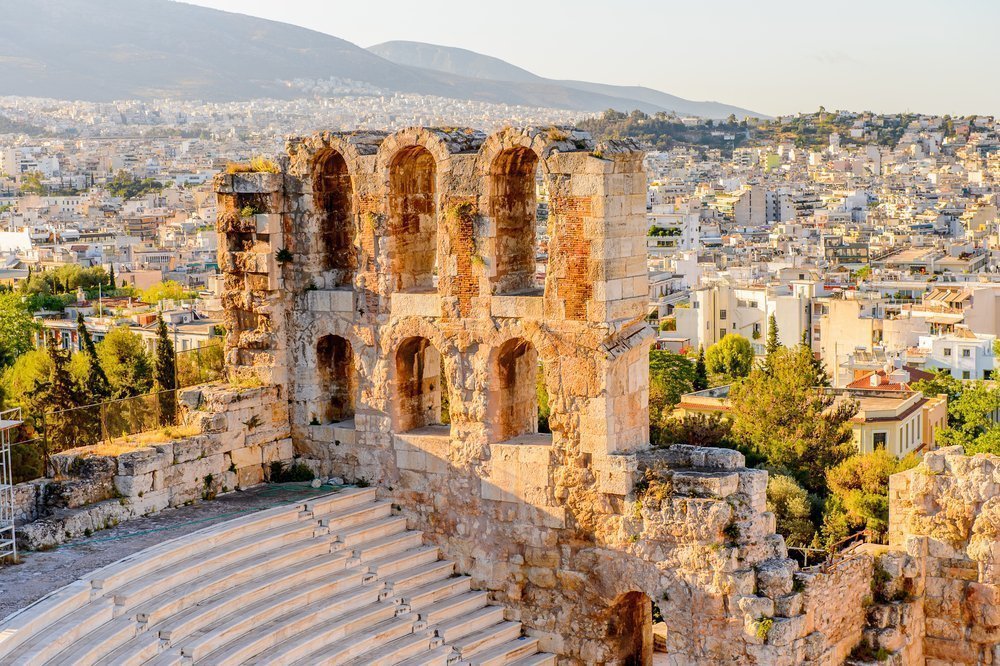
Then we come to the more obvious stuff: large areas of ruins where Greek cities, fortresses and sanctuaries once stood. The game features a (heavily exaggerated) Minoan place at Knossos, which is really there and constitutes one of the oldest large structures found in Greece. From the Classical period there are massive urban sites like Paestum, Akragas and Syracuse in Italy, Corinth and Athens in Greece, Cyrene in Libya, and many others. There are also huge sanctuary sites like Olympia and Delphi. At these sites we can learn the shape and size of buildings of different kinds, the layout of streets, the way monuments were placed and organised, the way cities were fortified, and so on.
Ruins might not look like much to the naked eye, but archaeologists can do a lot with a pile of stones: they can measure, for instance, how many storeys a building will have had, how much was made of ashlar or brick masonry, what the roof was made of, and many other things. The nature of the material can show the wealth of the settlement but also gives clues as to its decoration. Many stones and column drums still show traces of plaster or paint, which we can use to reconstruct their dazzling original state. The same applies to marble and bronze statues (we know the Greeks also made statues out of wood, but these don't survive).
Anything that is decorated with images can tell us things about the real world. Frescoes often depicted rooms or other buildings; vases were often decorated with scenes from everyday life; funerary monuments often depicted the deceased in all their finery. It is from such images that we learn what furniture looked like, how people dressed in different contexts (parties, funerals, travel, sport, war), what sort of objects they used, and sometimes even what they ate or how they worked. The archaeological record helps too, insofar as things made of non-perishable material (metal, stone, pottery, bone) can be preserved for a very long time if they are not reused or deliberately destroyed.
Finally, there's a lot we can learn from the literary evidence, even if it doesn't intend to describe ordinary things. Ancient geographies and travel guides tell us about landscapes, tell us what notable buildings looked like in their prime, describe lost art and sculpture to us, and so on. Other texts will often contain almost accidental references to things that their authors took for granted - they will list different types of artisans, describe things that are lying around, comment on sights they approve or disapprove of, etcetera.
From all this we can get a pretty good sense of the sights and sounds of the Classical Greek world.
How accurate are the environments of Assassin's Creed: Odyssey?
It's impossible to comment on everything here, but suffice to say that they clearly devoted a lot of attention to the physical world of the game. The landscape is heavily foreshortened: Greece in the game is tiny, and the mountains encroach on the city of Athens instead of leaving quite a lot of space that is now covered by the modern megacity. But its layout maps onto ancient Greece and its sites, and the cities are full of places and people that were actually there at the time. The architecture, art, sculpture, dress, and armour of the generic characters was all clearly designed after real examples (the wall decoration at Knossos, for example, repeats frescoed patterns found on the site, as well as some Mycenaean sites). There are some great details, such as the diversity of the population and the extravagant colour on many buildings and statues.
That said, the game designers obviously took liberties with a lot of things in the name of aesthetics and player experience. Many of the houses have very modern roof gardens and canopies that would have been unknown to the ancient Greeks; their actual houses were fairly dull and uniform, with tiled roofs and tiny windows on the outside walls. Many of the gates and temples of the game have hanging banners that have nothing to do with Ancient Greece and everything to do with Nazi Germany. The Classical Greeks didn't really use flags or banners at all. While the Greeks certainly did build giant statues, the game has them lying around just anywhere, many of them in a very late (Hellenistic) style while also already laying in ruins. The warships are a strange mishmash of the Classical trireme and more modern designs from the Age of Sail. The game pushes the idea that if Spartans wear red, Athenians must wear blue, which has no historical basis whatsoever. Most of the weapons and pieces of armour available to the player are fantasy designs with no archaeological parallel. The catapult was invented in the early 4th century BC (the traditional date is 399 BC in Syracuse), so they didn't exist yet during the Peloponnesian War. Also, there are piles of painted pots lying around everywhere for no apparent reason.
One of the most jarring aspects of the game world, but entirely understandable from the point of view that this is a fighting game, is the fact that loads of people seem to be walking around in full armour every waking moment. This is completely out of step with the real Greek world. Classical Greeks thought carrying weapons in public was characteristic of barbarians; civilized Greeks no longer did this. No one would voluntarily wear armour unless they were literally about to go into battle. Only tyrants, who had reason to fear assassination, would wear a cuirass when out on regular business. In reality, most people would go about dressed in much the same (colourful) ways, though the wealthy could always be identified by their tight cloaks, walking sticks, and dainty parasols (and their sons by their long hair). There would also not be armed guards anywhere except on the city walls in wartime, because why would there be?
Still, there is no doubt that AC:Odyssey represents the most detailed and careful attempt ever to create a virtual world that looks like Classical Greece. (It helps that there haven't really been any other attempts.) They had the means to do it right, and they made the effort to get a lot of things right. No doubt exploring this world will teach any casual player a lot about what Ancient Greece actually looked like.
This is a huge question so it'll get a short, cursory answer. Basically, yes we do have a decent idea, but it's a bit piecemeal.
We have plenty of decent archaeology and there are loads of reliable reconstructions of ancient buildings. For instance, we know quite a lot about the different phases of construction of the buildings on the Athenian Acropolis, at the Agora, or at the Epidaurian Asklepieion. There are some semi-useful visual images from the ancient world, but in pottery the Greeks by the 5th Century had really settled into depicting people rather than landscapes, and other earlier forms where landscapes are depicted tend to be more geometric. All of the mediums in which they did depict landscapes more (like painting, e.g. the depiction of Marathon at the Stoa Poikile) don't survive, and the people who wrote about them only describe (you guessed it) the people and action in the scenes rather than the environment. Still, your standard black and red figure pottery can be useful for giving a sense of aesthetic, e.g. armour styles, art styles, hair styles, etc; as is statuary.
In literature, as we see it, you can commonly find mention of particular sites and environs in the ancient world, but most of them are passing mentions or at best descriptions rather than dedicated geographies (the best of these can be found in Herodotus), but the contemporary ancient dedicated geographers like Hecataeus don't survive (except in fragments of very limited use). Probably the best literary source on the Greek environment is Pausanias in his Description of Greece from his travels around Greece in the 2nd C AD. He gives a decent amount of information of a peripheral type that you'd expect from/as a tourist. It's worth bearing in mind, though, that a lot of Greece was in ruins by this time and although we value Pausanias as modern readers, his work was neither popular nor influential in the ancient world. We also have some sketches and paintings by antiquarians of since lost or damaged buildings, but they're all from much later than antiquity - mostly as part of the Grand Tour in the seventeenth and eighteenth centuries.
Putting all of this together gives us a decent bet at a general reconstruction and aesthetic and allows for specific reconstructions in quite high detail of particular areas and sites. Other sites are much more difficult.
Some reading:
On material culture, John Camp's (2001) Archaeology of Athens is still the best place to start. Alternatively, try Mee and Spawforth's (2001) Greece: an Archaeological Guide. John Stravlos' (1971) Pictorial Dictionary of Ancient Athens has a really good range of material including plans, maps, statuary, pottery, modern pictures, and so on. Just beware that the commentary is now very dated and wasn't particularly strong or academic even when it was first published.
For literary sources, you need to read Herodotus' History and Pausanias' Description of Greece. Scholarship is hard on this because it's so varied but you could do worse than starting with the very contentious and critical but interesting read on Herodotus' approach to environment building in James Redfield's (1985) 'Herodotus the Tourist', Classical Philology 80.2.
On antiquarians, the best work (with lots of images) is still Maria Tsigako's (1981) The Rediscovery of Greece: Travellers and Painters of the Romantic Era.