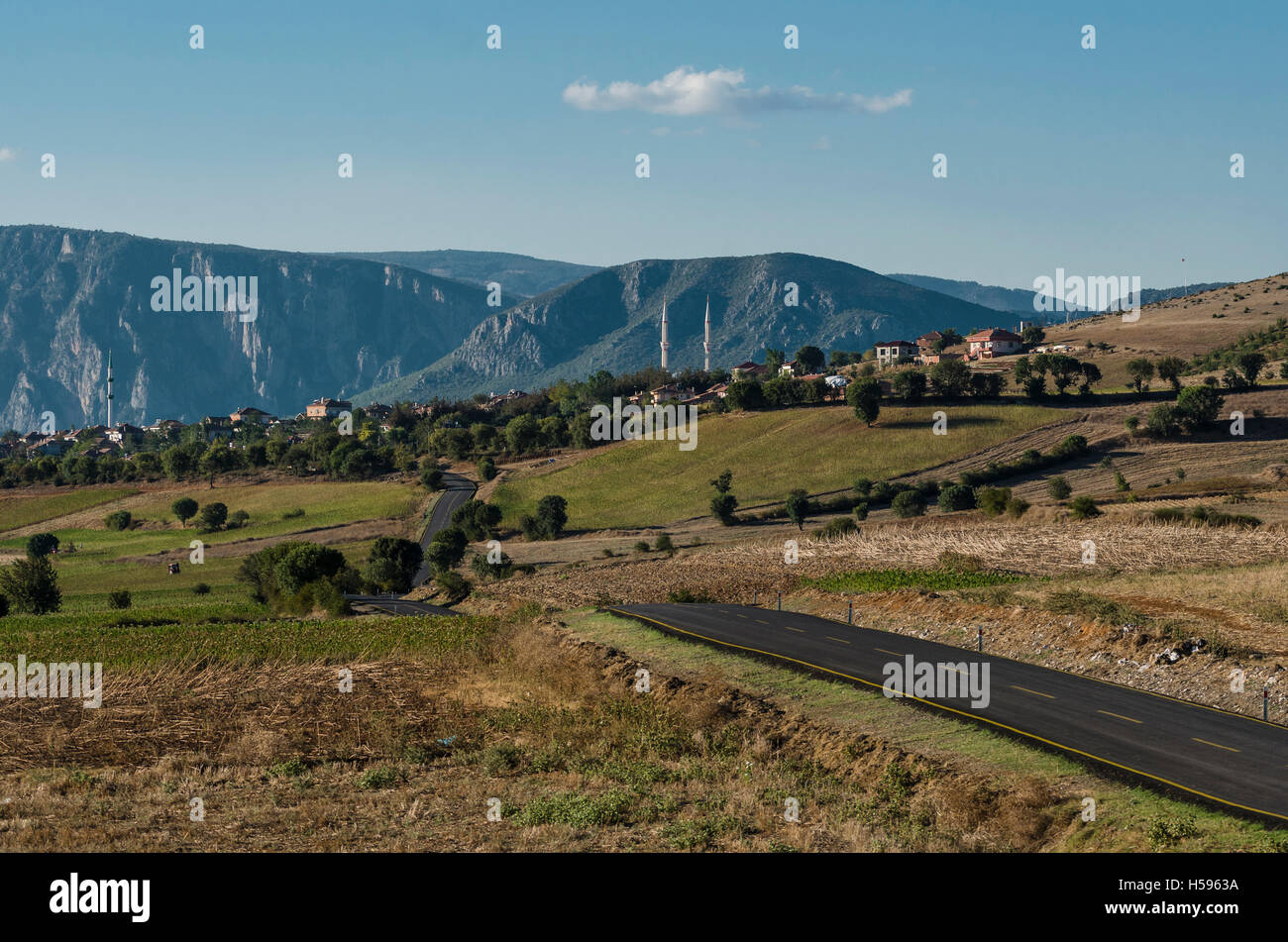
Hello everyone. The Hittites were renowned charioteers and art frequently depicts them riding to war on chariots. This strikes me as odd, since whenever I look up a physical map of Turkey, see pictures of Turkish landscapes or play video games partly set in Turkey, I see a country that is very rocky, mountainous and seemingly not conducive to cavalry, certainly not to wheels. How did the Hittites thrive with chariots in this environment, or am I wrong about the environment?
Let's look at this question in two parts: geography and chariots.
You're right that much of Anatolia has some interesting topography, with major mountain ranges and hilly plateaus. But, many of the places where we find cities are somewhat less topographically challenging. The central Anatolian plateau has a lot of low rolling hills punctuated by more extreme hills. Many cities are located near water sources on gentler topography and therefore the landscape is more conducive to vehicular transport. There are also several very flat parts of modern Turkey and the ancient Hittite Empire. The Konya Plain is a large region in Central Anatolia that is as flat as Florida, and the region of Kilikia/Cilicia is fairly flat as well. However, it is important to recognize that the Hittite Empire extended further south, into the plain of Syria and Northern Mesopotamia as well. One of the most famous and largest chariot battles in the Bronze Age was the Battle of Kadesh, between the Hittites and the Egyptians, and which you can see is gentle topography. Many of the large battles between Bronze Age Empires took place in the areas on their margins, which happen to be the Syrian plains and parts of Mesopotamia.
As for the chariots themselves, all Bronze Age empires were using them, and they were highly developed by the Late Bronze Age. The first vehicles of war appear to show up in Mesopotamia in the 3rd millennium BC as heavy, four wheeled war carts with solid wheels. By around 2100 BC, light 2-wheeled chariots appear in the Sintasha culture of Siberia, likely an Indo-European speaking people. By about 1700, the classical Bronze Age light, 2-wheeled, spoked wheel chariot appears and really sets of the chariot craze. By the 14th C. BC, Egyptian chariot makers were able to make chariots as light as 35 kg. Such light chariots can more easily maneuver on less than ideal terrains, expanding the potential for charioteering outside of flat areas. Of course, mountains are never going to be great, no matter the advances in chariot technology, but the rolling hills of Anatolia would be good enough.
Source. Chondras et al. 2016 The Evolution of the Double-horse Chariots From the Bronze Age to the Hellenistic Times FME Transactions 44, 229-236
e. Fixed some typos