Because an attempt to do so would have played directly into Japan's strategy for ending the war quickly, and also because the USN did not have the strength in 1942 to beat the entire Japanese fleet in a stand-up fight. Japan's strategy for winning a war against the US mirrored its successes in the Sino-Japanese and Russo-Japanese wars; to wit, they wanted to draw the American fleet toward a decisive battle with Japan, attriting it along the way by attacks from shore-based airpower and submarines issuing from island bases, before eventually destroying it in a decisive battle near the Home Islands. This was in fact their only hope of winning the war, because they lacked the transport capacity to hold on to Midway, let alone Hawaii or the West Coast.
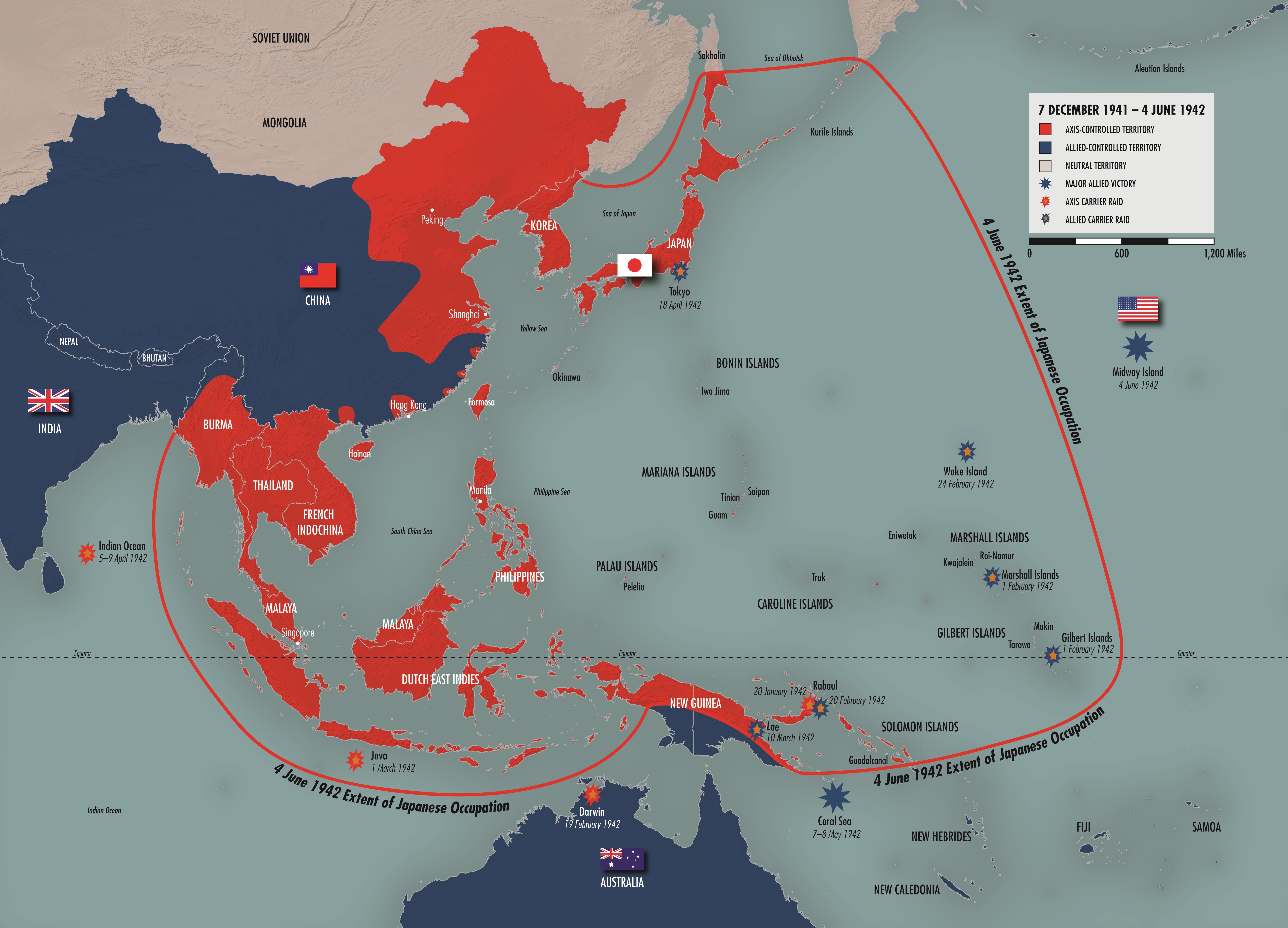
This is a map of Japanese possessions in the Pacific on the eve of the battle of Midway; the date is a bit arbitrary because Japan didn't lose any territory immediately after Midway, but Midway was the point at which Japan lost the strategic initiative in the Pacific. Even to an armchair admiral, it should be apparent that a strike directly at the Home Islands would put a fleet in range of land-based recon aircraft and floatplanes, and give the IJN significant warning to concentrate forces.
The destruction of four Japanese carriers at Midway, coupled with the crippling of two more at the battle of the Coral Sea in the run-up to Midway, is what allowed the USN to go on the offensive in the Pacific, but even so the invasion of the Solomons is often referred to as Operation Shoestring because the Allied forces were not anywhere near operating efficiently or with the sheer weight of numbers they would later in the war.
As the American weight of materiel grew overwhelming (Japan completed 10 aircraft carriers of all sizes during the war; the United States built 100), some islands were eventually bypassed and let to starve on the vine. The large Japanese base at Truk (modern day Chuuk) was hit with heavy airstrikes for two days in February 1944, during Operation Hailstone, and then essentially ignored; Rabaul was similarly disabled during Operation Cartwheel. The reason for bypassing those bases was that taking heavily defended islands was a costly proposition, and the goal of the island-hopping campaign was to seize bases within striking distance of Japan, so that American B-29s could carry on a bombing campaign preparatory to an invasion.