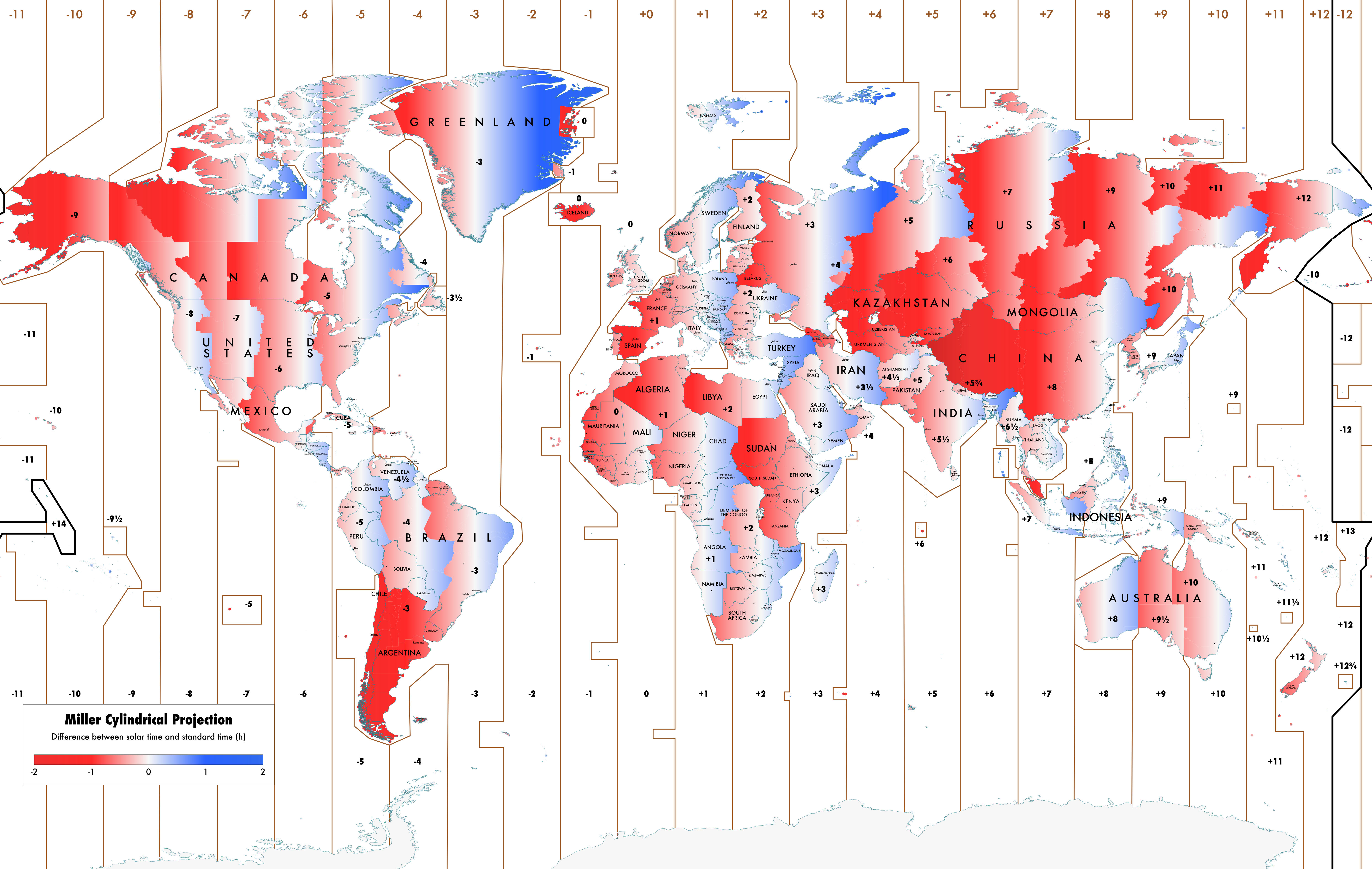
Like say when Columbus went to North America was he just sailing like “damn this day is super long”?? Did the change in time zone ever majorly mess with people when they travelled? When countries agreed to meet each other at 3 pm would there be drama bc they didnt know that each other’s 3 pms were different? Kind of a dumb question but i am curious
This is a common question on here and based on a common misconception. Time zones were not "discovered." They are entirely artificial concepts. "Noon" was defined as when the Sun was highest — so it was always local, meaning time moves with you, rather than you moving against time. Moving on foot, or even on horse or by boat, you will not visibly notice that your local time changes as you move longitudinally. 3pm is always 3pm wherever you are — any difference between 3pm in London and 3pm in Moscow, for example, would be lost in the travel between the two. The fact that it will be measured differently at different longitudes is just a natural consequence of living on a spherical planet, and has been known since Antiquity.
It is only when you have much faster transportation that you can outpace "local time" by a significant fraction. Time zones were first invented by the railway industry when it became clear that coordinate times was essential when you are sharing track between multiple fast-moving objects — if your "noon" and the other train's "noon" differ by 10 minutes, that can be a real problem if one train is going to occupy one place at "noon" and you are meant to occupy it a bit later than that. Breaking it into "zones" just meant, "we'll call this time X even if it is out of sync with local solar time." These zones later became globally standardized and agreed upon between nations for the same expeditious reasons. But, again, do not confuse them for a natural phenomena: they are just a way to insure standardization, and they are entirely arbitrary (which is why the map of them is so all over the place; some time zones diverge considerably from actual solar time by as much as 2 hours).
There is only one situation in which the time slip becomes noticeable by boat: when you circumnavigate the planet, and you lose or gain (depending on your direction) an entire day in the aggregate (we mark this with the International Date Line but it happens even without time zones, and is again a consequence of living on a sphere). While this fact is pretty straightforward to figure out in an intellectual sense, it was still bewildering to the crew of the first ship that circumnavigated (Magellan's voyage) when they found that their date count was off at one of their stops (they kept very careful logs). If you have travelled across the International Date Line even today, one can sympathize: "losing" or "gaining" a day still feels pretty strange, to suddenly be off the "count."
The idea that time is different on different parts of the globe has been known since classical antiquity, but since time was generally kept locally throughout most of history, this caused an extremely small amount of "chaos."