Attended early St Patrick’s Day festivities (in the US) and noticed some men walk by in white armbands. Another spectator became very agitated and upset that the armbands were inappropriate somehow and/or that the wearers must not understand what those bands meant.
A casual search turned up a reference to the painting “A Huguenot on St Bartholomew’s Day” and the massacre and the white armband signifying “an allegiance to Roman Catholicism” but I’m curious about what it might mean present day or recent past.
While it’s impossible to be certain as to what provoked this specific response in this specific context short of asking the person you saw, there’s some evidence to suggest one plausible explanation for his/her shock.
To provide a bit of (grossly oversimplified) context, during and after the 1920-1922 Irish war of independence, a number of paramilitary groups emerged on both the loyalist (those who supported Ireland remaining part of the British Empire) and republican (those who supported an independent Irish republic) sides.
One of these groups was the Ulster Special Constabulary, a group comprised principally of members of the Ulster Volunteers, a loyalist militia organized in 1912. These men were overwhelmingly Protestant and loyal to the unionist cause, and many of them had extensive experience fighting Irish republicans seeking to carve out an independent state from the British Empire. The B-Specials, in particular, were a part-time, one day a week division of the USC, who often patrolled in plainclothes.
During and after the war, B-Specials participated in a number of incidents that a supporter of the Republican cause might deem...well, problematic, such as the burning of the village of Roslea in reprisal for the IRA’s killing of a constable, or the 1922 Desertmartin killings, or...well, anyone from either side could go on at great length about all the atrocities the other side committed during that period of Irish history.
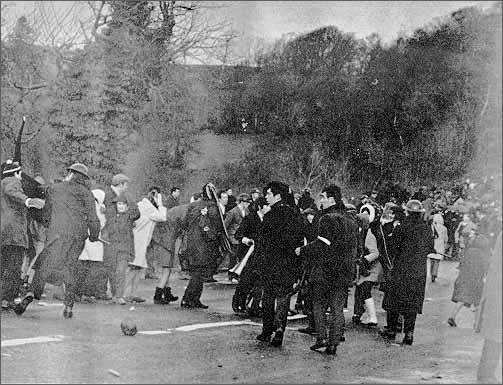
So what does this have to do with white armbands? In 1969, at the onset of the Troubles, a group of leftists affiliated with socialist group People’s Democracy launched a march from Belfast to Derry, in what was seen by many as a provocative action. Supporters of the notorious archconservative Ian Paisley and many of the B-Specials came out to counter-protest, and launched a violent attack on the marchers. From an eyewitness account:
“I saw the police moving through the fields, and then I saw the first attacker wearing a white armband. Then I began to see other men wearing similar armbands standing in groups on high ground along the road. I remember then dismissing the idea that the attackers would simply be angry groups of locals annoyed at demonstrators passing through their village. My impression now was that the attack was well organised, and the armbands were for recognition purposes.
By now the field seemed crowded with men and youths, perhaps 100 or 150. I saw some women and girls, too, among the people in the field. I saw the police marshalling a girl along in the field. She carried two milk bottles in her hand. Then I saw the first stone come whizzing through the air and remember shouting to the people near me to get in against the hedge. In a second the air was thick with missiles. I pulled my coat up around my head and crouched down, stumbling forward. There was utter confusion as girls screamed, and stones and bottles crashed around. I kept my head down but on once looking up I saw another large group of men with cudgels and sticks running onto the road ahead of us.”
You can see photos of the attackers in their armbands here: https://cain.ulster.ac.uk/events/pdmarch/egan7e.jpg
The attack became somewhat notorious, especially given that nearby members of the formal police, the Royal Ulster Constabulary, were widely perceived to have either ignored or actively abetted it.
I’m not sure this is why this person reacted in that way, but it seems to me like one plausible reason.
Sources: Pearse Lawlor “The Burnings 1920” (Mercier Press 2009) & “The Outrages 1920-1922” (Mercier Press 2011); Bowes Egan & Vincent McCormack “Burntollet” (LRS Publishing 1969)