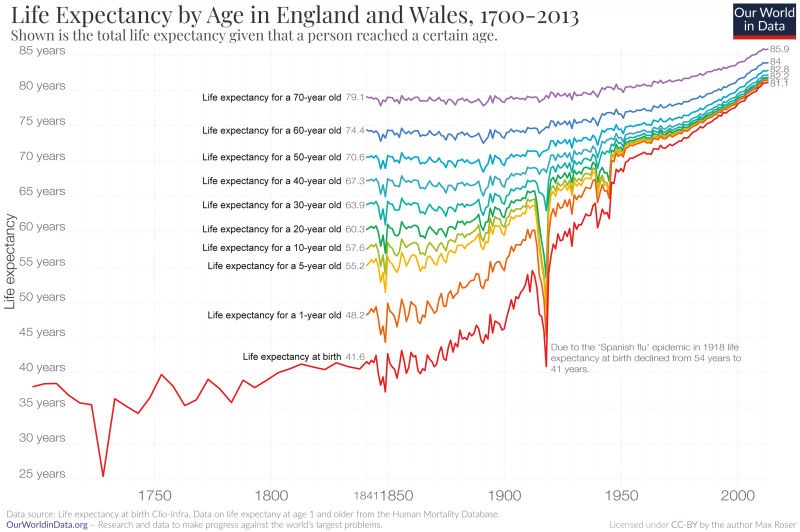
It was, at least for developed countries, lower.
The usual number given for life expectancy is the "life expectancy at birth" (LEB). This is the predicted mean age of death, given the mortality patterns at the time of birth. This can be significantly reduced by infant/child mortality. E.g., if half the population dies before 5 years old, and the other half dies at age 60, the LEB will be between 30 and 35.
It is possible to exclude infant/child mortality. For example, the "life expectancy at 20" (LE20) is the predicted mean age of death for 20 year olds, given the current mortality patterns.
Looking at data for England and Wales:
in 1841 the LEB was 42 and the LE20 was 60. This shows the impact of infant/child mortality (and the LE1 of 48, LE5 of 55, and LE10 of 58 give a more fine-grained view). The 2013 LE20 was 82, significantly higher than the 1841 LE20. The greatly reduced impact of infant/child mortality can be seen in the 2013 LEB of 81 (which is higher than even the 1841 LE70).
Basically, not only has modern medicine greatly reduced infant and child mortality, it has also allowed older people to live longer. Diseases such as cancer are much more likely to be successfully treated today, partly due to improved early diagnosis, and partly due to improved treatment. Victims of heart attacks and strokes are less likely to die. Apart from diseases of the very young and the old, those of in-between ages could and did catch infectious diseases, and sometimes die from them (see the differences between the LE20, LE30, LE40, and LE50 in the graph above). These diseases can be more successfully treated today (not always easily, and in the case, e.g., of tuberculosis, but still with much more success than before). Surgery is more likely to be successful, with a much lower chance of infection.
Where there has been a significant chance of death from warfare, LE20 has been lower (in the graph above, the impact of WW2 on life expectancy can be seen; WW1 is also visible, but partly masked by the much greater impact of the Spanish Flu pandemic). Major epidemics/pandemics can reduce life expectancy. These have resulted in decreases in LEB at times in some countries. For example, the AIDS/HIV pandemic had a major impact in some countries (especially in Africa), with reductions in LEB around the turn of the century (with an increase over the last decade or so, due to reduced transmission and improved treatment).