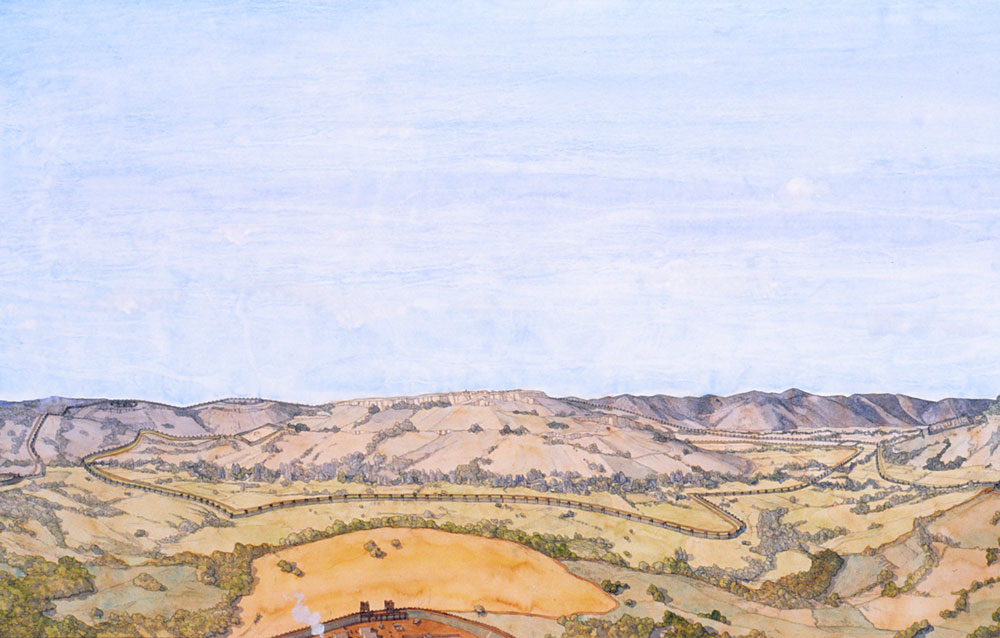
To be more specific, the city of Alesia was the city Vercingetorix held his last stand in during Julius Caesar's campaign of gaul. I know it's on a hill somewhere in central France. But where the hell is it? And how was the surrounding countryside like? Was it grassy, forested, or some sort of marsh of swamp or something? And what was the city layout? Was it based on a Forum or just a bunch of houses?
There's an academic quasi-unanimity locating Alesia on Mont Auxoix, a relief over Alise-Sainte-Reine (Côte-D'Or) in Burgundy although this had been a controverted question during the XIXth and XXth century, due to the political nature of archeology under Napoleon III and the Third Republic.
Contrary to common belief (and Astérix's jokes), a strong medieval traditions at least from the Carolingian period, already asserted the association which in spite of more or less scholarly alternatives ranging from quite fanciful as Alès (Gard) or more serious as Alais (Doubs), which was one of the main reasons, along the previous discovery of a stele bearing the name ALIISIA, why Napoleon III supported the archeological campaigns around Mont Auxois being particularly interested on them as he was writing a biography of Caesar as a leader that conquered a primitive people and pushed it to greatness, essentially a comparison and promotion of Bonapartism.
Excavations and surveys were made in the 1860's, tentatively identifying Caesar's double fortifications as well as Gaulish and Roman militaria, the case being closed off for some decades, without really convincing skeptics who pointed to possible topographic discrepancies between Alise and Caesar's description of Alesia : eventually, the development of archeological methodology allowed a more in-depth survey of Mont Auxois in the first half of the XXth century, which brought out the Roman city of Alisia that succeeded to the oppidum; but as well a reevaluation of XIXth and early XXth century finds. At this point, the controversy over the location of Alesia, with the possibility of other sites being proposed, began to die out in academic circles but continued on its momentum outside, highlighting some divorce between a more professionalized archeology and amateurs historians or pop-history, an evolution that was cemented by the Franco-German archeological campaigns of the 1990's.
Nowadays, the "controversy" is thus largely a matter of contrarian and non-academic history (fueled by media sensationalism and the historiographic importance of the battle), focusing on the politicized context of the first archeological campaigns and "official archaeology", still largely focusing on topography given by Caesar (which is, paraphrasing Yann LeBohec, particularly vague as uninteresting for Caesar's roman audience) an sites that were either already surveyed without result, or sites without strong evidence to justify funds attributions.
There's a real bundle of evidence with linguistics (the change from Alesia to Aliisia to Alise is following what we know of Gaulish and Vulgar Latin), miitaria (an important number of Gaulish and Roman weaponry pointing at a concentration of fighters), numismatics (Vercingetorix's coinage including a siege monetary made of unusual metals), traditions and of course the double fortification that is unheard of elsewhere in Gaul, evidenced both since the XIXth century but especially by aerial surveys.
As far as it can be told, the immediate context of Mont Auxois didn't widely change during centuries : a narrow plain probably favoring a agricultural polyculture based on grains and mixed cattle around an oppidum we know very little about, the surrounding heights being probably covered partly in trees. While entirely speculative, it wouldn't be wrong to imagine Alesia's surrounding as a mix of hilly forests and agricultural plains.
Unfortunately, we know much more about Caesar's fortifications (whose basis was made in stone) than about the oppidum of Alesia itself : Gaulish buildings were made in materials that aren't preserved well archeologically, clay, wattle and daub, wood, etc. and contrary to the oppida of Bibracte or Corent, the site was not abandoned after the Roman conquest but became a small Roman city abandoned in the Vth century CE; which is why most reconstitution avoid detailing the oppidum (such as Jean-Claude Golvindepiction of the Siege of Alesia)
Likewise, the political setting of Alesia is more speculated about than really certain : it's precised by Caesar that it was the oppidum of Mandubii, an otherwise unknown people which led to hypothesizing they might have been a pagus or a quasi-pagus of either Aedui or Lingones; but it could simply had been a small and unimportant people in the sphere of its powerful neighbors. Diodorus Siculus wrote that Alesia was the "metrpolis" of Gaul, a religious center for all the land, but it simply doesn't fit the archeological reality.
There's several elements pointing to Alesia's murus gallicus (possibly reconstructed after the siege) being mostly present in the eastern side of the plateau, the western part being naturally defended by the relief's escarpment. It's likely that only a part of the plateau was occupied (2 hectares altogether on 90, further separated in a North and South part), the proto-agglomeration likely playing a similar role to other oppida outside the Mediterranean arc, as in a planned community fortified and maybe built over an unknown sanctuary (that speculatively could have preceded Alisia's temple) and serving as a production (especially in metallurgy) and local commercial node : Celtic Burgundy was indeed the trade and economical hub of Gaul, connected to the Mediterranean trade.