Finland never had its own state before 1917 (the Russian grand dutchy of Finland could be argued, but it was still a part of Russia) but before being a part of Russia, Finland was part of Sweden for over 6 centuries. Given all of this, how did Finnish culture survive and how did the Finns remain their own distinct, unique people? Apart from bith the Swedes and Russians?
The earliest references to Finns in writing occur in the first century CE, through mentions by Mediterranean geographers, the Roman Tacitus mentions the fenni and the Greek Ptolemaios mentions the φίννοι (finnoi).
This is a Germanic term which has reached them through Germanic, likely Scandinavian, sources. This period, starting in the first century BCE is the 'Roman Iron Age' in northern Europe, due to the fact that the peoples started interacting with the Roman Empire, such as serving in Roman legions. Roman artifacts such as glassware begin turning up in Scandinavia - and Finland - in this period, and you also see the introduction of Roman agricultural methods and the Germanic peoples inventing/adapting the runic writing system based off a Mediterranean alphabet (probably Latin). There is less Roman influence in present-day Finland though, and to some extent the Roman influence may have come through trade with Germanic neighbors.
But in any case there was a lot of Germanic contact with Rome in this period and it's not so surprise then, that it's in this era that Finns and other northern European peoples start showing up for the first time in the written sources we have.
But this also means that, to the extent we can rely on these accounts (and they're not considered very reliable) the picture we get is a Germanic one. It's not clear which people (if even any specific people) these 'Fenni' actually refer to, although it is clear it's a neighboring people who the Germanic peoples consider more primitive.
The etymology of the term is uncertain but the most widely-held theory is that it shares a root with Old Norse verb finna ('to find'), Proto-Germanic *finþaną. A theory here is that this would've been a generic term for people who were living a hunter-gatherer lifestyle. By the Viking Age (800-1050) the meaning appears to have narrowed, with West Norse (Norwegian and Icelandic) using the term to refer to Sámi people (e.g. Finnmark in Norway) while East Norse sources (Swedes) are using the term to refer to people from Finland. A hint at the broader usage is the name Finnveden in southern Sweden (attested since the 6th century), which is not known to have ever had either Sámi or Finnic population, but as a somewhat remote, rocky, forested region may have been later to adopt agriculture.
So anyway, it's not obvious who these oldest sources are referring to. The earliest sources we have that certainly refer to Finns in Finland are Viking Age inscriptions on rune stones in Sweden, and sagas and other Norse sources from the 12th and 13th centuries. These sources are quite consistent, in that Finns and Finland are not the same as the present day sense. Rather, Finns are people from Finland, which is roughly the region now known as Finland-Proper (Varsinais-Suomi) or the Aura river watershed. They are one of a number of Finnic peoples occupying the regions surrounding the Gulf of Finland.
See this map. Going clockwise around the gulf you have Finns-Proper (F11 on the map), the Tavastians (Hämäläiset, F12), Karelians (F8), Veps (F9), Votes (F10), Vironians (F4), Estonains (F3) and Öselians (F2). (but Veps and Votes as well as Satakunta, F13 are attested a bit later, around 1300).
So 1,000 years ago, prior to Swedish rule, Finns and Finland in the present day sense do not exist. Rather you have distinct groups of Finnic peoples who have separate identities albeit with broad cultural commonalities, and form a dialectal continuum linguistically.
Likewise, Sweden was not a single country nor ethnicity in 1000 CE but divided into Svear (Old Norse Svíar, or Swedes-proper), Geats (ON Gautar) and the region now known as Småland (the 'petty kingdoms') is named such as it was divided into more petty kingdoms than people cared to count (map. At the end of the Viking Age, these people were brought under the rule of a single ruler within the Kingdom of the Svear (which is the Swedish name for Sweden).
In Scandinavia the Viking Age ends with the consolidation of power and unification of Denmark, Norway and Sweden. In Finnish historiography this is followed by the Crusader Period (1050-1250 or 1300). The Scandinavians were not the only vikings (in the sense of raiders) in the Baltic, even if they were those who traveled the farthest. In the 12th century the (relatively) new Scandinavian churches and settlements are being raided by their neighbors and the Northern Crusades begin, under the justification of being retaliatory raids on their pagan neighbors. The Swedish kings begin to establish themselves in Finland-Proper, and parts of the expanding Swedish population emigrate to coastal southwestern Finland as well. (also western Estonia) but the Novgorodians are also expanding westwards. Although we know nothing of Slavic missions to Finland, it appears that they made the first inroads for Christianity as many basic words pertaining to the religion are of Slavic-Greek origin rather than Germanic-Latin. (e.g. a cross is risti from Old East Slavic крьстъ and ultimately Χριστός ' christ', a bible is raamattu from OES грамота and Greek γράμματα, 'writing')
A Novgorodian chronicle mentions Swedes and Tavastians attacking them in 1142, although Swedish sources are silent, and in 1191 the Novgorodians and Karelians attacked the Tavastians. In 1187 the town of Sigtuna was attacked and burned by eastern pagans, Karelians in one account. In 1171 we have a letter from the pope to the Swedish king and Jarls admonishing them to send more forces to Finland to convert the population and protect the Christians there.
Tradition has it that the Saint-King Erik and Bishop Henry converted Finland and conquered it for Sweden in a crusade in the 1150s. Although part of the 'founding myths' of both Finland and Sweden today's historians put little stock in the story, as the only account is from far later and written by Erik's family who were lobbying to have him canonized. We can say for certain though, that inroads were being made in that era. It's not until Birger Jarl's reign around 1250 that Swedish rule over Finland (or really just southern Finland) is secured.
Over a dozen wars in the following 600 years between Sweden and Novgorod and then Muscovy and then Russia, the border shifts back and forth quite a bit but on the whole it stays around the Karelian isthmus. This border is defined more by the locations of strategic border forst (Vyborg, Keksholm, Nyen/Petersburg) than by any ethno-linguistic border. On the contrary, more often than not the border ran through the middle of Karelian lands.
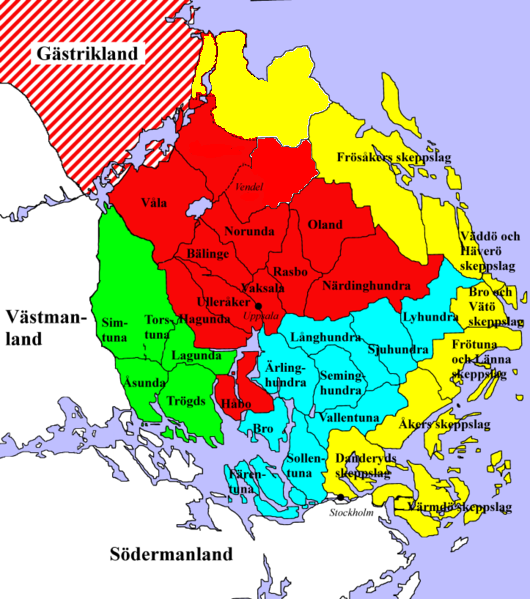
So it's only by the Renaissance or so that Swedes (and thereby others) begin using Finland as a pars-pro-toto for the entire region (within Sweden) inhabited by Finnish/Finnic speaking people. Likewise, the Finnic names for Sweden (Ruotsi/Rootsi) derives from Roden, the coastal area north of Stockholm that was closest to Sweden, (Yellow here) and which had been a petty kingdom of Svíar.
Administratively though, Finland was an integral part of Sweden divided into a number of administrative regions no different from those in the western half of the kingdom. Lapland was a single province extending into both countries, as was Bothnia until it was split into Westro- and Ostrobothnia. Finland was not a colony; Finns were full citizens with parliamentary representation in the Riksdag of the Estates and so forth. It was in fact a more integrated part of the kingdom than Lapland was, where the Sámi were by-and-large left to do their own thing.
Sweden was never really ethnically homogenous. The country was founded on a union of Svear (Swedes-proper), East and West-Götar (Geats), Helsings, Njudungar, etc who'd originally had distinct identities and their own laws and so on which faded over the Middle Ages in favor of a national Svensk identity. But there were and still are many regional cultural differences and dialects that are not mutually intelligible, even if few speak those dialects today. Medieval Stockholm was dominated by German tradesmen and merchants and there was a massive Low German influence on the language and culture.
But the Swedes in turn also had a massive influence on Finnish culture and language over the 600 years of Swedish rule. A large amount of Finnish vocabulary is borrowed from Swedish, some of this influence goes back as far as Old Norse and even Proto-Norse (i.e. well before becoming part of the kingdom). There is also some Finnish influence on Swedish language.
But there was never any active campaign to assimilate Finns. Once you reach the 1500s-1700s the educated and upper classes often tended to be able to speak Swedish and it had influence as being a prestige language. Finns who became ennobled tended to adopt a surname in accordance with Swedish noble surname traditions (and due to their actions in defending the eastern border, Finland ended up with a larger petty nobility) and adopt the language and manners expected of their station. Which at the same time was not really the language and manners of the Swedish-speaking peasant who lived in Finland, nor the Finnish speaking peasant who lived in Sweden - both of which were significant minorities.
[continue]