I have had the impression that the vikings and the finns didn't have much relations. I have heard that there is Norvegian or Icelandic saga telling of some viking raid to Finland which didn't go well. Is this true?
Well the Vikings and Finns are not really peoples here; the Norse peoples of present-day Sweden were divided into Svear, Geats, Gotlanders and others, and in Old Norse sources they are contently identified in this way. Likewise, Finns in the present day sense were divided into different peoples who were consistently distinguished in Old Norse sources. By 'Finland' they really meant what's Finland-Proper (Varsinais Suomi) or more or less the Aura river area, this was distinguished from Tafæistir (Tavastians, Hämäläiset) and Karelar (Karelians, Karjalaiset), which were also distinct peoples from those in Vírland (Vironia) and Eistland (Estonia). (areas like Satakunda, Savonia only turn up later in the Middle Ages) Here's a map
Now we have no written records from Viking Age Scandinavia, except for runic inscriptions. (and written records from Finland are even younger) But since rune stone carving was most common (by far) in east Sweden, we have written attestations of these place names in memorials of vikings who'd died there during the Viking Age. But even without that there is plenty of material culture attesting to close contacts, trade - and raiding (likely in both directions) - during the Viking Age and even before it.
Although the Viking Age is considered to have started with the raid on Lindisfarne in 793, the ships found in Salme in Saaremaa (Eysýsla in Old Norse, later Ösel) indicate that raiding had begun across the Baltic at least a half century earlier. Finns had peaceful trading contacts as well, not just with Scandinavians but with neighboring Novgorod as well, and present-day Germany. A hoard of 11th century coins was found in as remote a place as Kuusamo, and consisted mainly of German coins, likely indicating it did not come from vikings, as there would typically be more Anglo-Saxon and Arabic coins in the mix then. In Tuukkala, deep in Savonia, a late Viking Age buckle has been found. Stylistically it's from Gotland and engraved with runes saying "Hegvé owns me", indicating some Norsemen (or at least their stuff) made their way well inland.
That's just a couple examples, but as said there's a lot of material evidence going very far back.
There's also linguistic evidence; although Finnish has a lot of Swedish loanwords from its time as part of the kingdom of Sweden, some go much farther back. For instance kaupunki is likely from Old Norse kaupangr and not the later Swedish köping. Some loans even predate the Viking Age as they're from Proto-Norse, for instance kuningas from *kuningaz (Old Norse/Swedish konung, Swedish konung), juusto from *justaz (ON/S: ost). The initial 'j' from proto-Germanic was lost when it became Old Norse. That's also seen with juka from Proto-Norse *juką, (ON/S: ok, compare to English 'yoke' where the initial 'j' sound was not lost)
Despite these contacts, Finnic peoples are not mentioned very much in the Old Norse sources though. This is probably to be expected since most of these are from Iceland, and secondarily from Norway, with a few Latin chronicles from Denmark as well. But there is very little written matter from today's Sweden about or from the Viking Age, who were the peoples who were not only closest to Finland but also traveled eastward the most (see trade routes)
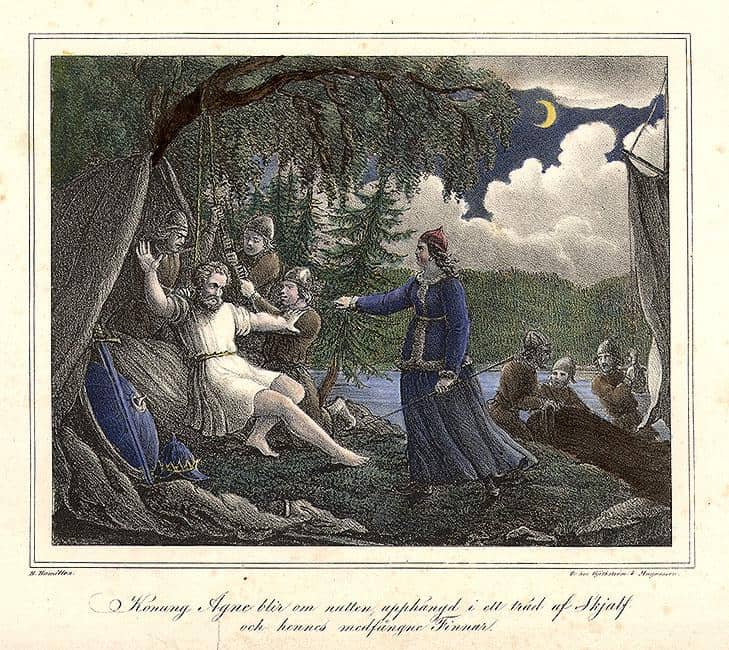
Some mentions did make it in to some of the Icelandic sagas though, primarily Heimskringla by Snorri Sturluson. His book contains Ynglinga Saga for instance, which tells stories of two Svea kings who took Finnish brides: Vanlandi seems to have had peaceful interactions with a prominent Finn he visited and marries his daughter, but he leaves her and returns to Sweden. When he doesn't come back as promised, she has him killed with magic. The second story is of king Agni, who defeated a Finnish lord and took his daughter as a wife and returns with her to Sweden. But she convinces him to have a wake (erfi) or grave-beer in memory of her father, gets him drunk and threads a rope through his golden necklace and has her men hang him from a tree. (fulfilling a prophecy that this necklace would lead to the death of one of the best of the dynasty) She then returns to Finland.
These stories are not considered historical by any measure by today's historians. They are also similar enough that some have suggested they may be different versions of the same original myth. But in any case they may nevertheless have something to say about interactions with Finns in the Viking Age and also attitudes and stereotypes about them.
Although the Yngling kings are listed in earlier sources (e.g. Historia Norvegie and Íslendingabok), the details about Finland are unique to Snorri's account, and could possibly be the result of the fact that he'd visited Västergötland in Sweden and picked up some local folklore and history there.
It is also in Snorri's Heimskringla that we find the story you're referring to, which is part of the Saga of Saint Olaf (Saga Ólafs hins helga), the viking saint-king who was the most popular Scandinavian saint by far in the Middle Ages (no doubt in part because of his viking background) and the subject of very many stories. Anyway, in this story he's on a raiding tour of the Baltic, he fights the Swedes, goes and loots Sigtuna and gets trapped inside lake Mälaren, but escapes by digging a new channel out to the sea through Agnafit (the place where the aforementioned king Agni was hanged!). He spends the winter in Gotland where they pay him tribute and goes on to Eysýsla/Saaremaa to demand tribute, but is met by locals carrying weapons rather than valuables and is forced to flee.
After this he goes to Finland(-Proper) and raids there, but the people ran inland into the forest with their valuables and Olaf and his men followed but were ambushed at a place named "Herdalar" (which is a Norse name and certainly not Finnic). They took cover but lost many men and were forced to retreat to their ships, but the Finns followed them along the shore and conjured storms.
So Olaf had no luck with the Finns here. (the Öselians or inhabiants of Saaremaa are also desribed as a distinct people well into the Middle Ages. They were however most likely Finnic as indicated by a quote in the Livonian Chronicle of Henry where Öselian pagans mockingly yell "Laula! Laula! Pappi") By this point in time in the late 1100s, when we have records in the neighboring countries, the Öselians are notorious for piracy and raiding. But also the Karelians were attributed with a raid on Sigtuna in 1187. As for Saint Olaf, his story is no doubt fictional in its specifics, but again, there's no doubt viking raids on Finland and Saaremaa and other places occurred, as well as Finnic raids on Norse peoples.
I mention Olaf's escape from Mälaren in Sweden as there's an older version of that particular myth; here, however, Olaf escapes by praying and god makes the rock open, much like Moses parting the sea. So this part of the story may be Snorri's re-working a story of a miracle attributed to a saint into a historical event where digging was involved. What's unique to Snorri here is that he mentions the place name from the story of Agni and puts all these events in specific places near "Stocksund" (now Norrström in Stockholm, most think - Stockholm probably wasn't founded yet)
So for this case, Snorri seems to be drawing on some Swedish sources here. He pretty much says as much too; the story claims many Swedes were killed when the water broke through the channel Olaf had dug but Snorri adds the comment that "The Swedes deny this".
So Snorri Sturluson, who wrote much of what we know of Norse mythology and folklore, likely fleshed out his stories with information he'd heard in Sweden, and it's through that that we hear about Finland. But the overall shortage of mentions of Finland is not due to a general lack of interaction but a lack of interaction with the peoples who wrote the sagas. (instead we have more information on what the Icelanders did, like travel off to America)
One might add that the Ålanders are completely absent in all Old Norse sources, despite being inhabited by fellow Norsemen (a general term I have to use since we don't really know i they considered themselves Svíar/Svear/Swedes or a separate people like Gutes/Gotlanders). Nor are there any Viking Age rune stones from Åland or Finland except for one fragment found in 1997 on a shore in Hitis/Hiittinen. (which could've ended up there as an anchor or ballast stone)
So there were contacts though, even if Finns were always depicted as being pretty "other" and there seems to be a persistent stereotype of Finns as magic users, which lasted well into the modern era if you look for instance at what Swedish neighbors wrote about Forest-Finns in the 17th and 18th centuries.
To answer our question in short though, it's true that saga exists. The story in it is certainly not true; Saint Olaf probably never went to Finland and suffered a defeat. But there's no reason to doubt that many other vikings did go there and lose, and that this story may owe something to accounts of such events.