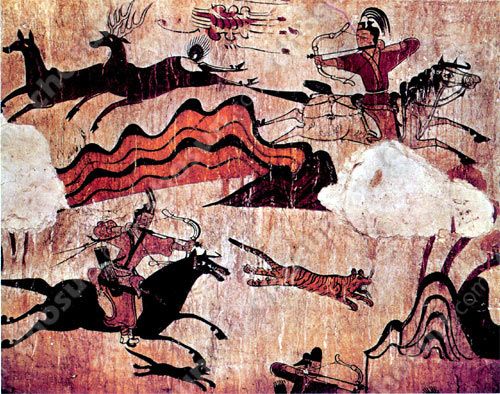
to me atleast it seems back quivers are far more convenient and less likely for the arrows to fall out than a quiver on the back of the waist so why was the latter alot more common than the former? is there some draw back to back quivers or advantage to hip/waist quivers im not thinking about or aware of
The main advantage of a back quiver is that it's easier to walk, march, or run, compared to a hip quiver hung from a waist belt. The hip quiver is only supported from the top, and can bounce around a bit as the thigh hit it.
The hip quiver has advantages, too. First, it's easy to see how many arrows you have left. Second, if you're using a quiver in which the arrows are stored tip-up (which is quite common for hip quivers), you can see what kind of arrow you are getting out. Third, tip-up quivers like this are usually closed quivers, with a lid to protect the arrows, and it's easier to open if you can see what you are doing. (Some nock-up quivers are closed quivers, too.)
The hip quivers that are most susceptible to bouncing around are low-slung quivers. These quivers are, historically, specialised cavalry quivers:
Similarly, low-slung swords are cavalry swords, as I discussed in https://old.reddit.com/r/AskHistorians/comments/feo6m0/why_did_some_people_wear_their_swords_hanging/ - these swords also bounce around when running.
Infantry tend to wear their quiver higher, and closely attached to the belt rather than hung on long straps:
The two archers on the right are using a common style of infantry quiver. The archer on the lower left wears such a quiver, but is also holding a bundle of arrows in his bow hand, for quicker access. The archer on the upper left has the same type of quiver, but is wearing it as a back quiver.
The last archer - the upper left archer - shows that the same quiver often can be worn in more than one way. An archer could, for example, sling the quiver over one shoulder for convenience when marching, and either shoot with the quiver in that position, or if the hip is preferred, and time is available, move the quiver to the hip before battle.
There is also a compromise between the hip quiver and a back quiver, in which the quiver is hung from the shoulder, but at the side of the body, rather than at the back. In this case, the quiver often hangs a little above the waist, and won't be bounced around by the legs when running or walking.
less likely for the arrows to fall out
A quiver that doesn't hold the arrows securely and bounces around when running could result in arrows falling out. However, the simple solution is to (a) avoid low-slung quivers when on foot, and (b) use a quiver that holds the arrows securely. A back quiver that doesn't hold arrows securely can result in arrows falling out if the archer bends over, e.g., to pick up something.
The last three points - the same quiver can be worn on the back or at the side, the side quiver hung from the shoulder, and quivers that securely hold arrows - are discussed in https://www.youtube.com/watch?v=UBo_ZPuK7ec which also shows some examples of back quivers.
Back quivers can also be seen in Assyrian art, ancient, Medieval, and Early Modern Persian art, and Indian art.
While the low-slung quiver is a classical cavalry method, other methods and types of quivers have been used by mounted archers. For example, Chinese and European examples of back quivers:
Note that the Chinese soldier has a low-slung bow case.
Another alternative for mounted use is the short quiver on a waist belt:
With these quivers, the quiver only covers the tips of the arrows, and the arrow shafts are behind the back. The arrows can be in a similar position to how they would be held in a back quiver (but usually with the nocks near the left shoulder rather than the right shoulder). The arrows are removed by grabbing the shaft of the arrow near the tip. Quivers like this were used most notably in East Asia, especially by the Manchus and Qing Chinese, and in Japan:
These quivers, with most of the arrow exposed, are just one end of a continuum of quiver design. At the other end are quivers that completely enclose the arrows (often but not always closed quivers). Between these extremes are quivers that cover and expose more or less of the arrow. Quivers that cover more of the arrow than these tip-only quivers can be worn with the top of the quiver in a similar position, and the arrow taken out of the quiver similarly:
For more discussion of quivers, see the discussion by u/Hanrohan and u/Noble_Devil_Boruta and u/Muleo (and me) in https://www.reddit.com/r/AskHistorians/comments/8bhqjn/how_did_archers_keep_their_arrows/