The painting in question can be viewed here, and very clearly depicts a man and a woman indoors, clothed but with their bottoms hitched up to reveal their genitals. A third companion remains covered. What's with this?
The painting is part of a series of all 12 months of the year from a prayer book called Très Riches Heures painted by the Limbourg brothers for a Duke in France from 1412 to 1416.
What's with this?
Class warfare.
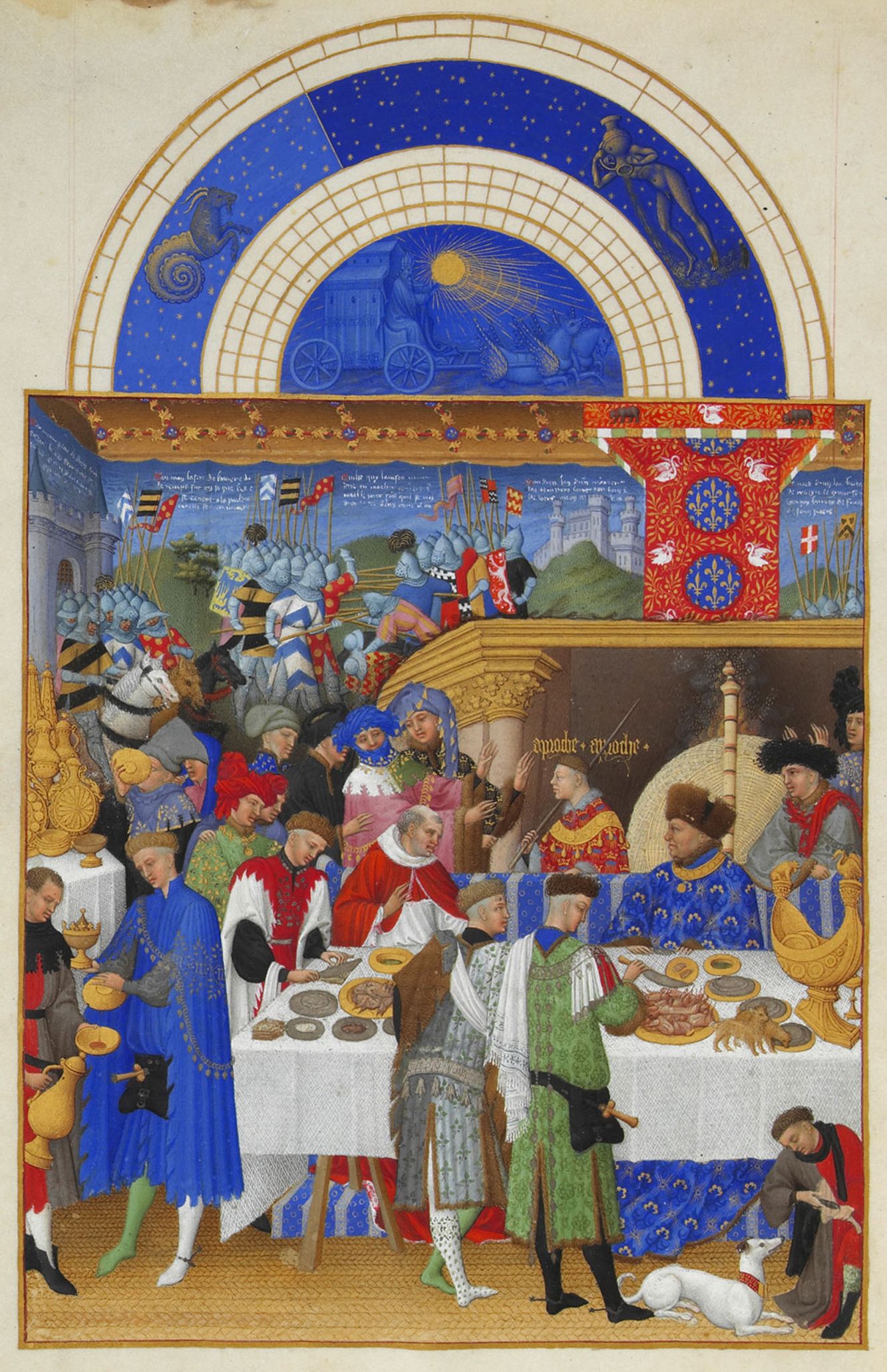
The boorish, lowbrow peasants with their genitalia exposed are contrasted with (1) the woman 'closer' to the reader in the February miniature, whose clothes depict her as also a peasant but better off, and with (2) the illumination for January, a parallel scene depicting fully-clothed nobility.
Jonathan Alexander picks up on earlier identification of an Italian influence on several of the Months, including Jan-Feb. In that mode, you might see a peasant lifting her skirt slightly but modestly for warming. The Northern version's addition of the risque peasants, given the mostly-traditional miniature cycle, is thus A Statement.
To support the idea that it's not a depiction of different, er, warming practices between Italy and France, Alexander also identifies the phenomenon at work in the September miniature. Most of the peasants are stooped over, hard at manual labor. But of course the reader's attention is drawn to the center, where a peasant is bent over thus exposing his buttocks. He is grouped with two beasts of burden in the immediate viewing frame, not with other people.
The Tres Riches Heures skates an interesting line between the standard "virtuous peasant" depictions, and the "lazy peasant" ones. These peasants aren't lazy, but they're...I think a good parallel would be, they're the medieval version of "virtuous rednecks."
And the December illumination, based on the castle in the background, depicts the duke's servants and court hunting in the royal forest. The miniature cycle isn't just about demonstrating amused superiority over peasantry; it's a claim on the part of the nobility.
...Particularly, as Alexander points out, because any of the duke's contemporaries viewing the manuscript on display would have understood that the income from those peasants' backbreaking labor was what enabled the duke to afford such lovely decorations.
The Tres Riches Heures illuminations are an assertion of power.
Oh hey, I know this one! To begin, some of the best and most accessible sources on the topic are J. J. Alexander's "Labeur and Paresse: Ideological Representations of Medieval Peasant Labor" and Michael Camille's "'For our Devotion and Pleasure': the Sexual Objects of Jean, Duc de Berry." Most of what follows summarizes their analysis of the manuscript and its images.
The manuscript in question - the Très Riches Heures, made for Jean of Berry in the early fifteenth century - is considered one of the finest examples of medieval and early modern book production. It's also incomplete, as its artists - the Limbourg Brothers - died of the plague in 1416 (the same illness that claimed their patron). The manuscript is a Book of Hours, a kind of devotional "guidebook" intended for the lay piety, which surged in popularity and production during the reign of the Valois (the French royal house, to which Jean belonged). Because Books of Hours include a calendar of prayers, cosmological and astrological imagery was not uncommon; in this case, the miniatures, which are crowned by an astrological lunette, tie the operations of Jean's feudal estate to the order of the cosmos.
A word about Jean as a patron and collector: he was known as the most avaricious man in the world, and his collection included precious stones and jewels, deluxe manuscripts, as well as twelve châteaux, which were inhabited by menageries of exotic creatures. These estates were so important for a variety of reasons, not the least of which is because they included thousands of serfs who labored under the duke as part of the manorial system. Indeed, the manors and castles that belonged to Jean's reach are illustrated throughout the manuscript and have been invaluable in the historical analysis of French medieval architectural cites, most especially the palace of the Louvre in Paris. As Alexander has argued, the inclusion of these structures in the manuscript's miniatures - especially relative to the peasants - enacts a system of social surveillance. In other words, even if the Duke isn't specifically depicted in most of the miniatures, through the presence of his palaces and castles, he exerts an implicit and contemptuous gaze over his vast holdings. It is in this way that the manuscript serves as a sort of autobiographical artifact or a catalogue of collection, through which we may map something of the patron's worldview.
To the point: the February miniature cannot be understood absent consideration of the January miniature that preceded it. The January miniature imagines the Duke during the New Year feast. He is notably seated against a roaring fireplace, whose screen acts like a halo framing the Duke's unholy figure. The miniature is also important because it represents something of a painterly inventory, on a day characterized by the exchange of gifts (as a footnote here, gift exchange was an important part of the regulated power dynamics practiced by the Valois). Rather notably, on New Year's, Jean gifted Pol - the oldest of the Limbourg brothers - an eight-year-old heiress, whom the Duke had abducted when her mother refused the marriage. As Camille has argued, the January miniature represents a sort of homosocial space, where the cupbearers, who are distinguished by the phallic corkscrews they carry, are like Ganymede, sexual accessories in the attendance of the Duke and some of the prized objects of his collection.
Playing on these themes, the February page mocks the plight of the peasants as possessions viewed and consumed under the Duke's watchful gaze. In both the January and February miniatures, the subject is one of warming in the wintertime - nobles in the former and peasants in the latter. However, the fire in the February miniature is not nearly so powerful, and the cold of the snowy landscape is emphasized by the serfs laboring outdoors. Their exposed genitals are not unlike the corkscrews in the January miniature, but here, explicitly drawn, they make the peasants into vulgar and boorish foils (some have even argued that the February genitals resemble cow's udders). Because the manuscript presumed a single reader - that is, Jean of Berry - the warming of the serfs' genitals by the fire is not a documentary record of medieval peasant behaviors - rather, it becomes a way by which the patron fetishized the objects of his domain, poking fun and undermining their plight relative to his own.
It's worth noting, moreover, that there's a play on "flesh" happening here. The manuscript is, of course, manufactured on vellum, which is tanned and scraped calfskin. Leafing through the manuscript, therefore, would have required flesh-to-flesh contact (the fingers of the reader and the animal skin comprising the page). There is a kind of suggestive connection in the way that the individuals and objects represented (on other pages, the peasants bare their bottoms, for example) serve as representations of the flesh in another sense - that is, as sexualized objects in the Duke's collection. In short, through the manuscript, we come face-to-face with Jean of Berry's fetish of collection - jewels, gems, properties, and people.
And yes, for anyone wondering, the Duke was a totally terrible dude. Even his brother, King Charles V, cut him off for his various misdeeds.