Sweden is cold. Although I might look outside my window right now and see a sunny, clear day, I know it's going to be cold when I go out for a nice walk in the sun.
In the construction of houses in Sweden in the 19th century, what we'd recognize as wall insulation existed, often in the form of wooden panels to prevent drafts. However, it wasn't until the late 19th century that houses were consciously insulated as part of their construction. If you lived in a castle, the chances were high that it was built before the 19th century. In the worst case scenario, you have a specifically cold castle with a terrible draft. Thermal comfort, therefore, was not built into the frame of the buildings.
In 1835, the reigning king of Sweden was Charles XIV John (Karl XIV Johan), originally born as Jean Bernadotte in southern France. Although Charles XIV John had been king for little less than 20 years at this time, there was one aspect that would continuously bother him until his death in 1844: The Swedish climate. "The soul shrinks and becomes gray of this cold," he wrote to his wife, something that succinctly explains his reasons for keeping himself indoors, preferably in his bedroom or in the adjacent parlor, during the Swedish winter in which the cold drafts from the exterior leaked in through windows and floors. Charles liked it warm, approximately 20°C-24°C (68°F-75°F), and to achieve this steady temperature, he turned to masonry stoves (kakelugnar). Masonry stoves were beautiful and large, and essentially became an important piece of royal furniture as the design was improved in 1767 by Fabian Casimir Wrede and Carl Johan Cronstedt. From thereon, the masonry stove was practically an obligatory presence in any Swedish castle. While the large, open fireplaces remained alongside the masonry stoves, the masonry stove had an advantage in that the channels that led the smoke through the chimney was designed in a way so as to keep the heat longer in a room than had ever been possible before. Yet for a man like Charles XIV John who wanted it really warm, he supposedly had two masonry stoves on full effect. It would take another 60 or so years before central heating was invented. Other measures to keep a room insulated and prevent heat loss was the use of curtains which would serve to regulate heat during the summer and to sustain heat during the winter.
In Gunhild Eriksdotter & Mattias Legnér's article Indoor Climate and Thermal Comfort from a Long-Term Perspective: Burmeister House in Visby, Sweden, c. 1650–1900 (from the The Journal of Architecture, Design and Domestic Space, 2015), in which they investigate the well-off Burmeister house, show changes in thermal comfort over time but they also show how difficult it can be to interpret the heat systems in a historic building. Yet one interesting observation they make in their analysis is their focus on paintings and furnishings as affecting thermal comfort. The placement of furniture could take advantage of different heat sources, for example, and no to mention the use of light sources (kerosene lamps, etc.) from the mid-19th century forward. More importantly, it also shows that the aspirations for thermal comfort changed over time. During the 19th century, the demands would be higher than they might have been in the previous centuries, which is reflected in the improvements of different stoves (masonry, iron, tile).
In summary, the latter half of the 19th century saw new developments in insulation in the time leading up to the introduction of central heating at approximately the turn of the century. A Lord or a King would have relied on fireplaces and masonry stoves to keep the rooms inhabitable year round, although Charles XIV John is an extreme example of someone who definitely let the cold bother him. This is not taking in consideration the work that Charles XIV John's servants had to put in to keep him warm by constantly tending to fireplaces and stoves.
In your case, however, I would not recommend doing the same thing. My advice for you would be to perhaps invest in a chest full of gloves that you could let your daughter wear, and perhaps, just maybe, ask your wife for advice? I get the feeling that she might have some knowledge from her past about keeping enclosed spaces warm.
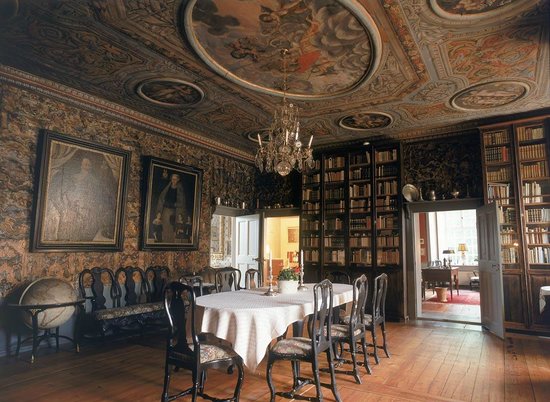
Well there were few castles in the medieval-defensive-structure sense left in Sweden by that time that would've been rebuilt many times over the century into something more chateau-like, although Swedish does not distinguish the concepts (slott). Ängsö slott_ pictured here for instance is built on medieval foundations (which are quite obvious if you visit its dungeon!) but most of its current appearance is due to rebuilding in the 18th century. So it by-and-large looks like it would've in 1835 too (except for the external metal fire-escape), and so do the interiors.
Castles are pretty notorious for being cold and draughty, and the reputation is not undeserved. There were large rooms with high ceilings, many large windows (in later eras) and the stone and/or masonry walls were good conductors of heat. So the average Swedish peasant living in a full-timber house (e.g. like this) had an easier time holding his place warm, not least since the fireplace was in use much of the day for baking and cooking. As /u/Bernardito talks about in his post here, in larger homes and in more urban environments where you needed stoves to provide heat alone, the Swedish-style of masonry stove dominated by that point in time.
Nevertheless, it was quite costly to keep an entire castle warm. Stone and/or masonry walls were a more solid, expensive and higher-prestige material. In fact the peasantry would often go to some lengths to make their houses not look wooden, with paneling on the outside and stucco on the inside walls. But wood was a much better insulator. Having big rooms was also a matter of prestige, even a masonry stove or fireplace would still not heat a large room that effectively. To mitigate that you'd have things like curtained beds (e.g. at Skokloster), or the sleeping quarters would be in a small room. In some cases there'd even be a fancy large bedroom for receptions in bed (imitating the French kings) but a separate adjacent smaller bedroom for actual sleeping.
The concept of insulation was well understood by this point in time, but there was relatively little that could be done without substantially reducing the sizes of the rooms. Wood paneling as Bernadito mentions is one thing, but it was also common at the time for the walls to be covered with painted cloth, separated from the walls on wooden lathes. Or more elaborate tapestry with woven patterns, depending on your style and on how rich you were. Leather tapestry was big in the 17th century but pretty out of fashion by by the early 1800s, although it remained in some places like Grönsöö slott.
In short it wasn't easy to keep the place comfortable on the whole and quite expensive. In the case of Ängsö for instance the current owners don't even try; they live in one of the external wings and keep the main building heated only to the extent required to avoid humidity issues.
So, you'd really need a masonry stove in your room, unless perhaps the room shares a wall with a fireplace that's used to the extent that enough heat leaks through it to the other side.
Keeping her isolated from people may be a problem; I'm not sure ice powers gave you automatic dispensation from the law that made attendance at church services mandatory, as well as husföhör, the mandatory testing of everybody knowing Luther's Small Catechism and their ability to read select bible passages.