With something so simple and using ingredients that were, to my knowledge, relatively common across Europe I'd have thought it would have been more common. Did everyone else just get distracted by bread?
I've read the Wikipedia entry for the history of pasta and I understand it's related to other boiled doughs throughout history but these all seem focused around Arabia, North Africa. How come no other European cultures decided to mix eggs and flour and then boil the dough into something resembling pasta? Or alternatively, is there an understanding as to why it took hold in the Mediterranean and not elsewhere?
Long traditions of pasta making largely overlap geographically with long traditions of growing durum wheat. What is durum wheat? Durum wheat (Triticum durum) is the second most commonly grown species of wheat, but at only about 5% of the global wheat crop, is far behind common wheat (Triticum aestivum), which is about 95% of global wheat production. Durum wheat is a hard wheat ("durum" is Latin for "hard", and the root of English "durable"). It is notably difficult to mill to a fine flour, and is traditionally ground to coarse semolina rather than a fine flour. While durum wheat has a high protein content and a high gluten content, this coarser milling makes most of the gluten unavailable to form the gluten network that results in an elastic dough and soft risen bread. Not for nothing is common wheat also known as "bread wheat" - the high-protein varieties yield a high-gluten flour that makes excellent elastic bread dough (this type of flour is known as "hard flour", while low-protein flour is "soft flour", better suited for soft cakes than bread-making).
Dough made from semolina (i.e., milled durum wheat) can be used for bread-making, but the bread tends to be dense. More commonly, durum wheat is used for pasta-making, semolina porridge, dense cakes, and other wheat products such as bulgur. Semolina dough is plastic rather than elastic, and well-suited to being rolled into thin sheets, lacking the elastic rebound seen when, e.g., rolling or stretching pizza dough. With its low gluten availability, semolina dough can be crumbly, and thus eggs are commonly added to help bind the dough.
Thus, durum is widely used for pasta because (a) it isn't good for bread-making, and (b) it's good for pasta-making. Medieval pasta was made from common wheat as well as from durum wheat, or a mix of the two, but all-durum pasta was generally recognised as a superior product.
Durum wheat was the predominant wheat variety grown in Western Asia, and it spread around the Mediterranean in antiquity. Durum suits the Mediterranean climate well, and this made up for the greater difficulty of milling, and its unsuitability for bread. Durum also has a long history of being grown in India, where it is used for flatbreads and semolina cakes such as halwa and sweet semolina puddings. More recently, it is grown in Russia and Kazakhstan, where it is mainly used for domestic pasta production, and Canada, the USA, and Australia, where it is used for pasta and also exported to the Mediterranean area.
There are traditional European pastas outside the Mediterranean area, such as Spätzle and Knöpfle of southern Germany and Austria, and similar pastas to the east and west, from Alsace through to Hungary. These pastas are often made from durum semolina, with eggs, but were often made from spelt (Triticum spelta) flour in the past. There are also pasta dishes with a long history in northern Europe, including noodle soups (e.g., chicken noodle soup), macaroni and cheese, and filled pastas/dumplings. Macaroni and cheese has a long northern history, with a recipe appearing in the Medieval English cookbook The Forme of Cury (14th century):
Take and make a thynne foyle of dowh. and kerve it on peces, and cast hem on boillyng water & seeþ it wele. take chese and grate it and butter cast bynethen and above as losyns. and serue forth.
In the eastern Mediterranean, there are filled dumplings like the Turkish manti, which are descended from old Turkic dumpling traditions rather than Mediterranean filled pasta traditions. There are also Turkic and Persian traditions of unfilled pastas - noodles - going back to Medieval times if not earlier. These are commonly made from common wheat, sometimes milled whole (i.e., wholemeal flour). East Asian wheat noodles are also made from common wheat, often with an alkali added to alter the mechanical properties of the dough. These noodles are often pulled rather than rolled, and an elastic dough is required. Rolled-and-cut noodles and pinched noodles don't require such elastic dough, and are often made from grains other than wheat, such as rice, or non-grains such as buckwheat, beans, and sweet potatoes.
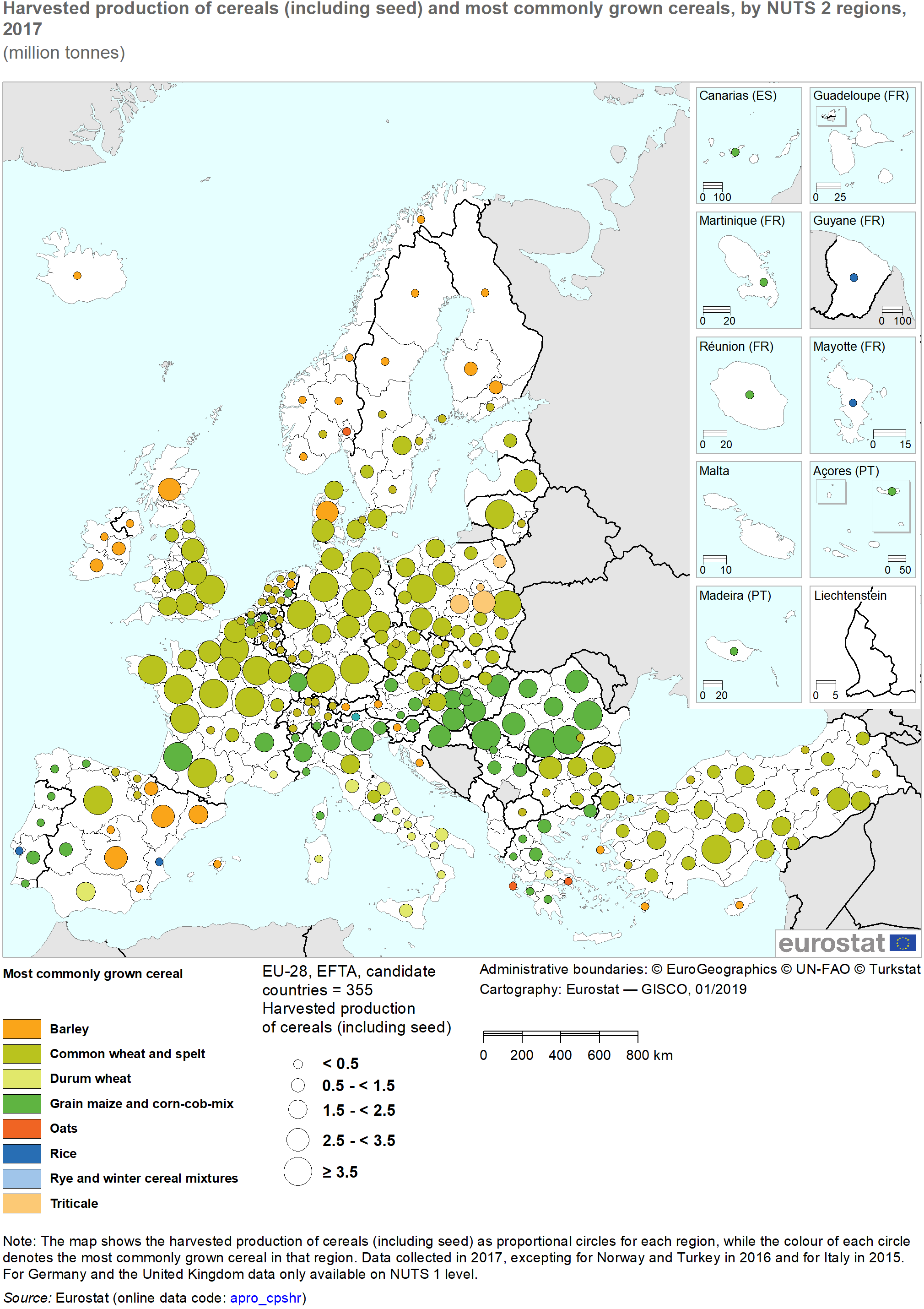
Finally, it should be noted than wheat was not the most-grown cereal in much of northern Europe, where barley, rye, and oats were often more important. This reduced the role of both wheat bread and pasta in the region.
For more on the history of pasta, see
For a map showing cereals grown in different parts of Europe, see:
Missing from this map is cereal production in North Africa, where durum wheat is an important crop (much of which is made into couscous, also a pasta even if much smaller than typical Italian pastas).