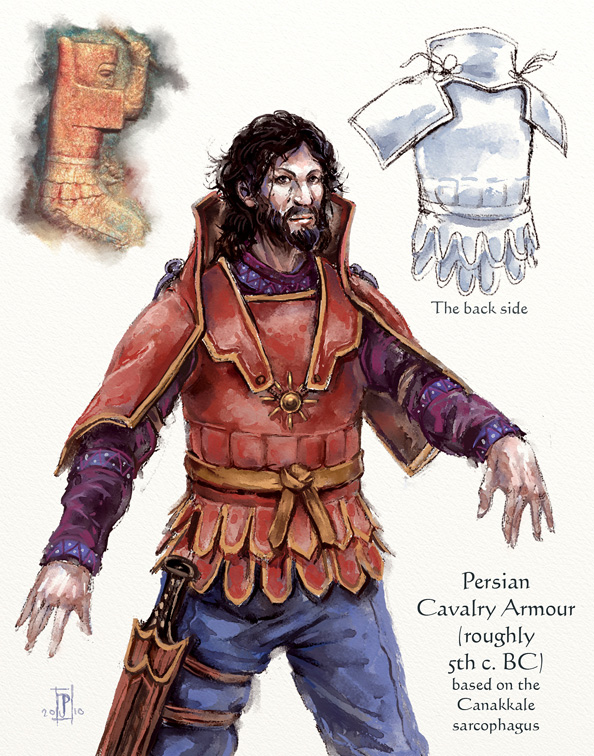
Hello, I plan on recreating the Battle of Marathon for my 3D short film project and I have two questions concerning the Persian gear:
Thank you very much for any advice,
martin
This is very difficult to say, for a couple of reasons. First, obviously, there's about a century between the Battle of Marathon and the sarcophagus depiction, and the Persian military undoubtedly changed over time.
Second, as you can see, the relief of the cavalryman is not exactly clear. I'm especially unclear on the interpretation of the legs, if you look at the full relief you'll see that the soldier seems to be wearing some sort of greaves that go well above the knee, and it's really hard to say what the covering of the upper legs and glutes is supposed to be. It's at least conceivable that the artist is trying to depict some form of scale armor made from metal there, and the same goes for the section below the waist.
Most likely, the Persians had at least a few different types of cavalry. Archaeological evidence and Assyrian depictions of Median cavalry suggest that some horses would have worn at least a minimal amount of scale armor, and that some riders would also wear scale armor, much like the Persian royal guard seems to have done. Essentially, such armored riders would form the forerunners of the later Cataphracts. This depiction is one possible interpretation of what they may have looked like - but any attempt at "reconstructions" such as this should be taken with a large pinch of salt!
The standard-bearer seems to be derived from this depiction on a c. 470 BC bowl. The handful of mentions of standards in Xenophon and Herodotos suggest that they were carried by commanders and officers:
When [at the battle of Plataia] the commanders of the other divisions of the barbarians saw the Persians pursuing the Greeks so hastily, they all forthwith seized their standards, and hurried after at their best speed in great disorder and disarray.
This suggests that the purpose of the standards was organizatorial and that they provided a visual cue for soldiers to follow, aiding cohesion.