I build model planes in my spare time and I frequently see paint schemes labeled with not only a unit or squadron but a specific pilot. I know in modern times, US planes may have a pilot's name listed on the aircraft but it's not always flown by that person. In WWII some aircraft marking systems indicated ranks or leadership, so I've been assuming specific pilots could only fly certain planes but that seems like it would cause unnecessary limits during wartime.
If anyone could provide some insight on this I would be very grateful.
I'm afraid it only covers the RAF, but from my reply to a question a little while back:
Pilots were assigned specific aircraft, they didn't just rush to the nearest (unless in an emergency); here's a section of Geoff Wellum's First Light describing his checks on his aircraft for a morning on readiness with 92 Squadron:
"Dispersal pen and my Spitfire. I pause and look at her. A long shapely nose, not exactly arrogant, but, nevertheless, daring anyone to take a swing at it. (...) I walk forward and hang my parachute on the port wing for a quick getaway; you can easily put it on whilst the engine is being started (...) Now up to the cockpit. Up on to the wing and step in. I hang my helmet on the stick and plug in the R/T lead and oxygen tube. At the same time, I check the bottle content: full. Fuel? Press the fuel gauge button,real full also. Now brake pressure. OK, that's fine. Trim? Let's adjust it now and then it's done with. Full rudder bias to help with the swing on take-off, elevators one degree nose heavy, that's good. Airscrew, full fine pitch. That's about it, then, ready to scramble when the time comes. Bound to come sometime. It'll be a miracle if we get through to midday without one."
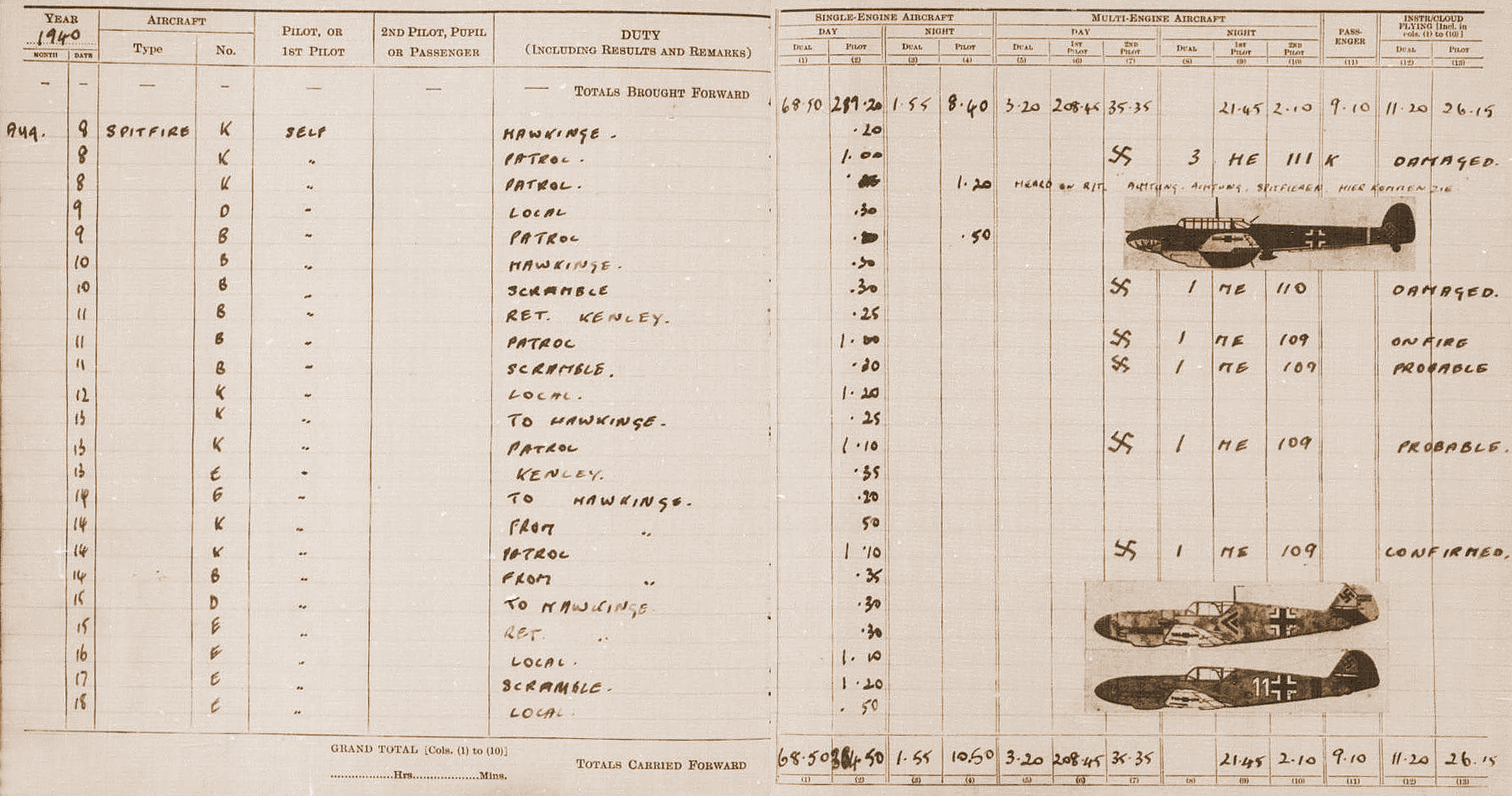
It wouldn't necessarily always be the same aircraft; squadrons typically had an established strength of 12 aircraft and between 16 and 26 pilots to allow for rotation, leave, illness and injury etc. Logbooks record which aircraft were flown; F/O J J O'Meara of 64 Squadron, for example, flew Spitfires coded 'B', 'D', 'E' and 'K' during August 1940, whereas F/Lt E H Thomas of 222 Squadron mostly flew Spitfire 'ZD A' between 1st-9th October 1940. The higher the rank, the more chance there was that a pilot would have a favoured or personal aircraft; nose art was less common in the RAF than the USAAF but there were instances, such as the shamrock painted on Brendan 'Paddy' Finucane's Spitfire. Wing Commanders would usually have their own aircraft and rather than having squadron markings they bore the initials of the pilot, so 'Johnnie' Johnson's Spitfires carried the code 'JE J'.