After watching a comedic historical show (Kaamelott, not historically accurate at all since it is comedy), where two Roman millitary (a soldier and the commander of Roman Britain) mention spending over a decade in Britain without seeing their wives and childrens who stayed in Rome.
This made me wonder how soldiers of the Imperial Roman Army, who often served for at least 20 years, had a family life.
Did they have to leave their family behind or did they marry locals? Was there a significant difference between the average soldier and officers stationned in some distant part of the empire?
That's a good question! Of course, being deployed far away from ones home can be one of the more difficult and stressful aspects of military live soldiers have to cope with during all times. This is especially the case for soldiers in the legions of the principate and the high empire, who could be stationed away from their home province for decades, often their entire career. I'll be focusing mainly on this period, and service in the legions, as things do change during the 3rd century, and are again wholly different for the auxiliary forces.
During the 1st and 2nd centuries, this question might have been on the mind of many a Roman soldier, since this problem lies at the intersection of a few social, moral and legal aspects. The legal situation was crystal clear from the time of Augustus, who was interested in appearing as keeper of tradional mores and discipline: Soldiers were forbidden from marriage. He tried to extend this marriage ban to his officers also, but he was unsuccessful in that, as Sueton tells us that he
... made many changes and innovations in the army, besides reviving some usages of former times. He exacted the strictest discipline. It was with great reluctance that he allowed even his generals to visit their wives, and then only in the winter season. [Suet. Aug. 24,1]
Military discipline forbade marriage, simple as that. In there you also already have the answer for your officers. It was quite uncustomary for Roman wives to follow their husbands on a campaign, so they would usually stay at home, in Rome, Italy, Gaul or wherever. There are examples, like Agrippina, or Munatia Plancina, wife of L. Calpurnius Piso who followed her husband to Syria upon his appointment as governour, but those cases are rare. Even so, after the reign of Tiberius it seems to have been increasingly common, though still uncustomary, for the wives of the commanders to follow their husbands into the camp. This was also easier for them, since the higher officers had much more space for themselves, with their own houses, than the common soldiers who lived eight to a small room. Officer's privilege. So our story could end here, right? No marriage, no family live for ordinary soldiers. Just disciplina and porridge. As is often the case with questions of military life and discipline, there are two sides to this problem: official disciplinary regulations, and real practice.
In this time, most of the recruits for the legions came from Northern Italy, many from southern Gaul and Spain, but were stationed on the military hotspots along the Rhine and Danube frontier, Britain, or Syria and Palestine, often for a very long time, so, far away from their accustomed communities. Since the average recruitment age was from age 17–21, and Roman men tended to marry late, most would have been single at that time.^1 Obviously, a bunch of 17–21 year old single men far away from home are not going to stay celibate. There were lots of opportunities for sex, familial bonds and friendships for a Roman soldier in his camp.
It seems in the 1st century, many brothers tended to join the army together, as is evidenced in some tombstones which show members of the same family. Others might have found something close in their contubernium, their 'tent-community', the small 8-man unit that lived, dined, and fought together, and which will for many have become something like a family. We have many tombstones in which people who are obviously not related to each other are addressed as frater, brother, which I think signifies something more than just 'comrade'. But that's obviously not going to be enough for most people. Even hardened Roman legionaries want more than just the camaraderie their comrades could provide.
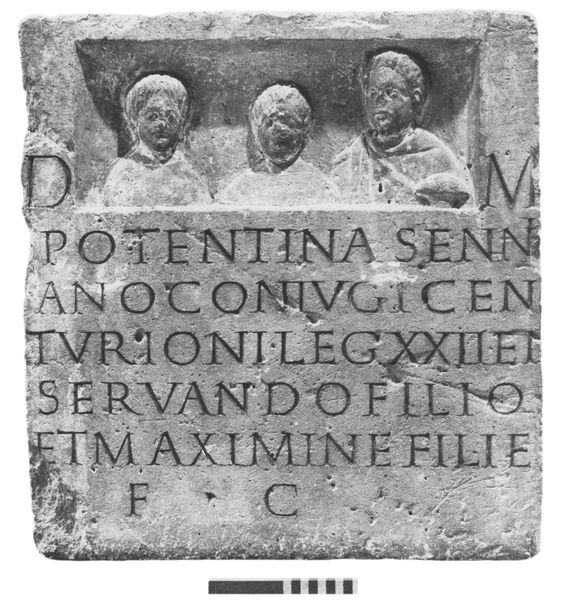
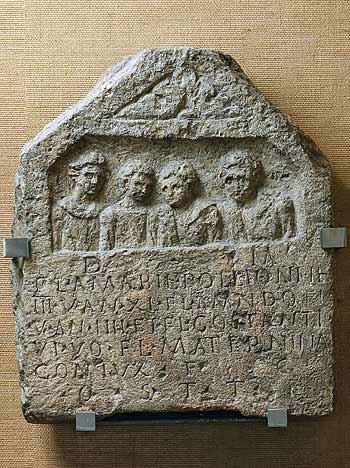
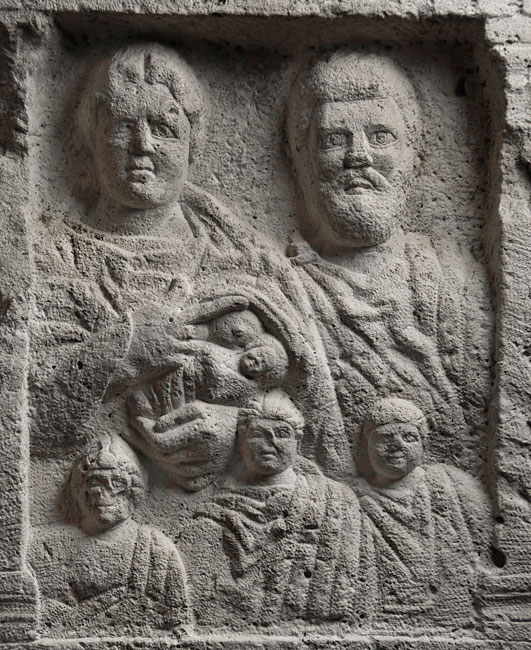
There's an excellent source that can tell us both about their desire for and their achievement of marital bliss, the tombstones of soldiers, often set up before their death and thus an expression of their desire to express their identity and their successes. Many of them chose a martial depiction for their tombstone, such as a soldier in arms, but others are depicted together with their wife and children. This tombstone from Cologne (CIL XIII 8290) for a centurion shows a bust of the deceased along with wife and child (or his son and daughter?), while this funerary monument from Regensburg shows the family of Flavius Amabilis of the legio III Italica. Another depiction of married military life can be found in this stele, erected by Aelius Munatius, medic of the first miliary cohort of Hemesii, and his wife (might be NSFW in America since the mother is breast-feeding one of her childs). That last depiction is for an auxiliary soldier, and from the 3rd century to boot, but what these reliefs and inscriptions show us that these soldiers did have a great and understandably human desire for marriage, for a stable family, and they took pride in being depicted that way. After all, this is how they wanted to be remembered for eternity (and Aelius Munatius explicitly says so in the inscription, fecit m(onumentum) m(emoriae), having it set up during his life time. So you can rest easy, there's no family tragedy behind all of them being on the same tombstone. On the other hand, they're probably all dead by now).^2 Our others sources support this picture: soldiers appear to have been more in search of stable relationships and marriage than just sex.
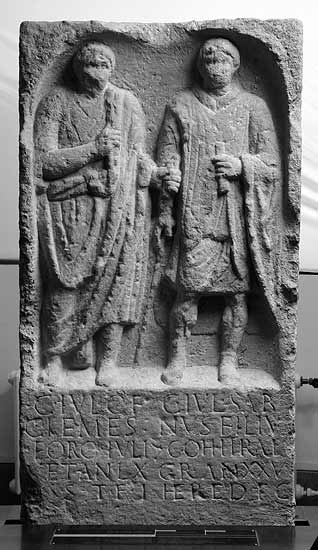
In many of the provinces, over time, this would lead to the development of military 'dynasties' and whole societies shaped by the military community (which might, as Alföldy has claimed, have been an important factor in the evolution of military usurpers and emperors, along with attempts at local independece, as in the case of the Gallic and Palmyrene Empires, and of course the later fracturing of the Empire), with the sons serving in the same units and the recruitment of the legions shifting towards the provinces they were stationed in. This funerary stele from early 2nd century Wiesbaden (CIL XIII 7583) depicts a veteran and his son, who at that time had become centurion of an auxiliary cohort. Many veterans chose to settle down and found a new home near their camp instead of returning to their 'home' they might not have seen in decades, becoming an important catalyst in the formation of provincial society.
But where did the women come from? That might be relatively easy to answer, since an often overlooked aspect of military history, modern and ancient, is that women or 'camp followers' were, in modern times at least from the crusades up into the 19th century, a normal and indeed necessary part of military life and a constant component of what one can call the 'paracivil' aspect of military society.^3 Women were traders, nurses, prostitutes, companions and thus served a vital role for the survival and reproduction of these societies. This was no different for Roman armies. As during the 1st century, legions usually spent their time not on campaign in fortified camps, these became the nuclei for the paracivil societies that began to cluster around the camps in what in Roman terms would be called the canabae legionis, literally the 'barracks' or 'huts' of (around) the legion. Traders, smiths, masons and other artisans that provided indispensable services for the army, along with other civilians who settled down around the camp. These were the origin of many great European cities, like Cologne, Mainz, Strasbourg, Vienna or Budapest. This of course made the development of stable families much easier.
Prostitution was of course one of the businesses, and one of the possibilities for soldiers to fulfil their desire for sexual relations, but not necessarily their desire to found a kind of family. But how did they do that, if marriage was forbidden? Roman law only recognized full marriages and the resulting legal consequences (especially the question of inheritance would have been at the forefront of someone in the military profession) if both partners had the ius conubii, the right to marry, which soldiers did not have due to the prohibition against marriage by Augustus. They could only enter a concubinate, which was legally practically useless for them, until much later, Christian times. Children of such a connection were illegitimate and were unable to inherit intestate, i.e. without a testament, in which case a legitimate child would automatically inherit a certain part of the estate by law. One could work around that by inserting them as peregrine (non-Roman) heirs into the testament, but many might not have been savvy enough in legal matters. That this was a problem can be seen in a reform enacted by Hadrian: One important step for military families was the possibility for military children to be included intestate as third-class, cognate heirs, as shown in an imperial letter preserved in Egypt, even though the soldiers were still admonished for having broken military discipline. NB this was not a problem for children born of a wife that was a Roman citizen: those childrens were Roman citizens by birth, and both the marriage and the child could be legitimized upon discharge. Many local women wouldn't have been Roman citizens, though, as especially in the first century, this was still rare in the provinces.
That the question of inheritance was important for the soldiers can be seen from several birth documents that have been preserved. Since a soldiers illegitimate child could not be simply enrolled as his child, these documents contained the signatures of witnesses who swore by Iove that this child by that mother had been born to that soldiers in the camp so-and-so, so they could legitimize the child after their discharge.