From what I can tell, the general consensus is that Rome is "still the same city" from the ancient days of the Roman Empire and Republic. It was sacked multiple times, and most of its ancient buildings no longer stand, but Rome has a continuous history.
As a contrasting example, Tenochtitlan apparently no longer exists. Its Wikipedia page begins "Tenochtitlan was a large Mexica altepetl...", and popular consensus is that it was destroyed and that Mexico City was built upon its ruins. However, even though Cortés razed the inner city, there seems to be a fair bit of continuity, and apparently the name Tenochtitlan continued to be used by the Spanish for some time.
How different are these situations really? If I were to say that Mexico City is Tenochtitlan, would I be wrong?
With around 2000 years of history behind these two cities, there is a lot to be said on the topic, so I will try my best to answer your question directly.
The biggest difference between Rome and CDMX (Mexico City, DF, Tenochtitlan, etc) is that Rome has a continuous through-line of cultural and political influence, and a large part of that is due to the Papacy. While Rome has been sacked and changed hands politically in some sense, there has been a continuous Roman (Latin) culture that has predominated for most of its history.
On the other hand, Mexico City was obviously taken by conquest, and the socio-political landscape of the city and country was completely overhauled. To put it briefly (because you seem to be more interested in the physical and architectural landscape of the city), when Cortes finally conquered Tenochtitlan, he instituted a Hispanicized Mexico that has continued to this day, where an event like this has not quite happened in Rome throughout its history.
However, Mexico City's landscape shares similarities to Rome in terms of its ancient ruins. While there is no Colosseum dominating the visual landscape, there is just as much, if not more, ruins of the Great Pyramid as the Roman Forum. When Cortes took over the city, he, like many conquerers (include the religious ones that re-appropriated Roman temples), converted Mexica temples into churches, destroyed cultural artifacts, and even used the stones from Moctezuma's palace to build his own. We can make a direct spiritual connection between the Popes stripped Roman marble off of temples to build their Catholic churches, and temples such as the Pantheon converting to places of Catholic worship. Cortes kept the general layout of the Aztec city, and so walking its streets from the Zocalo to Chapultepec, you can easily imagine a Mexica reality to its urban landscape.
What's interesting about Mexican history and cultural identity is that there is differing viewpoints on how to view Mexico as a nation. To your very last question, some Mexicans--including historians--would answer in the affirmative. Cortes had mestizo children, physically and symbolically ushering in a new "people." As preivously mentioned, the Zocalo's layout matches that of Moctezuma's city. Chapultepec Castle has defended the city from an ancient spiritual hill. The Basílica de Nuestra Señora de Guadalupe is built as a pilgrimage site where Indian Juan Diego saw an apparition of the Virgin Mary and converted to Christianity. Hell, they even NAMED the city after the people, as Mexico is the Hispanicized Mēxihcah.
Thus, there are many who see Mexico City, as a metonym for Mexico at large, AS a continuation of indigenous culture. The city itself, while only settled about 200 years before Cortes' arrival, perhaps carries just as much of an ancient spirit as Rome does, although I am not nearly as studied on Italy as I am Mexico. As a personal anecdote (and therefore to be taken with a grain of salt), I find being in CDMX very similar to being in Rome in terms of what you're asking.
In sum, viewing Tenochtitlan as a past reality and Rome as a continuous entity might be white-washing the issue a bit. Romans also have a bit more comfort with its evolution than Mexicans do; however, there remains a great deal of pride and acknowledgement of influence in Tenochtitlan. To put it simply, there is a LOT of Tenochtitlan in CDMX.
EDIT: Since I got here first and am the top post due to how Reddit karma works, let me add some addenda and clarifications from the conversation that has sprung from this:
In this post I advocate for seeing post-conquest Mexico City as a continuation of pre-conquest civilization, not as a "clean break." I do believe it is important to acknowledge just how life-altering conquistador occupation of Tenochtitlan was, however. While indigenous culture prevailed in numerous ways for centuries, a centralized political power remained in the hands of the Spanish, and so this collision of cultures (resulting in the social interactions of the three social classes that resulted from that collision) completely changed the city forever, to say the least. This plays out differently for different cities and regions in Mexico at this time, but that is beyond the scope of this thread.
Cortes razed the city to the ground, as u/Mictlantecuhtli points out, yet much of the surroundings of the Zocalo were rebuilt in indigenous fashion, as u/611131 points out. While this juxtaposition of Spanish and indigenous culture played out practically in the streets of the city, what we see develop over the next few centuries is an interesting interaction and mixture of these two cultures, as u/drylaw outlines. Go check out those posts for more detail!
My sources, as I didn't include originally: Fire and Blood, TR Fehrenbach
Promiscuous Power, Martin Nesvig
Any work by Ramon Eduardo Ruiz
It is new Rome in its courtly manners and shapely figure ....
Then Mexico is the heaven of this world,
For here grows the greatest beauty that the world has seen.
-- Bernardo de Balbuena, Grandeza Mexicana (1604)
Thus compared the Mexican criollo his hometown Mexico with ancient Rome, showing off the city's riches and importance. But how different were both?
Well for starters both conquest campaigns took place on two different continents and over 1000 years apart. You're basically asking two questions here, on Rome comparisons and on Tenochtitlan. So I'll first talk a bit about why I think making this comparison is difficult if not impossible, then turn to the siege of Tenochtitlan and to the continuities with the pre-colonial city and culture - which did and do exist.
There were many parallels between Spanish and Aztec societies, which were already noticed at that time: hierarchical society with rulers, noblemen and commoners, central position of an organized faith, etc. But if one looks more closely, there are also massive differences. This was also the case with the siege of Tenochtitlan - first of all the very different forms of warfare. And then especially the organization of the Nahua (Aztecs) in city-states or altepetl. The groups were loyal to their state, and less so to a larger "empire" of the Mexica. This is one reason why different groups and subgroups joined the Spanish; which was certainly the central reason for the fall of Mexica.
There was the massive demographic catastrophe, killing in some regions up to 90% of the population through a combination of new diseases, war, forced labor and resettlements. There was, in short, modern European colonialisation at play, with ruler built partly on law and on violence. And important adaptation and resistance to it, too.
I am researching colonial Mexico and not ancient Rome - but even in this very brief overview, numerous differences from the fall of Rome are apparent. Above all, however, I would like to emphasize the ultimately very different society with which the Spaniards came into contact, with its own distinct cosmology and way of life. For this reason alone it seems difficult to compare the two examples directly without falling into generalisations or Eurocentrism (sorry Balbuena!).
I think that comparisons can be helpful in history, but especially when the objects are comparable. This comparison seems problematic here. What I can do is to address the second part of the question, which hopefully will allow everyone to make their own comparisons.
(Adapted from an earlier answer)
So we can note at least two reasons for Cortés' comparatively harsh actions against Tenochtitlan (and the Mexica): military and religious reasons. His native allies also used the fall of the Mexica as an opportunity for revenge. Lastly, not all of pre-Hispanic Tenochtitlan was destroyed with the Spanish victory, as its indigenous population rebuilt large parts of the city afterwards.
The Spanish were at first very impressed with the huge city they found built on Lake Tezcoco (estimates are of roughly 250.000 inhabitants), with its large markets and canal system. This changed with the Noche Triste, when after a massacre carried out by one of Cortés' generals the Spanish were chased from the city in 1520. Barbara Mundy notes (in “Death of Aztec Tenochtitlan, the Life of Mexico City“)
While Cortés initially wrote admiringly of the city in his letters to Charles V, his attitude and those of his fellow conquistadores would change dramatically when they attempted to capture the watery city. The surrounding lake functioned like a great moat protecting the island city, and the bridges spanning the breaks in the causeways, which allowed the flow of water from one part of the system to another, could be removed to further isolate the island capital.
[During the Noche Triste, the Spaniards] found that their enemies used the urband canals as transport routes for canoes filled with as many as 60 armed warriors each. Slogging around the canals slowed the conquistadores in their retreat, and when, exhausted, they fled on foot along the causeways, those raised roads served to organize them into a neat firing line for the Mexica sharpshooting archers gathered alongside in the lake in their canoes. Small wonder that they emerged from the war with little appreciation of the role that these causeways and dikes played in protecting the city from the scourges of floods. (p. 76)
This knowledge of the canals and dikes was then used by the Spaniards in their siege of the city about a year later. They methodically destroyed these structures that had helped the Mexica, used them to their advantage, and even cut the city fresh water supply. These were methods of warfare only bent on conquering the city that Cortés and his men had lost once before, without much thought about the long-term effects. These effects were harsh: For centuries after conquest, the city then known as Mexico City would be plagued by heavy floodings, lacking the protection of the dike system, the knowledge of which was lost by then. This led to many projects of draining lake Tezcoco, finished centuries later, which has led to massive other problems for the city.
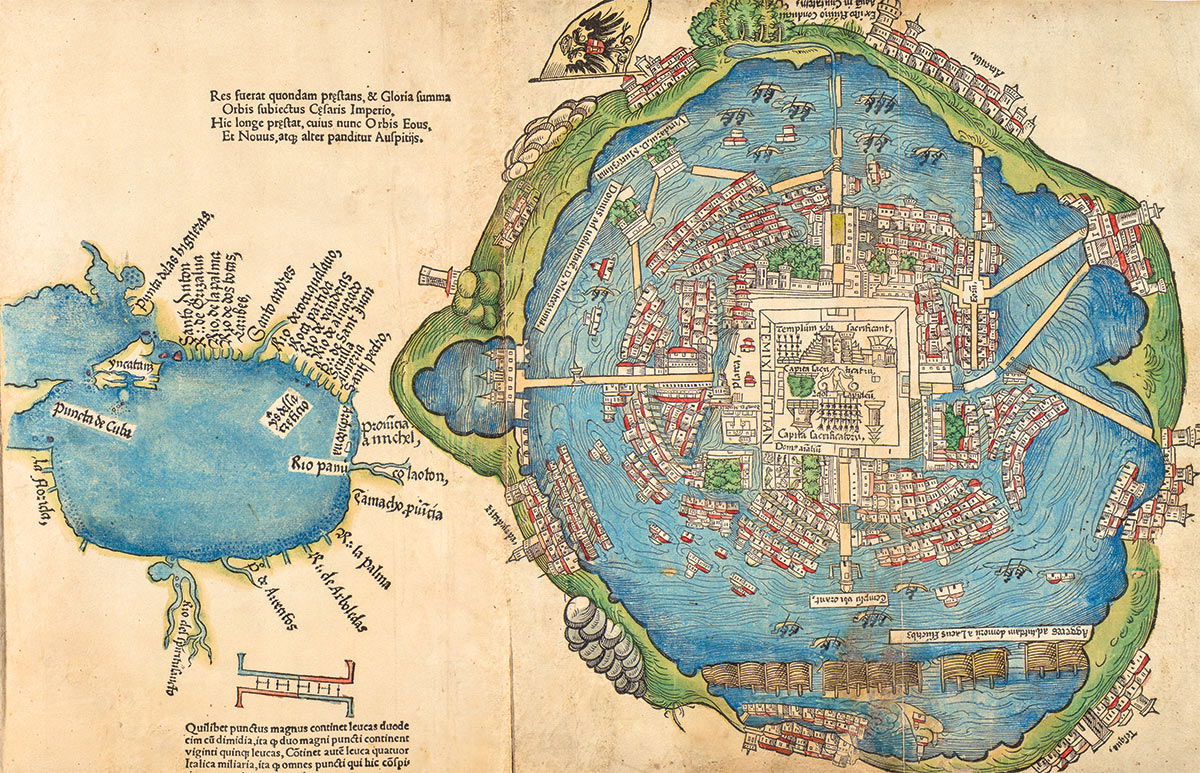
Here's the earliest European map of Tenochtitlan, sent with one of Cortés letters in 1524 so 3 years after the siege. It's probably based on native maps and gives a good idea of the bridges and moats I find.
But getting back to general military reasons: For Cortés at this point it was imperative to conquer Tenochtitlan, since his whole plan was built on overthrowing the Mexica, leaders of the Aztec Triple Alliance. The year between the Noche Triste and the siege of Tenochtitlan he had spent preparing by planning attack plans with canoes, and bringing together more native allies – including from Tlaxcala, Tezcoco and HuejotrincoHuejotzinco. His strong reaction against Tenochtitlan was partly typical European siege warfare; and party due to the city's special position lying on a lake, and to his necessity of conquering it. They also fits in a pattern of Cortés using sometimes extreme violence as examplary punishment, so that other native groups would not oppose him (also evident in his later hanging of the last Mexica ruler Cuauhtemoc). Overall the success of his whole military campaign 1519-21 hinged the conquest of the capital.
And his native allies were not passive either after the city's fall. This important since there wre around 1.000 with estimated 200.000 native allies without whom the Psanish siege woould've been impossible. One native chronicler, Fernando de Alva Ixtlixlochitl, describes that the Tlaxcalans actually were more brutal against the Mexica who remained in the city, who had been their traditional enemies. While Alva Ixtlixlochitl had an anti-Tlaxcala bias, we can deduce that overall it was in many native allies interest to avenge themselves of their former overlords the Mexica – in part by looting their former capital.
After the city had fallen into Spanish hands, major buildings like the palace and the temple were destroyed. However, their fundaments remain intact until today (the temple can be visited), with e.g. the palace building the base of the later colonial palace. In the descriptions of conquistadors like Cortés and Díaz de Castillo they already note their disdain of the temple during their first visit – in contrast to their suprise and admiration of the canal system, and the large markets that were according to them bigger than any in Spain.
Of course, the conversion of the native population to Christianity was officially the main reason for Spanish colonial expansion. So the destruction of temples fits with a larger pattern of destroying any important symbols of native beliefs: especially statues, art, manuscripts, and of course the large temples. This has to do also with the influence of religious orders in early colonial Mexico. Especially the Franciscans were called by Cortés there shortly after conquest, and showed fervour for destroying signs of native faith; but also of learning about it in order to replace it more effectively.
Stepping back from Tenochtitlan, I'll add that the destruction of temples happened in many other cities in central Mexico after they fell under Spanish jurisdiction or were conquered. Even though many were not destroyed as systematically as Tenochtitlan was (in part due to its special position). What is more, destroying temple of other religions and building Christian cathedrals has a long tradition in Iberia. This is what happened during the “reconquista” in medieval Iberia, with the major cathedrals e.g. in Sevilla and Cordoba built over the remains (or partly inside) the former mosques. So that the Mexican conquistadors also built on medieval Iberian patterns here, as in many other areas. We have then in Tenochtitlan also a symbolic replacement of native buildings representing state power (palace) and religion (temple) with their Spanish equivalents.
No, you would not be wrong, you would be completely right and very astute. Mexico City is Tenochtitlan. It is also a conglomerate of numerous other precontact indigenous cities and early modern and modern towns, which now sit on the drained lake bed, that have been incorporated into the modern cityscape. Wikipedia and a lot of the answers in this thread are following an outdated interpretation of the fall of the Aztec capital, which argues that the city was destroyed and replaced by Mexico City and Spanish rule. While much of the central core was destroyed, the city was rebuilt by the local Nahua residents and local indigenous leaders and still referred to as Tenochtitlan for several centuries. See /u/drylaw's answer, notably the second part for a good summary of this literature; this person's answer is...as usual...excellent.
I want to go even more in a revisionist direction to make my own argument that answers your question. If Mexico City is still Tenochtitlan much like Rome is still Rome, then why do we imagine a juncture in Mexico City's past but a continuity in Rome's? I argue that the reason is actually not so much a difference in historical events as everyone else has so far written, but rather a difference in historical memory.
Of course, there are lots of historical differences between Rome and Mexico City-Tenochtitlan. The Aztecs were upstarts who had not been in Central Mexico for long before they ascended to power. Tenochtitlan was not ancient in the way that Teotihuacan was, rather it was a booming, new city. Since it was not so prestigious, it consciously emulated older Mesoamerican communities and rewrote its "official" history to connect Aztec rule to other, more ancient Mesoamerican powerhouses, an effort which legitimized the new Aztec Empire. But even at its height, which was interrupted by the Spaniards, the city's population was probably only about 75,000, not the hundreds of thousands of people that scholars previously estimated. Aztec religion was obviously totally different than Rome's, as was its experience with and relationship to Christianity (and where the power of Christianity came to be located). The city's history was clearly different from Rome, even without the wars that broke out in 1519.
I think the real difference in practice was a conscious and sustained effort on the part of the Spaniards to justify their rule after it had already begun. To do this, Spaniards wrote a history that over time came to be predicated on a major juncture with the city's indigenous past and erased indigenous people. The basics of the narrative were penned by Cortés himself at the very beginning of Spanish rule by creating a false account about "his" "brilliant" "conquest" of "Mexico" (yes I put scare quotes around every one of those because they are all wrong). The false narrative was elaborated upon in subsequent decades after the Spanish invasions by recasting Mesoamerican religious practices as exceedingly violent and cannibalistic, and indigenous leaders as weak and ineffective. It was developed further by describing indigenous people as technologically backward (they weren't) and savage (nope). Further, it occurred by subtly implying that when the city fell, all of Mesoamerica fell with it (not true) and that the indigenous people who lived in the city quickly vanished into thin air, leaving behind only Spaniards and mestizo populations... the survivors of war, disease, and genocide. Later, these mixed populations got turned into symbols for what was quintessentially unique about Mexico. The social and cultural mixing was what made Mexico special...a nation that mixed indigenous and Spanish to make something completely new. How we remember Mexico City follows this same vein: Mexico City was something that resulted from the violent collision between indigenous and Spanish, which resulted in something totally new: a new, great modern city.
I do not study Rome at all. I bet Roman history has experienced lots of rewriting and reinterpretations, but as far as I know, Rome does not have one master story... at least not one as ingrained in popular culture...like the story of the Conquest of Mexico and the creation of Mexico City out of Tenochtitlan's ruins. This story is among the most famous stories in world history, and nearly every person knows its basic plot points. As I've tried to show very briefly, that narrative created a false break between the past and present. I don't know of a similar sustained effort to break "modern" Rome from its older Roman past (if there is such a moment, I would love to know about it; that would be very interesting...though I doubt it has the hold on popular culture as the Conquest of Mexico story).
Further reading: Check out Restall's Seven Myths of the Spanish Conquest and his new book When Montezuma Met Cortés. Also Camilla Townsend's new book Fifth Sun presents a wonderful long history of the Aztecs. Mundy's book cited by /u/drylaw is really good. For the classic book on the long cultural changes experienced by the Nahuas, see James Lockhart's Nahuas After the Conquest. For studies of how people rewrote Mexico's past see, Peter Villella's Indigenous Elites and Creole Identity in Colonial Mexico and the very dense classic How to Write a History of the New World by Jorge Cañizares-Esguerra.
It's the same, actually. It's not as complicated as they make it out to be here. Simply put, Mexico was another name for Tenochtitlan and the name never changed. In the early colonial period there were still Mexica officials governing the city. It wasn't as abrupt a shift as some think. Tenochtitlan was alternatively called Mexico Tenochtitlan. Mexico basically means "place of the Mexica", which was the specific ethnicity of the Nahuatl speaking people who founded the city. Some in Mexico still refer to the capital as simply "Mexico".
Edit: Added more information at the end.