Yes! From an earlier answer:
~~
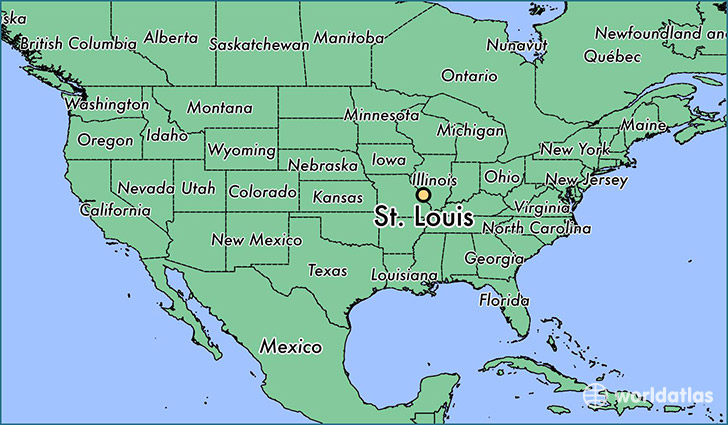
With the best hockey team, best baseball team, best basketball team, best sports fans, best college mascot, and a strong tradition of selling beer at concession stands during children's soccer games, St. Louis, Missouri is unquestionably the sports capital of the U.S. But for about fifty years in the 19th century, it also made a play to be the nation's political capital.
In 1820, a St. Louis newspaper was still reporting that "St. Louis is no more fit for a [Protestant] Christian than hell is for a gunpowder storehouse," and Missouri only became a state barely eighteenth months later. But as early as 1829, advocates of St. Louis were predicting the city would become the cultural and social center of the US as well as its geographic center, and if so, why not also the political capital?
At that early date, however, there was one big problem, as pointed out by future Washington University founder William Greenleaf Eliot in 1834: "St. Louis is very far." It was not until the mid-1840s that Thomas Hart Benton, hardcore American imperialist and perhaps Missouri's most famous senator who was not elected as a corpse, could start realistically proposing and gaining support for the idea of St. Louis as the new U.S. capital.
Most importantly for Benton, the movement of the capital to Missouri would reinforce his grand vision of Manifest Destiny. For the leading citizens of St. Louis like Eliot who applauded Benton, and the writers who promoted the idea of a St. Louis capital in local newspapers, city pride and their own potential financial gain were probably the more important motives. Nevertheless, they attempted to lay out a practical case in their editorals.
With continuing westward expansion, the looming transcontinental railroad, and an imminent Mexican-American War sure to result in territorial gain for the U.S., the gravitational center of United States culture was on the march to the west. At the end of the decade, the California Gold Rush gave more weight to elite St. Louisans' calls for a truly central capital.
These men weren't just going to depend on rhetoric and continuing organic growth. Some of them masterminded an impressive recovery from St. Louis' version of the good ol' Great Fire-that-deserves-that-name, in 1849.
Some of them participated in the ongoing process of destroying so much of the medieval Cahokia Indian city around which modern St. Louis was originally built (it's a favorable meteorological location). In part this was when the great mounds got in the way of their moneymaking schemes, but also because they worried that such a prominent reminder of Native American rights to American land would not be attractive to the national white elite of a country working to strip even more of those rights away.
And some of them, like Eliot, banded together in 1853-54 to found "Washington University in St. Louis"--the name is not a coincidence. A decade later, Eliot would neatly summed up the principles behind the foundation:
It is not a sectional or sectarian interest...The Mississippi Valley is destined to be the controlling power in the Union, and the immediate establishment of the right standard of education in its central city is of the utmost importance. [...] As citizens of St. Louis, we are laboring faithfully to do our part, but we think that our enterprise partakes...of a national character.
Okay, this particular statement is aimed at getting financial support from outside the city, but Eliot was being honest to the university's charter. The school was indeed aimed at making St. Louis the cultural center of the U.S.
But you won't read the real story behind the founders' goal on the Wash U website. In Eliot's statement, it looks like he is simply assuming St. Louis will become the political and economic capital, and working to make it the best capital it could be. In fact, the school was a key part of its founders' ploy to bring the capital to Missouri in the first place.
You see, the city didn't actually need an institution of higher education in order to properly match other cities. St. Louis University had actually been the first college founded west of the Mississippi River, and in 1853, was the major cultural venue for civic events.
But it is Jesuit.
At the time of the rise of the Know-Nothing Party, St. Louis's rich Protestant citizens believed that they needed to minimize the French and German Catholic influence of the city in order to draw outside support for their ultimate goals. Creating Wash U as a safe alternative to SLU (pronounced "sloo") would eventually result in a decent enough school that is really not happy with its origin story, but at the time, it indeed was that unhappy origin story.
Of course every city thinks it's all that, but St. Louis actually is as Wash U entered its second decade, American history was busy convincing people outside St. Louis that maybe it was right.
I'm talking, of course, about the Civil War.
In the first stage of agitating for St. Louis as the national capital, Eliot and his allies argued that the city could become the great unifier by erasing "foreign" Native (ha, ha) and Catholic culture. But after the South attempted to secede and was promptly reminded this was treason, the title of America's most significant cultural divide looked a little different to the country's white elite.
And so relentlessly ambitious St. Louis resident Logan Reavis, a failed teacher and newspaper founder who was about to fail at one more thing, took up the call to make St. Louis the capital of the United States in a big, big way. He argued extensively and to massive publicity that moving the capital would be a fresh start for a traumatized nation, a view that already had adherents elsewhere. And where better to be the emotional center of a nation than its geographic center?
The first national bill to move the capital to St. Louis was introduced to the House in 1868; the main Chicago newspaper even endorsed the proposition in 1869. This is all the more striking since the completion of the transcontinental railroad via the northern route had vastly favored Chicago--but St. Louis's play for the capital was intimately bound with its efforts to draw the nation's main east-west transportation artery to the south.
Basically, in the years around 1870, everyone wanted to move the capital, and a whole lot of them wanted to move it to St. Louis.
But as Daron Arenson argues in Great Heart of the Republic, the city had already lost its shot.
Between:
the Midwestern and Western promoters of St. Louis as the national capital could never quite concentrate their arguments enough to persuade the East Coast or their efforts enough to make that part not matter.
And so the United States settled for its "rebirth" by ending Reconstruction and launching the era that has been called "the nadir of race relations" in the U.S., and Washington, D.C. kept its status and power as the national capital.
But St. Louis still has the best park, the best ice cream, and most importantly the best college, so in the end--fair trade.