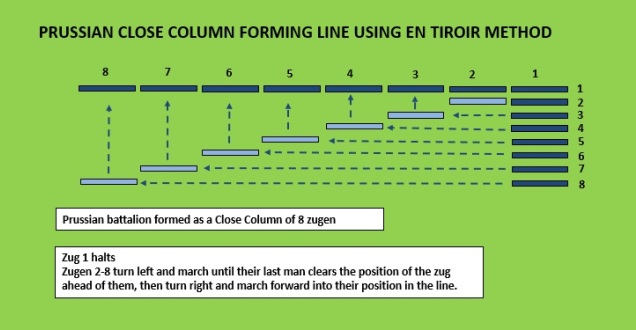
In the mechanical sense, not the actual battle formation and the placement of the different contingents. How did Greek armies get from their camps or marching columns into line of battle? Reading about early modern armies, you can easily find diagrams of how they deployed, with many different systems arising over the 18th century, such as the Traversierschritt and the en tirior method. These systems of deployments required well trained officers in a detailed chain of command, which the militia armies of Classical Greece did not have. Xenophon describes the Spartan method for deploying for battle, but how did other Greek armies form up? Was it more of a free-for-all, 'everyone from Tribe A form up to the right of that tree, Tribe B to their right' and so on, or did they have some rudimentary system for deployment?
Parade drill perfection is an obsession of European military theorists - to the point of parody, as seen in characters like General Scheisskopf in Heller's Catch-22. As you can imagine, the very military-minded 19th-century Prussian pioneers of the study of Greek warfare spent a lot of time on reconstructions of the principles of drill known to the ancient Greeks. From Rüstow & Köchly's standard work (1852) onward, clumsily illustrated guides to known formation evolutions were a fixed element of any treatment of Greek warfare. J.K. Anderson's Military Theory and Practice in the Age of Xenophon (1970) is, to my knowledge, the last academic study to rehearse the whole subject in mind-numbing detail (98-108 and fig. I-V).
The authors of these studies of Greek drill invariably assume that an army cannot function without it. They take it for granted that any force of infantry or cavalry that fights in a regular grid formation must be able to perform basic formation evolutions, like forming from column into line. After all, if they did not know such drill, the result would be chaos, and it's inconceivable that the Greeks would have fought their wars in a chaotic way.
There is, indeed, good evidence for Greek formation drill, including a few remarks on deploying for battle. However, if we disregard the later Hellenistic tactical manuals and focus on the Classical period, there are 2 problems. First, all the evidence is from Xenophon (c. 430-354 BC). Second, while Xenophon describes both Spartans, Greek mercenaries, and fictional Persian infantry performing formation evolutions, all of it seems to reflect the Spartan system of drill.
To put it bluntly, earlier authors have ignored this problem because it did not suit them to acknowledge it. Several of them explicitly declare that what Xenophon described for the Spartans must also have been common elsewhere. As we've seen, the alternative would be chaos, and that's just not acceptable.
But Xenophon does not say the system of drill he describes is well known to all Greeks. In fact he makes clear that it is not known to other Greeks. In his description of Spartan drill, he urges his readers not to be misled by people trying to convince them it is much too difficult, because actually it's really easy. Such advice would make no sense unless the Greek states outside Sparta really didn't understand formation drill at all, and needed to have it slow-pedalled to them. Xenophon's repeated explanations of the Spartan drill system absolutely read like ELI5 answers. Or perhaps "Explain Like I'm Not a Spartan." Moreover, there is no trace in any Classical source of an alternative system of drill that other Greeks might have used instead. The obvious implication is that they used none.
Indeed we have no evidence outside Sparta of an officer rank below the level of the lochagos, a commander of a unit the size of a modern company (or even a battalion), though lower-level officers are a considered a sine qua non for these kinds of manoeuvres. We precious few examples of non-Spartan units performing manoeuvres of any kind that left their formation intact, and most of those are unusually experienced troops or troops that have been led (and presumably drilled) by Spartans. We have no description of any non-Spartan army carrying out the column-into-line manoeuvres that the 4th-century Spartans were capable of.
But the alternative is chaos! I hear you cry.
Well, exactly.
Here's Thucydides describing a non-event in response to the progress of the Athenian siege wall at Syracuse in 415/4 BC:
The Syracusans, appalled at the rapidity with which the work advanced, determined to go out against them and give battle and interrupt it; and the two armies were already in battle array, when the Syracusan generals observed that their troops found such difficulty in getting into line, and were in such disorder, that they led them back into the town.
-- Thuc. 6.98.2-3
And again:
Gylippos, observing that the Syracusans were in disorder and did not easily fall into line, drew off his troops more into the open ground, while Nikias did not lead on the Athenians but lay still by his own wall. When Gylippos saw that they did not come on, he led off his army to the citadel of the quarter of Apollo Temenites, and passed the night there.
-- Thuc. 7.3.3
Here's Xenophon's account of the situation of the Greek mercenaries in the army of Kyros the Younger at Kounaxa, when it was already past midday and the Persian enemy was advancing upon them:
At this critical time the King's army was advancing evenly, while the Greek force, still remaining in the same place, was forming its line from those who were still coming up.
-- Xen. An. 1.8.14
Here's Xenophon using generalship as an analogy to make a point about the difference between those who take their job seriously and those who are negligent:
The things that all generals know, and most soldiers, are done by some commanders and left undone by others. For example, they all know that when marching through an enemy's country, the right way is to march in the formation in which they will fight best, if need be. Knowing this, there are some who do it, and some who do not do it.
-- Xen. Oikonomikos 20.7
Here's Plato speaking in analogies to justify Sokrates sticking to his guns while on trial for his life:
"Wherever a man stations himself, thinking it is best to be there, or is stationed by his commander, there he must, as it seems to me, remain and run his risks, considering neither death nor any other thing more than disgrace."
-- Plato, Apology 28d
I could go on. The picture these passages sketch is simple. The Greeks maintained no system of regular drill. They did not know how to form from column into line; in many cases they would not even form a column in the first place. The army began to form around its few officers once they had received guidelines (or decided on their own) regarding the depth of the phalanx. Men would join the line as they came up, and while they would sometimes be told where to stand by their commander, at other times they would simply find a place for themselves. As several of these passages show, the process would take a long time - probably most of the day - and it might never reach a stage where the general was actually confident that his army was ready. If the chaos did not gradually resolve into something like order, it was perfectly acceptable to simply call off the battle altogether.
It was only in this environment that the very basic Spartan system of drill - follow your file leader, who will fill out the formation by forming "on the shield hand" (i.e. each file draws up to the left of the last one) - could be presented as a marvel of efficiency and skill.