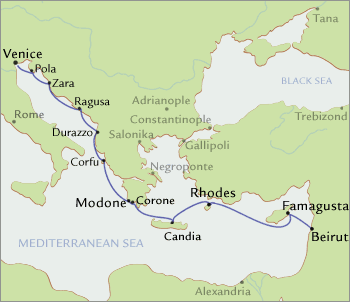
From my readings about the 15th cenury it seems that the usual route from places like Italy to Levant (Antioch, Beirut, etc.) would take you past Crete to Rhodes and from there directly to the ports of choice (with a possible stop at Cyprus).
For example, we have a manuscript written by a Venetian/Greek known now as Michael of Rhodes who was a sailor and later an officer in the Venetian ships and navy and who documented many of his trips. The map of his journeys to Beirut as part of Venetian convoys looks like this (taken from here where you can find more info) and clearly shows going from Crete to Rhodes to Cyprus to Beirut.
There are other 15th century sources supporting this. In 1450s and 1460s Englishman William Wey went to two pilgrimages to Jerusalem and left us Itineraries of his trips, which you can read here. You can see his trip took him from the Adriatic, to Corfu and than directly through Crete and Rhodes and Cyprus to Jaffa in the "Holy Land".
Another important account is Bernard von Breydenbach's 1483 pilgrimage whose account of the trip Peregrinatio in terram sanctam was widely published and printed (with some amazing illustrations if I may say so). His voyage with Venetian galleys followed the above described route: from Adriatic and Corfu to Rhodes, Cyprus and then finally Jerusalem.
I have little concrete information on the periods prior to 15th century, but John Pryor mentions that during all the Crusades naval travels to Holy Land (like Richard Lionheart, Phillip Augustus of France, later Andrew IV of Hungary etc) went the same route by way of Crete, Rhodes and Cyprus. The same author has a chapter in the much informative book Age of Galleys titled The Geographical Conditions of Galley Navigation in the Mediterranean where he discusses some of the conditions the vessels faced. He does mention the anti-clockwise current but he says travel by hugging the northern shore in both directions was preferred as the southern shores had much more dangerous geographical and nautical features, which for ancient and medieval vessels that traveled close to shore was a more pressing problem then counteracting the currents which would anyway be weaker near the shores than in open seas.
I do want to mention that in the Michael of Rhodes account mentioned at the beginning Venetian galleys going to Egypt would (sometimes) do exactly what you describe in your question: go to Beirut and Levant and return via northern way (map). However it seems that this maneuver was reserved for returns from Egypt and not a preferred way to reach Levant, Cyprus, Holy Land....